
Vandaag of morgen in huis

Kwaliteit gegarandeerd

Welkomstaanbiedingen ontgrendelen: GRATIS bezorging | Tot 80% korting | Gratis 30 dagen JoyPlus-proefperiode
Download de app
A large cat tree gives indoor cats room to climb, scratch, play and relax. Small models can quickly feel cramped, especially for large, active or multiple cats. However, a height of 200 cm does not automatically mean a cat tree is suitable for your home or your cats.
Before buying, pay particular attention to three common pitfalls:
A good choice therefore starts with the dimensions, construction and everyday use.
A tall cat tree makes good use of vertical space in a living room or flat. As well as the height, check the length and width of the base. A wide, reinforced base helps keep the structure stable when cats climb or jump at the same time.
For models taller than 150 cm, wall attachment is strongly recommended. Use the supplied anti-tip system or suitable fixings for your wall. Place the cat climbing tower on a flat, non-slip surface, and check all screws and connections after assembly.
Not all cats scratch in the same way. Vertical sisal scratching posts are practical for cats that like to stretch out while scratching. An angled scratching board or ramp may appeal to cats that prefer to scratch at an angle.
Look out for:
Having plenty of scratching options can help make furniture and curtains less appealing, but every cat behaves differently. You can make a new post more attractive with a toy or a small amount of catnip.
A cat tree for multiple cats needs more than one basket. Look at the combination of a cat house, hammock, basket and resting platform. Several resting areas reduce the need for cats to share a single spot.
When checking the weight capacity, see whether it refers to a total static maximum. This is not a guarantee for every jump or every level. For example, the product information for the grey 206 cm model states a total static weight capacity of 70 kg and a platform capacity of approximately 10 kg per level. These are product specifications; always use the cat tree in accordance with the safety instructions.
The following selection links specific product details to different usage profiles. This means you can compare products not only by colour or height, but also by space, scratching options and maintenance.
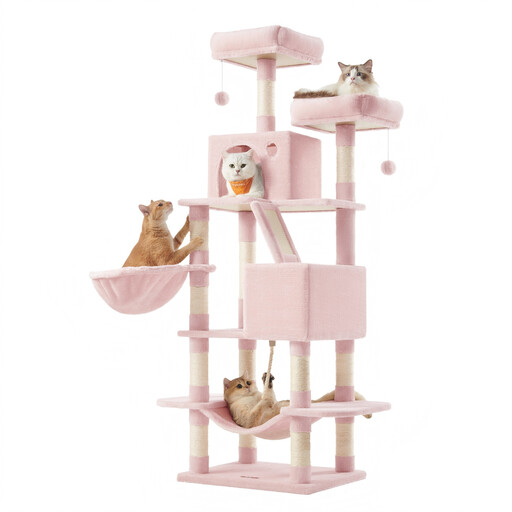
Why it suits this profile: A straightforward model with five levels for households looking for a spacious cat tree without immediately choosing a tower over two metres tall.
The dimensions are clearly stated: 55 × 45 × 168 cm. The cat tree has a reinforced base and an anti-tip feature.
13 sisal posts plus a ramp, two platforms, two houses, a basket and a hammock. The stated total static weight capacity is 65 kg.
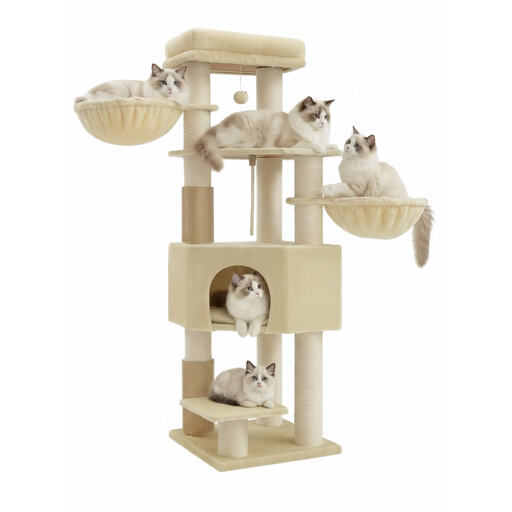
Why it suits this profile: A sturdy choice for anyone who values easy maintenance and additional features for everyday grooming, as well as climbing and sleeping areas.
The construction has a reinforced base and anti-tip kit. The product information requires permanent attachment to a load-bearing wall.
9 sisal posts, an integrated brush, removable mats and a maximum static weight capacity of 105 kg. Dimensions: 50 × 50 × 160 cm.
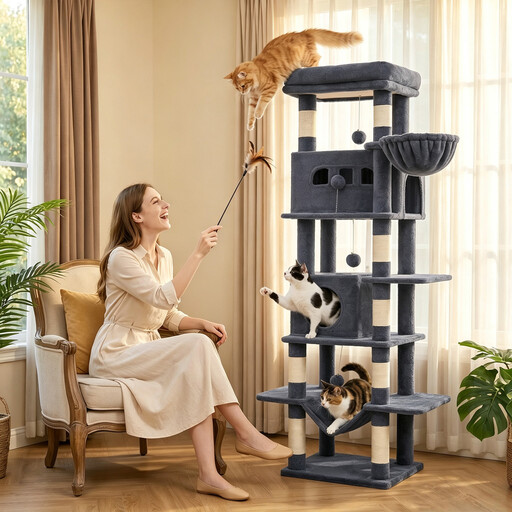
Why it suits this profile: Designed for active cats and multi-cat households that make good use of plenty of vertical space and separate resting areas.
The base is widened and reinforced, with anti-tip features included. Due to its height, correct assembly and wall attachment are particularly important.
A 60 × 40 cm resting platform, two caves, a hammock and a basket. The levels are spread across six tiers, and the covering is 400 g/m² according to the product description.
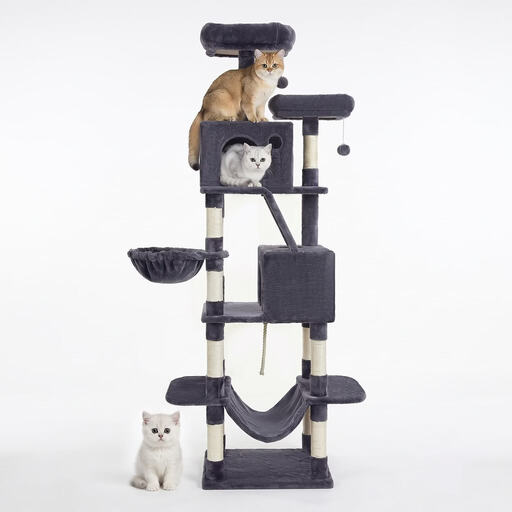
Why it suits this profile: The layout, with multiple resting and hiding areas, suits a multi-cat household where the cats like to have their own space.
The product information states that it has a large reinforced base, 13 sisal posts and an angled sisal ramp. Check all connections before use.
Two cat houses, two platforms and a hammock. The stated total static weight capacity is 70 kg; the height is 206 cm.
We have put together a complete, up-to-date list of products that fully meet these strict selection criteria and the applicable European safety regulations.
A large cat climbing tower will last longer when it is assembled correctly and checked regularly. Use this checklist:
A cat house is useful for privacy, while a cat hammock or spacious resting platform is particularly well suited to relaxing. Consider your cats’ sleeping habits: an active climber has different preferences from a cat that mainly wants a wide resting area.
For large or active cats, a model from around 150 cm upwards is often a good option, provided the base is sturdy enough and the cat tree is secured correctly. Also consider the width of the platforms and the distance between the levels. A tall cat tree without a spacious resting area can still be impractical.
Its lifespan depends on the number of cats, their weight, how they play, and the quality of assembly and maintenance. Check the sisal, plush, screws and platforms regularly. Stop using the cat tree if any part is cracked, loose or unstable.
A cat tree does not normally use electricity. Ongoing costs mainly consist of cleaning and any replacement sisal, cushions or toys. A model with removable covers can make everyday maintenance easier.
