
Vandaag of morgen in huis

Kwaliteit gegarandeerd

Welkomstaanbiedingen ontgrendelen: GRATIS bezorging | Tot 80% korting | Gratis 30 dagen JoyPlus-proefperiode
Download de app
A large cat tree can make good use of your living space and give your cats a dedicated place to climb, scratch, play and sleep. But a tall cat tree can sometimes disappoint in practice. A narrow base, a small perch or sisal fitted to just one post can make the tree less useful than its product photos suggest.
So don’t focus only on height and the number of levels. The right choice depends on your cats’ weight and activity levels, the space you have available and how you secure the tree.
An XXL cat tree that’s two metres tall takes up vertical space, but height alone says little about stability. A tall structure with a narrow base may wobble more when cats jump on it or use it at the same time. Check the dimensions of the base plate, the material used for the platforms and whether an anti-tip fitting is included.
A stated load capacity usually refers to a static load: the weight the structure can support under certain conditions. Cats jumping on it create different forces from cats resting quietly. So check the permitted weight per cat, the maximum total weight and whether the instructions recommend securing the tree to the wall.
A cat tree with a hammock, house and toys may look complete, but cats also need plenty of sturdy surfaces to scratch. Check how many sisal posts there are, where they’re positioned and whether your cats can stretch out fully while scratching. Replaceable parts are handy when a sisal post or toy wears out.
First, measure the space where you plan to put the cat tree. Allow for skirting boards, doors, radiators and walkways. A model from 160 to over 210 cm tall also needs careful consideration of ceiling height and assembly.
A good layout has several levels with enough space between them. Platforms around 20 to 40 cm apart make climbing easier than a structure with large jumps between levels. Wide intermediate platforms and short climbing steps are practical for older cats or those who are less agile.
A sturdy cat tree has a wide, weighted base and posts that don’t visibly wobble when you apply gentle pressure. Place the tree on a flat, non-slip surface. For tall models, securing the tree to a load-bearing wall is strongly recommended if the manufacturer supplies an anti-tip kit.
Look for:
Product information may state a maximum static load capacity, but that doesn’t guarantee the same result with every use or on every surface.
A cat tree with sisal posts provides scratching areas across several levels. Natural sisal is often wrapped around the posts. Check that the fibres are firmly attached and that damaged parts can be replaced.
For households with several cats, multiple resting spots are important. A cat tree with a house, bed, hammock and wide perch means your cats don’t all have to share the same spot. Removable cushions and washable covers make cleaning easier. You can usually clean plush surfaces with a vacuum cleaner or lint roller; always follow the care instructions provided.
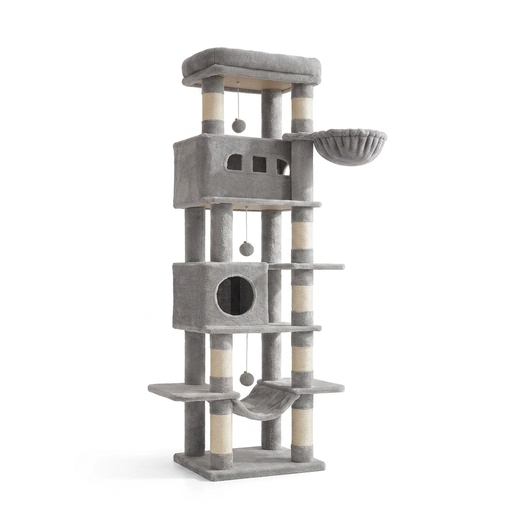
Why it suits this type of buyer: This six-level cat tree combines a relatively compact footprint with several places to rest and play. That makes it a good first large cat tree for a flat or a household with several cats.
The product information lists 17 support posts, 8 of them covered in sisal, as well as a reinforced double base and an anti-tip fitting.
170 cm tall, with six levels, a hammock, a 30 cm bed and two removable cushions. The stated capacity is up to six cats weighing 6.8 kg each.
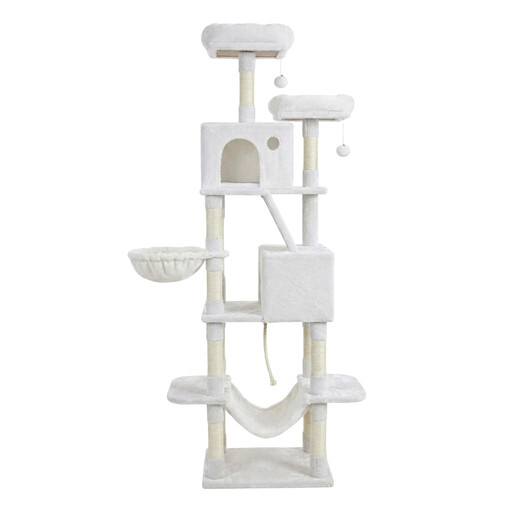
Why it suits this type of buyer: This extra-tall cat tree offers plenty of vertical space for active cats and households that need several places to rest.
The structure has 13 posts covered in natural sisal, a reinforced base and an anti-tip kit included. Wall fixing is recommended for this tall model.
206 cm tall, with two houses, two platforms, a bed and a hammock. The product information gives a total static load capacity of up to 75 kg.
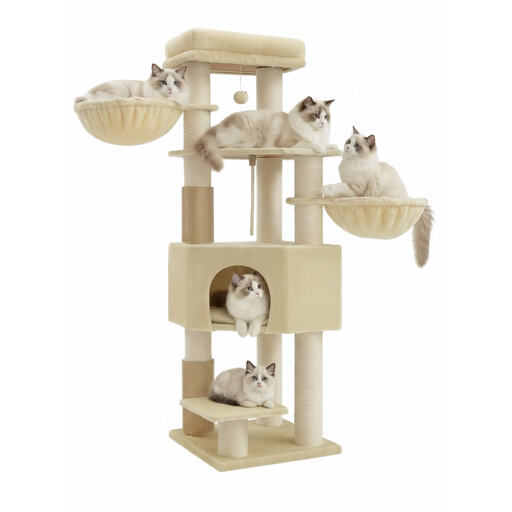
Why it suits this type of buyer: This model is designed for larger or heavier cats and frequent daily use. The built-in brush and removable parts are practical in a busy household.
The manufacturer specifies permanent wall fixing with the anti-tip kit after assembly. Also check the screws, posts and covering regularly.
Measures 50 × 50 × 160 cm, with 9 sisal posts, a large perch, a hideaway and a bed. The stated maximum static load is 105 kg.
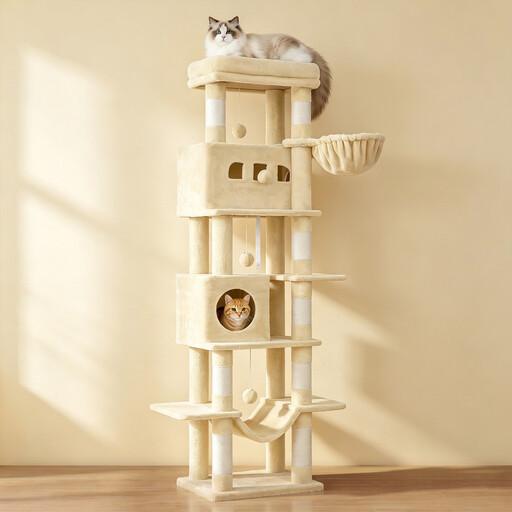
Why it suits this type of buyer: Two cat houses, a hammock, a bed and a wide platform offer different places to climb and rest in one vertical arrangement.
The product information lists 17 thickened support posts, 8 sisal posts, a double integrated base and an anti-tip lock.
212.5 cm tall, with six levels, a 65 × 45 cm platform, two houses and replaceable toys. The stated capacity is up to six cats weighing 6.8 kg each.
We’ve put together a complete, up-to-date list of products that meet these strict selection criteria and current European safety requirements.
Assemble your large cat tree on a flat surface and tighten all the connections according to the instructions. For models over 150 cm tall, wall fixing is often advisable or explicitly required. Use fixing materials suitable for your type of wall.
After the first few weeks of use, check all the screws and connections again. Then regularly check for:
The lifespan depends on the materials, frequency of use, your cats’ weight and how well you maintain the tree. Replace a cat tree if its supporting parts are damaged or the structure remains unstable even after you’ve tightened it.
If you have several cats, choose a tree with multiple resting spots, at least a few separate scratching areas and a wide base. Don’t just look at the maximum number of cats stated in the product description; compare it with your cats’ weight and behaviour.
This is often advisable for tall or narrow models. Follow the manufacturer’s instructions and use an anti-tip kit if one is included. Also, don’t place the tree next to windows with loose cords, heaters or other obstacles.
Regularly use a vacuum cleaner or lint roller on plush surfaces. Washable cushions and removable covers make cleaning easier. Check the care instructions before cleaning any parts with water, and allow washed fabrics to dry completely.
