
Vandaag of morgen in huis

Kwaliteit gegarandeerd

Welkomstaanbiedingen ontgrendelen: GRATIS bezorging | Tot 80% korting | Gratis 30 dagen JoyPlus-proefperiode
Download de app
A large cat tree offers more than somewhere for your cat to sharpen its claws. Indoor cats use a cat climbing tree to jump, look around, sleep and retreat. But an impressive XXL cat tree can disappoint in practice. A tall tower isn’t automatically stable, and lots of accessories don’t necessarily make it useful for your cats.
The Joybuy Product Recommendation Officer has brought together the key things to check. This way, you can compare products by their dimensions, construction and practical features, rather than judging them by photos or marketing copy alone.
A tall cat tree has a high centre of gravity. When a cat jumps onto it from the sofa or windowsill, it moves more than it would during a steady climb. So don’t just check the height. Look at:
For models taller than about 150 cm, wall fixing is a sensible precaution if the manufacturer recommends it or includes an anti-tip kit. Place the cat tree on a flat, non-slip surface too.
A product can have plenty of support posts without every post being suitable for scratching. Check how many posts are actually covered in sisal and how thick they are. A cat tree with sisal posts gives cats several places to scratch at different heights. This is especially useful in a multi-cat household.
An angled scratching ramp can be useful too. It offers a different scratching surface and can make some levels easier to reach.
A cat tree with lots of levels isn’t automatically comfortable for a heavy or long cat. Check the dimensions of the platforms, baskets and cat houses. An adult cat should be able to stretch out on at least one resting spot without hanging over the edge.
Multiple resting zones are important if you have more than one cat. A cat tree with a hammock and a cat tree with a cat house can offer rest, privacy and variety, but check that the different areas don’t block one another.
A tall cat tree makes use of vertical space while taking up relatively little floor space. This can work well in Dutch flats, but measure the room height and available floor space first. Leave some room around the tree so your cats can land safely.
According to the product descriptions for some models, levels spaced about 20 to 30 cm apart are intended to make climbing easier to navigate. Whether this works well depends on your cat’s age, agility and behaviour. For kittens, older cats or cats that are less steady when jumping, wide intermediate platforms and a ramp are practical features to look for.
A stated capacity is usually a static weight capacity. This doesn’t automatically mean that a cat, or a group of cats, can safely put the same weight on it while jumping. So compare:
The 206 cm JOYFURNOS tower has a stated total static weight capacity of up to 70 kg, with around 10 kg per platform. The 160 cm SONGMICS model has a stated maximum static load of 105 kg. These figures come from the product information and should be considered alongside the assembly and safety instructions.
Chipboard or particleboard often forms the core of a large cat tree. Its stability then depends on the thickness of the boards, the joints and the base. Soft plush covering is comfortable, but it needs regular vacuuming or cleaning with a damp cloth.
When buying, look for removable cushions and covers. Washable parts make everyday care easier. Check the sisal covering, screws, joints and platforms regularly. Stop using the tree if any parts are torn, loose or unstable.
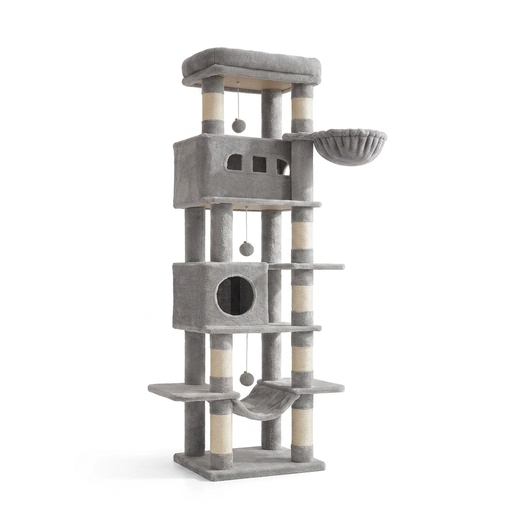
Why it suits this profile: This model combines six levels with a large and a small cat house, a hammock, a basket and two removable cushions. It offers plenty of features without committing to a tower more than two metres tall.
The product description mentions a widened, double-reinforced base and an anti-tip fitting. Eight of the 17 support posts are covered in natural sisal.
Six levels, a 50×30 cm platform, a 50×40 cm cat house and removable cushions, according to the product details.
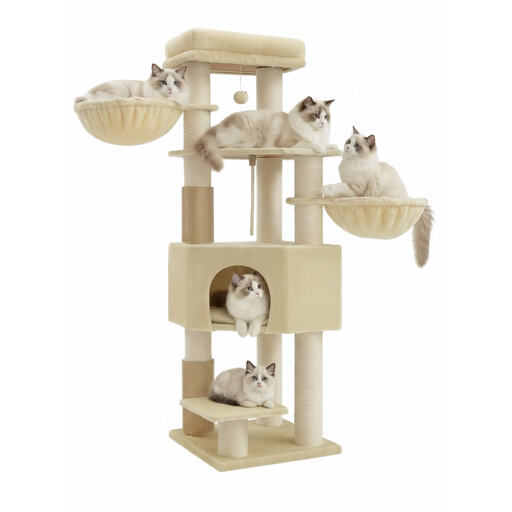
Why it suits this profile: This is a practical choice for households that prioritise easy care, resting spots and wall fixing. The product information mentions an anti-tip base, removable parts and an integrated brush.
The instructions state that, once assembled, the tower must be permanently fixed to a load-bearing wall using the included anti-tip kit.
Nine sisal posts, a washable mat and a stated maximum static load of 105 kg.
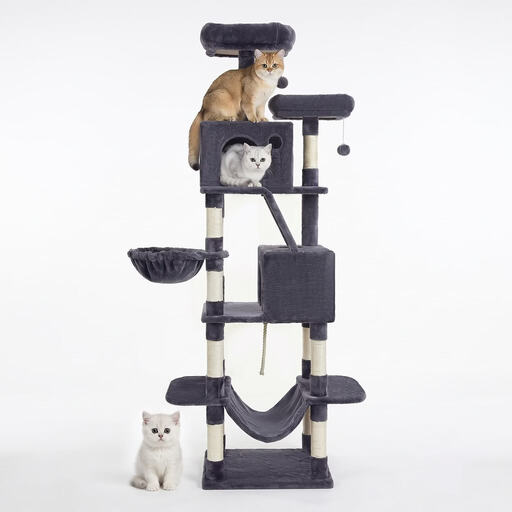
Why it suits this profile: This extra-tall cat tree is designed for active cats and multi-cat households that need separate climbing, scratching and resting zones.
The product description lists 13 natural sisal posts, an angled scratching ramp and a reinforced base. At this height, correct assembly and wall fixing remain important.
Two cat houses, two raised platforms, a basket, a hammock and a stated total static weight capacity of up to 70 kg.
Position the large cat tree before fully tightening all the parts. Then check that the base is completely level. With a tall cat climbing tree, it’s a good idea to use the anti-tip kit rather than keeping it as a spare accessory.
Let your cat get used to the different levels at their own pace. A toy or a little food can help make the tree more appealing. Place it by a window, sofa or another spot where your cat already likes to spend time, but keep it away from heaters, open flames, cords and window-blind cords.
Sisal and plush will wear over time. If several cats use the tree heavily, checking the screws, posts, hammocks and toys once a month is a useful routine.
We’ve put together a complete, up-to-date list of products that meet these strict selection criteria and the applicable European safety regulations.
Don’t just look at the height. A wide resting spot, sturdy posts and plenty of room on the base are just as important. Check the dimensions of the platforms and baskets against your cat’s length and weight. If you have multiple cats, several resting spots and scratching surfaces are useful.
Wall fixing is often recommended or required in the instructions for tall models. It reduces the risk of the tree tipping when cats jump on it. Use the included anti-tip kit if there is one, and only attach it to a suitable, load-bearing surface.
Its lifespan depends on the materials, assembly and how heavily it is used. A cat tree with sturdy sisal posts can stay in good condition for longer if you regularly check for loose strands, damaged plush and loose joints. Replace damaged parts before letting your cats use the tree again.
