
Vandaag of morgen in huis

Kwaliteit gegarandeerd

Welkomstaanbiedingen ontgrendelen: GRATIS bezorging | Tot 80% korting | Gratis 30 dagen JoyPlus-proefperiode
Download de app
A large cat tree needs to offer more than somewhere to scratch. Large, active cats want to climb, jump, play and stretch out comfortably. In a multi-cat household, there is another important requirement: every cat needs enough space of its own.
However, an impressive height or an “XXL” label does not tell you everything. Some cat trees have a narrow base, small resting areas or sisal posts that are mainly decorative. Use these practical checks to avoid a poor purchase and find a large cat tree that suits both your home and your cats.
A tall cat tree takes up relatively little floor space, but a tower measuring 160 to 212 cm can experience a lot of movement. This is particularly true when a heavy cat jumps down from a higher platform. Always check the dimensions of the base, the weight of the cat tree and whether it has an anti-tip feature.
A tall cat tree without wall anchoring may not be suitable for some homes. If a model includes an anti-tip system, use it according to the instructions.
A multi-level cat tree may have several tiers, but that does not automatically mean the cats will not get in each other’s way. Look for a combination of cat houses, beds, hammocks and wide platforms. Two cat houses and several resting places are more practical than one large top platform that every cat wants to use at the same time.
The number of posts matters less than their positioning and dimensions. Cats often scratch vertically while stretching their bodies. Sisal scratching posts should therefore be positioned along key climbing routes and be long enough for your cat’s body length. Also check whether the sisal can be replaced or is securely wrapped around the posts.
Do not look only at the stated total weight capacity. Pay particular attention to:
A product description may, for example, state a load capacity for six cats, but this may sometimes be subject to a limit per cat. For models with a maximum load of 6.8 kg per cat, you therefore need to take each individual cat’s weight into account.
For a cat tree for large cats, small shelves can be a problem. A platform measuring 60 × 40 cm or 65 × 45 cm provides more room to turn around and lie down than a narrow perch. Also check the entrance to a cat house. A large breed should be able to get in and out without becoming stuck.
A cat hammock is a comfortable additional resting place, but pay attention to its fastenings, size and whether the cover is washable. Removable cushions and covers make regular cleaning easier.
A multi-level cat tree works best when the levels connect logically. Distances of around 20 to 40 cm may be suitable for many cats, but the right choice depends on their age, weight and agility. For senior or less nimble cats, jumps that are too large are less practical.
A vertical layout is useful in a flat because it creates climbing space without taking up a large amount of floor space. However, measure the ceiling height beforehand and leave sufficient space around windows, doors and radiators.
The options below have been selected based on verifiable information such as height, materials, number of scratching posts, resting places and stated load capacity.
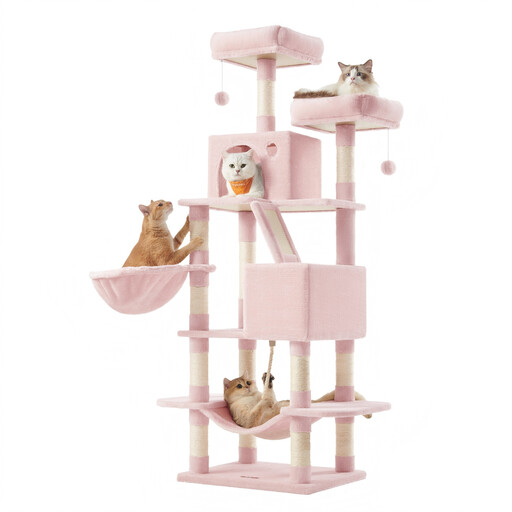
Why it suits this profile: A practical starting point for anyone looking for several features without immediately choosing the tallest cat tree. This model is 168 cm high and has several resting and scratching zones.
The specifications list 13 scratching posts, two houses, a bed and a hammock. The included anti-tip feature must be attached to the wall.
Five levels, 14 scratching zones and a stated maximum static load of 65 kg.
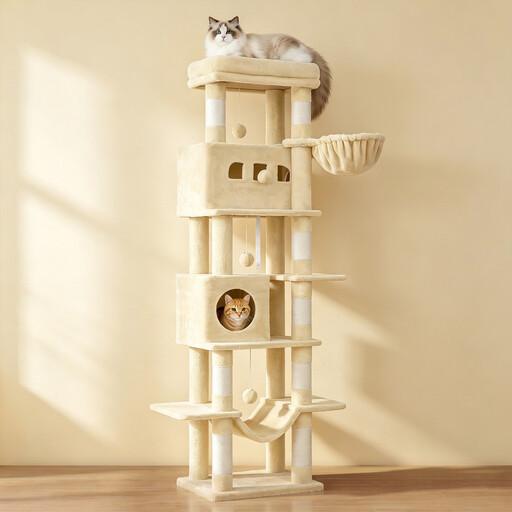
Why it suits this profile: Suitable for households looking for a tall, versatile cat tree with plenty of vertical space and separate resting areas.
The wide base, 17 supporting posts and built-in anti-tip lock are designed for use with multiple cats. Check the assembly and anchoring before use.
Six levels, eight natural sisal posts, two cat houses, a bed and a 65 × 45 cm platform.
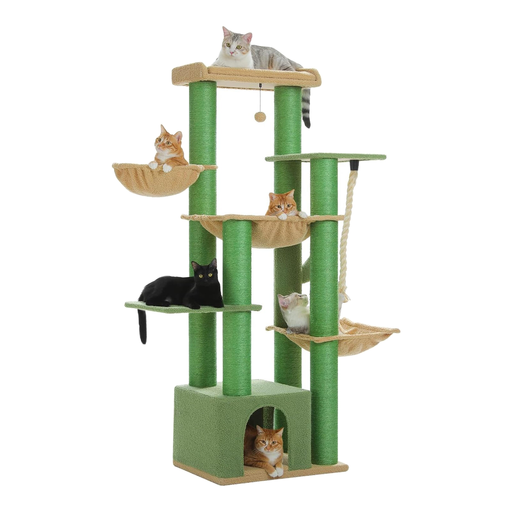
Why it suits this profile: For large or highly active cats that make extensive use of scratching, climbing and resting facilities. The manufacturer states that it is suitable for cats weighing up to 10 kg.
The structure has 13 sisal posts with a diameter of 11 cm and a 58 × 45 cm base. It also includes three hammocks and three extra-large top platforms.
Seven levels, an extra-large cat house and removable, washable parts.
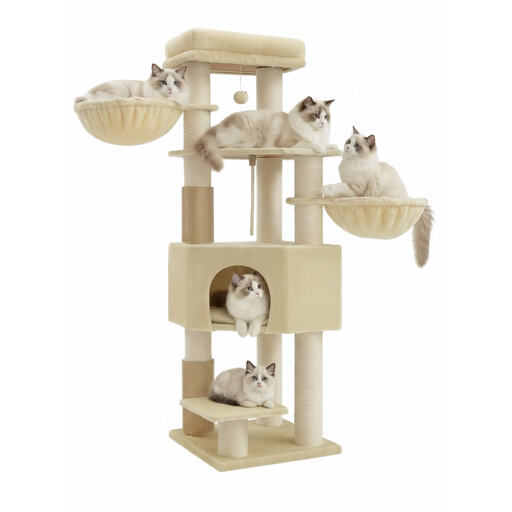
Why it suits this profile: An option for anyone who values easy maintenance, separate resting areas and secure anchoring as well as scratching facilities.
The model has nine sisal posts, an anti-tip kit and removable covers. The product information specifies permanent wall anchoring.
160 cm high and 50 × 50 cm wide, with a stated maximum static load of 105 kg and a built-in grooming brush.
We have compiled a complete, up-to-date list of products that fully meet these strict selection criteria and the applicable European safety regulations.
Place the scratching post on a flat, stable surface and follow the assembly instructions step by step. Tighten the connections again after a few days, as the materials may settle slightly after assembly. Anchor tall models to a load-bearing wall when required by the manufacturer.
Then check regularly:
Remove loose parts immediately if a cat chews them or could swallow pieces. Replace damaged toys and resting areas before using the cat tree again.
Consider more than just the height. A wide platform, long sisal posts and a sturdy base are more important than an extra tier. Measure your cat when fully stretched out and compare this with the dimensions of the resting areas. For heavy cats, a model with an anti-tip feature and a clearly stated load capacity is the wiser choice.
Use a vacuum cleaner or lint roller regularly on plush surfaces. Washable cushions and hammocks can be cleaned according to the care label. While cleaning, also check the sisal covering, screws and seams. A cat tree that cannot be maintained properly can become unhygienic more quickly.
Its lifespan depends on the number of cats, their weight, how intensively they scratch, and the quality of the assembly and maintenance. Check all components regularly and replace worn sisal, cushions or toys whenever possible. Stop using the cat tree if it has structural damage or is unstable.
