
Vandaag of morgen in huis

Kwaliteit gegarandeerd

Welkomstaanbiedingen ontgrendelen: GRATIS bezorging | Tot 80% korting | Gratis 30 dagen JoyPlus-proefperiode
Download de app
A large cat tree can combine climbing, scratching, play and relaxation. However, a tall model isn’t automatically right for every cat. A heavy cat can make a narrow structure wobble, while a cat tree with lots of accessories offers little value if the resting spots are too small.
So don’t focus only on height or the number of levels. The main differences lie in the base, weight distribution, sisal covering and size of the resting areas. This practical checklist can help you avoid having to buy another one after just a few months.
A tall scratching post offers plenty of vertical space, but a narrow base can create an unstable centre of gravity. Active cats that jump down from a platform put different stresses on the structure each time. So check for:
For models over around 150 cm, wall fixing is advisable if the manufacturer specifies it or includes an anti-tip kit. Always place the scratching post on a flat, non-slip surface.
An XXL scratching post with just one thin sisal-wrapped pole may not provide enough scratching space. Cats often scratch after sleeping or near doorways. Sisal-wrapped poles along several routes are therefore more practical than a single pole at the bottom.
Check the number of sisal-wrapped poles, their thickness and whether worn parts can be replaced. Sisal scratching posts provide a dedicated place to scratch, but every cat is different.
A cat house or cat hammock may sound appealing, but its size will determine whether your cat actually uses it. A large cat needs room to turn around and stretch out. If you have several cats, providing multiple resting and hiding places is also important to help prevent overcrowding.
Check the size of the platforms, the distance between levels and the weight capacity of each level. A stated total weight limit doesn’t always tell you how much an individual platform can support.
A tall scratching post measuring 160 to over 210 cm makes use of vertical space in a flat. This can be useful if you have limited floor space. Also check the distance between levels. Levels that are too far apart are less practical for kittens, older cats or cats that are less agile.
A multi-level cat tree works best when it has a logical route to the top, with enough room to turn around and take a break.
Check whether the weight capacity refers to a static total weight. This doesn’t guarantee stability during every jump or collision. Products with a wide base, sturdy boards and several support posts generally distribute weight more effectively.
If several cats will use it, consider all their weights, how active they are and whether they may use one platform at the same time. Always follow the assembly instructions and retighten the screws after the first few weeks of use.
Washable cushions and removable covers make it easier to remove fur and small stains. Check regularly for:
Interactive cat toys and pom-poms are extras, not a substitute for supervision. Stop using the tree if a part comes loose or your cat starts biting pieces off.
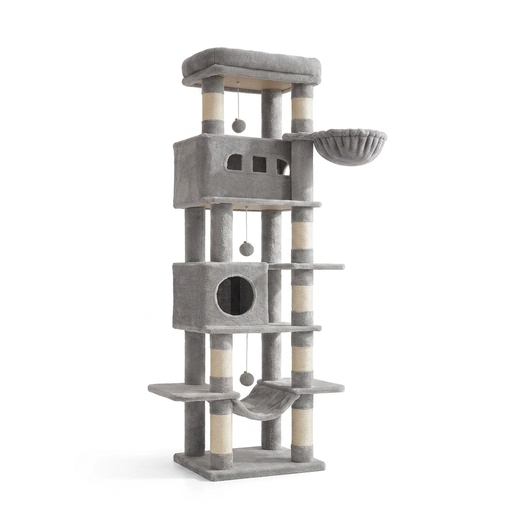
Why it suits this type of household: A straightforward large cat tree for households looking for several features without opting straight away for a model over two metres tall. Its layout has six levels, a cat house, a hammock and a basket.
The description lists 17 support posts, 8 of which are wrapped in natural sisal, as well as a double reinforced base and an anti-tip feature.
170 cm tall, six levels, two cushions, a basket and replaceable hanging balls.
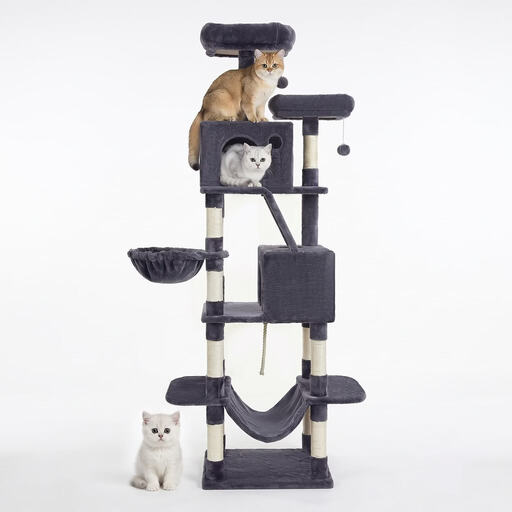
Why it suits this type of household: This extra-tall cat climbing tower is designed for active indoor cats and multi-cat households. A combination of resting spots, hiding places and an angled scratching board gives it a versatile layout.
According to the product description, this model has a reinforced base, 13 sisal posts and a supplied anti-tip kit or recommended wall fixing.
Two cat houses, two platforms, a basket, a hammock and a stated static total weight capacity of up to 70 kg.
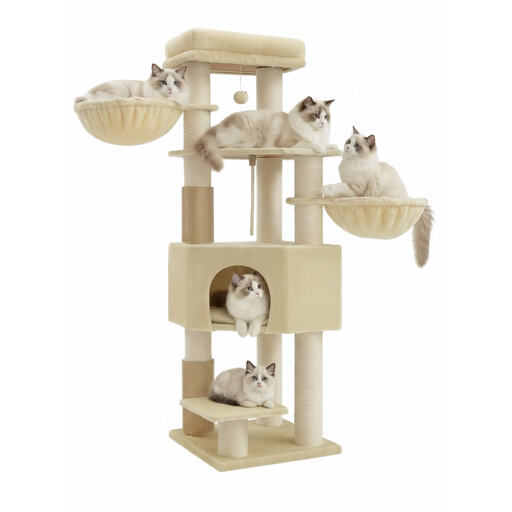
Why it suits this type of household: A practical choice for large cats and households that value stability, easy care and scratching options. The integrated brush and removable mats add a useful everyday grooming feature.
The manufacturer lists 9 reinforced sisal posts, an anti-tip base and permanent wall fixing after assembly. Always check the supplied instructions for details.
Measures 50 × 50 × 160 cm, has a stated static maximum weight capacity of 105 kg and includes washable parts.
Before buying, measure the ceiling height and allow for skirting boards, radiators and doors. Don’t put the scratching post next to a blind cord, heat source or open fire. Cats often enjoy a spot with a view of the room, but make sure there’s still enough space to walk around.
Introduce your cat to a new cat tree gradually. Place a toy on a higher level or use a small treat to encourage them to explore. You can supplement the interactive cat toys built into the structure with separate toys, such as a Meowmagic Feather and Sisal Ball Toy Pack. Check loose toys regularly for damaged feathers, string and stuffing.
We’ve put together a complete, up-to-date list of products that meet these strict selection criteria and the applicable European safety regulations.
It depends on the space available and how mobile your cat is. Models measuring 160 to 210 cm offer plenty of vertical space for play. More important than height alone are a wide base, sensible spacing between levels and a platform where your cat can turn around and lie down.
Assemble all the parts according to the instructions and place the cat tree on a flat, non-slip floor. Use the supplied anti-tip kit if instructed. For a tall cat tree, securing it to a suitable wall is often a sensible safety measure. Check the screws, posts and platforms regularly.
Its lifespan depends on the number of cats using it, their weight, scratching habits and how well it’s maintained. A structure with replaceable sisal posts, sturdy joints and washable cushions may be more practical over the long term. Replace any part as soon as it becomes loose, torn or badly worn.
