
Vandaag of morgen in huis

Kwaliteit gegarandeerd

Welkomstaanbiedingen ontgrendelen: GRATIS bezorging | Tot 80% korting | Gratis 30 dagen JoyPlus-proefperiode
Download de app
A large cat tree gives cats room to climb, scratch, sleep and retreat. However, a tall model is not automatically suitable for every home or cat. A narrow base, thin sisal post or impractical covering can quickly lead to instability and extra maintenance.
If you’re looking for a tall cat tree, cat tree for multiple cats or a cat tree for large cats, it’s worth looking beyond the number of levels and the appearance. Below, you’ll find the key points to check, along with some popular options based on verifiable product information.
A cat tree measuring two metres or more mainly takes up vertical space, but that tells you little about its stability. Also check:
A tall cat tree with a narrow base may be more prone to wobbling when an adult or heavy cat jumps down from a higher platform.
You should always read a statement such as ‘suitable for multiple cats’ in context. The number of cats depends on their weight, activity levels and the way they use the tree. For some models, for example, the product information states a maximum load of six cats weighing less than 6.8 kg each. This is a product specification, not a general guarantee for every situation.
Measure your cats and consider the total level of use. For two large, active cats, a more spacious platform may be more important than an additional toy.
A cat tree may have several levels but still provide very little usable scratching space. Pay attention to the number and position of the sisal-covered posts. Cats often scratch after sleeping or near passageways. A cat tree with sisal scratching posts at different heights can therefore be more practical than a single scratching post at the bottom.
Sisal does not automatically protect furniture completely from scratching damage. Place the cat tree somewhere your cat already likes to scratch and reward them for using it.
A model with six levels offers more opportunities for climbing and resting. Also look at the distance between the levels. For a product measuring 212.5 cm in height, a distance of approximately 30 to 40 cm between levels is stated. Another 170 cm model uses distances of around 20 to 30 cm.
A steep layout can be appealing for kittens and active adult cats. Older or less mobile cats often benefit more from wide intermediate platforms and an easy-to-follow route. Also check the ceiling height and the available space above doors, radiators or curtain rails beforehand.
A stable cat tree needs more than sturdy posts. A double or wider base can keep the centre of gravity lower. An anti-tip mechanism or anchoring strap provides extra security, particularly with a tall cat tower.
Place the tree on a level surface and tighten all the connections securely after assembly. Check again after a few days to see whether any screws or fittings need tightening. Ideally, do not place a very tall tree on a smooth rug that can easily move.
Plush covering feels soft, but cat hair can sometimes become trapped in it easily. Removable, washable cushions make everyday maintenance simpler. A lint roller or vacuum cleaner is usually more practical than cleaning the entire cat tree.
With a cat tree with a cat house, also check the size of the openings. A large cat house is not automatically comfortable for a big cat. Compare the internal dimensions with your cat’s body length and sleeping position.
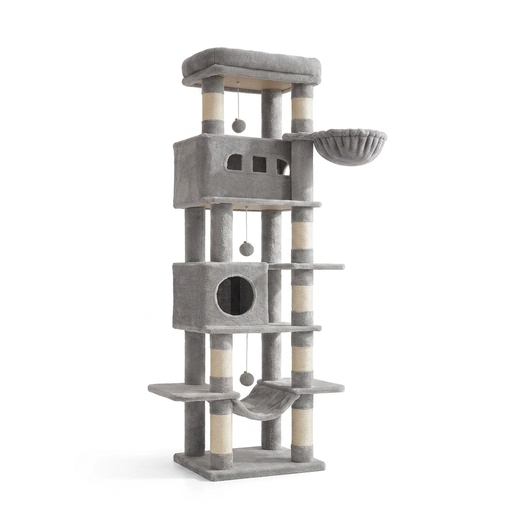
Why it suits this profile: This model offers six levels without the height of an extra-tall tower. As a result, it fits into more living rooms and is a practical first climbing tower for households with one or more cats.
The product information states that it has a widened double base, an anti-tip feature and 17 support posts, 8 of which are covered with sisal.
170 cm tall, with a large 50×30 cm platform, two cat houses, a hammock and removable cushions.
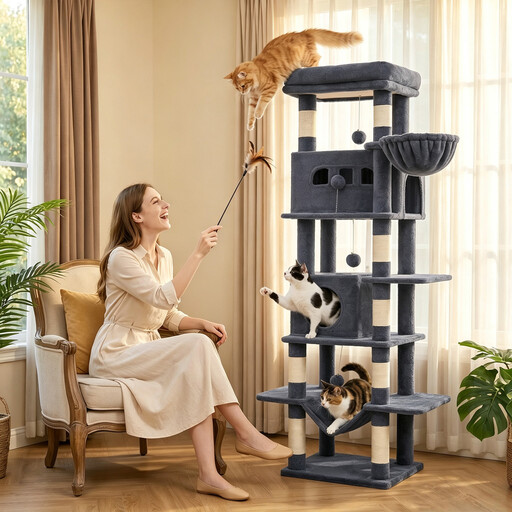
Why it suits this profile: This tall cat tree is designed for households looking to make the most of vertical space and provide several places to rest and hide.
Rather than stating only the height, the product information lists a widened base, anti-tip features and 8 sisal posts across the levels.
A 60×40 cm platform, two cat dens, a hammock, removable cushions and a vertical design for flats.
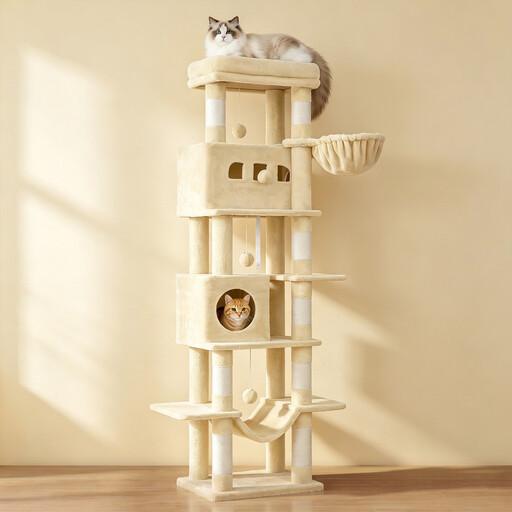
Why it suits this profile: The combination of multiple levels, two cat houses, a basket and a hammock makes this cat tree suitable for multiple cats with different resting preferences.
According to the product information, 17 posts are used in the construction, 8 of which are wrapped in sisal. The double base and integrated anti-tip lock are designed to provide greater stability.
A 65×45 cm platform, two cat houses, a 30 cm basket, a hammock and two washable cushions.
We’ve put together a complete, up-to-date list of products that fully meet these strict selection criteria and the applicable European safety regulations.
Before buying, check that you have sufficient clear height. A 212.5 cm cat tree will not fit in every room and may be less suitable where the ceiling is low. Also leave enough space around the base for cats to move safely and to prevent people from bumping into it.
During assembly, use only the supplied parts and follow the instructions. If a model includes an anti-tip strap, attach it to a suitable wall as instructed. Then regularly check:
A cat tree will generally last longer when the scratching areas have not been completely worn through and loose parts are replaced promptly. Its lifespan depends on the weight and number of cats, as well as how intensively it is used.
Place the tree on a level, non-slip surface, tighten all the connections securely and use the supplied anti-tip feature. With a tall cat tree, anchoring it to the wall is particularly important if your cats are heavy or very active.
That depends on the available space and your cat’s behaviour. A 170 cm model already provides several climbing levels. A 212.5 cm cat tree makes better use of vertical space but requires a higher ceiling and secure positioning.
Ongoing costs are usually limited to cleaning and any replacement sisal, cushions or toys. Removable, washable cushions and replaceable hanging balls can make maintenance easier. Before buying, check whether replacement parts are available.
