
Vandaag of morgen in huis

Kwaliteit gegarandeerd

Welkomstaanbiedingen ontgrendelen: GRATIS bezorging | Tot 80% korting | Gratis 30 dagen JoyPlus-proefperiode
Download de app
A large cat tree offers more than a place for your cat to sharpen their claws. Indoor cats use a cat tree to climb, rest, play and survey their surroundings from a higher vantage point. In a multi-cat household, a well-designed tree can also help provide separate resting spots and scratching areas.
However, bigger doesn’t always mean better. Look out for these common pitfalls:
A tall cat tree is ideal for cats that love to climb and keep an eye on their surroundings. Check not only the overall height, but also the distance between levels. According to the product information for various models, steps of around 20 to 40 cm are designed to make climbing up and down more manageable.
Resting space is also important for larger cats. A 50 × 30 cm platform offers a different experience from a 65 × 45 cm platform. Check the dimensions of the cat houses, bed and hammock, too. A cat tree with a cat house should be roomy enough for your cat, without the entrance or resting area feeling cramped.
A stable cat tree has a wide, weighted or double-layered base. An anti-tip device can provide extra support, particularly if the tree is positioned against a wall or used by several cats at once.
When assembling it, check:
According to the product information for the models listed below, certain versions are designed to support several cats weighing up to 6.8 kg each. This is a product specification, not a guarantee for every home or situation. Always check the latest information on the product page, and secure the tree if recommended.
A cat tree with sisal posts provides designated scratching surfaces. Check both the number of sisal posts and where they are positioned. For frequent use, eight sisal posts spread across several levels are more practical than a single sisal post.
Plush fabric and soft cushions make comfortable resting spots, but need regular care. A removable cushion that can be washed or rinsed is handy in households with several cats. Also check whether any loose toys can be replaced when they wear out.
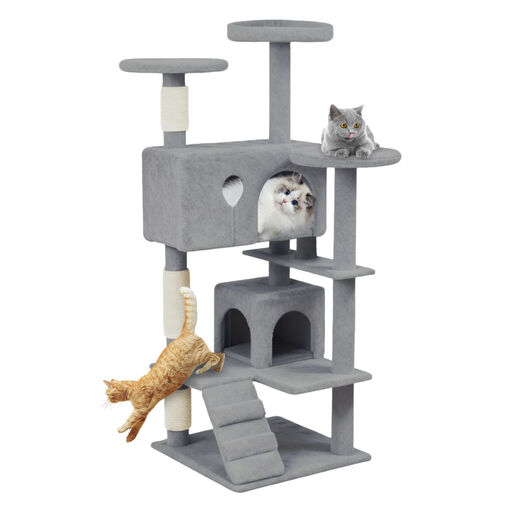
Why it suits this type of buyer: A compact option if you’re looking for your first indoor cat tree and don’t want to start with a very tall tower. Its 49 × 49 cm footprint should fit easily into a living room or bedroom.
The dimensions are clearly stated, so you can check your available floor space before ordering. The product name specifies a cat bed and scratching post.
130 cm tall; 49 × 49 cm base; light grey finish.
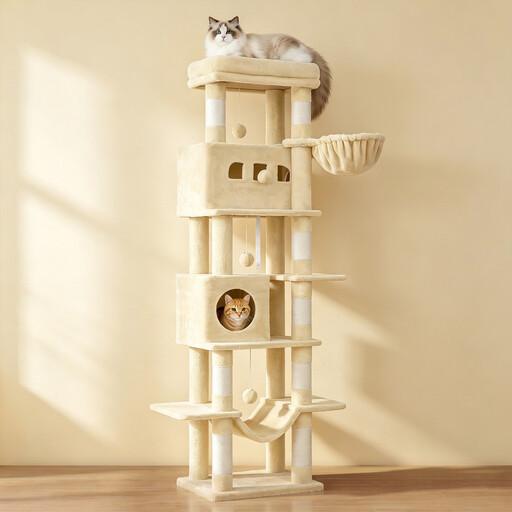
Why it suits this type of buyer: This tall cat tree is designed for households looking to combine several resting spots, cat houses and a hammock in one large tree.
According to the product information, it has 17 support posts, 8 of which are covered in sisal. The double base and anti-tip fitting are designed to limit movement.
212.5 cm tall; 65 × 45 cm platform; two cat houses, a hammock and eight sisal posts.
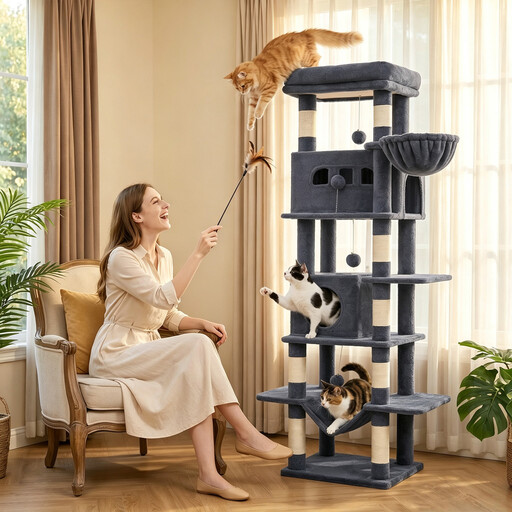
Why it suits this type of buyer: A practical choice for active or larger cats that make good use of climbing, scratching and resting spaces. Its vertical design makes the most of the room’s height without taking up extra floor space.
According to the product information, the eight sisal posts are spread along the climbing routes. A reinforced base and anti-tip fitting are built into the design.
212.5 cm tall; six levels; 60 × 40 cm platform; two enclosed spaces, a hammock and washable cushions.
We’ve put together a complete, up-to-date list of products that meet these strict selection criteria and the applicable European safety regulations.
Consider the number of separate resting spots, the width of the platforms and the maximum weight capacity. A cat tree for several cats is more practical when they can move around each other on different levels. Two cat houses, a hammock and a separate bed offer more choice than a single central sleeping spot.
Place the cat tree on a level surface and tighten all the fittings securely. Use the supplied anti-tip device if there is one. Check after a few days, and then regularly, to make sure no screws have come loose. If you have a very tall cat climbing tower, it’s also a good idea to position it against a suitable wall.
Its lifespan depends on the number of cats, their weight, their scratching habits and the quality of the fittings. Check the sisal, plush covering, platforms and fixing points regularly. Loose parts or replaceable toys can help keep the tree usable for longer, but damaged load-bearing parts should not continue to be used.
