
Vandaag of morgen in huis

Kwaliteit gegarandeerd

Welkomstaanbiedingen ontgrendelen: GRATIS bezorging | Tot 80% korting | Gratis 30 dagen JoyPlus-proefperiode
Download de app
A large cat tree needs to offer more than just a sisal scratching post. Indoor cats often need opportunities to climb, scratch, rest and retreat. Stability and enough places to lie down become even more important in a multi-cat household.
Even so, a large model can look impressive on paper but disappoint in practice. So don’t focus only on its height or number of levels. Pay close attention to its construction and dimensions, and consider how you’ll use it in your home.
A multi-level cat tree sounds appealing, but narrow platforms can be awkward for large or heavy cats. Check the dimensions of the platforms, cat houses and openings. A wide top platform or cat bed gives your cat more room to turn around and stretch out.
A tall structure needs a low centre of gravity and a wide base. A model that wobbles when a cat jumps on it can quickly become less appealing. Check for a double-reinforced baseboard, the thickness of the support posts and whether it comes with an anti-tip feature.
Some product descriptions state that models come with an anti-tip kit or can be secured in place. Always check whether this feature is actually included with the product, and fit it according to the instructions.
A cat hammock, toys and a cat house are useful, but they’re no substitute for proper scratching areas. For everyday use, several sisal-wrapped posts at different heights are more practical. That way, your cat can scratch after sleeping, while climbing or when passing a platform.
First, measure the space where you plan to put the indoor cat tree. Leave enough room around it for cleaning and for your cat to jump on and off safely.
For example, a 170 cm-tall cat tree with a 50 × 40 cm base needs a spot where it won’t get knocked into. Also check the distance between the levels. Product descriptions listing gaps of 20 to 40 cm give you a useful guide to how easy the tree is to climb, but the ideal distance varies from cat to cat.
For a stable cat tree, thick posts aren’t the only thing that matters. Look at the combination of:
When choosing a cat tree for multiple cats, don’t automatically treat the stated weight capacity as an unlimited guarantee. According to the product information for some models, they can support up to six cats weighing 6.8 kg each. This still depends on assembly, use and how the weight is distributed.
Sisal scratching posts should be tightly wrapped around the post and shouldn’t come loose under light pressure. Also check how many sisal posts there are and where they’re positioned. Scratching surfaces at different levels make the tree more versatile.
Removable, washable cushions are practical for resting areas. Plush surfaces can collect fur, so a design that can be cleaned with a hoover or lint roller will save you time. A cat house is handy for cats that like to retreat, while a cat hammock or cat bed offers a more open place to rest.
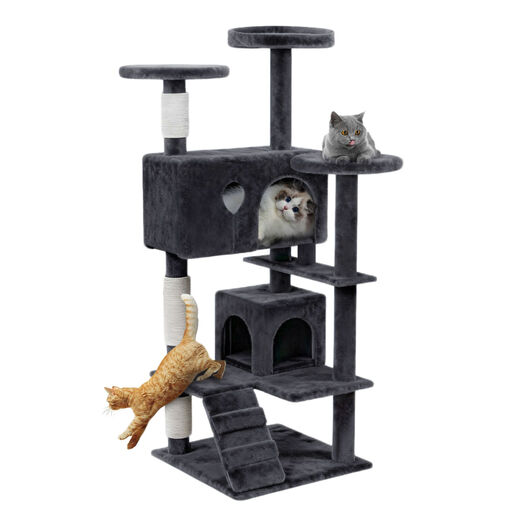
Why it suits this profile: At 130 cm tall, this compact large cat tree fits into many living rooms and combines a cat bed with a scratching post.
The stated base dimensions of 49 × 49 cm make it easy to see how much floor space you’ll need. Before buying, check the full assembly and stability information.
130 cm tall, with a cat bed and dedicated scratching area; available in dark grey.
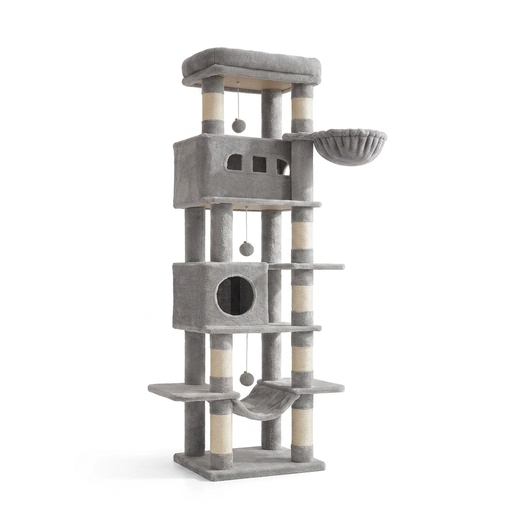
Why it suits this profile: Six levels, two cat houses, a hammock and a bed offer indoor cats plenty of ways to play, climb and rest.
The product description lists 17 support posts, 8 of which are wrapped in sisal, as well as a widened double base and an anti-tip feature.
170 cm tall, with six levels, two removable cushions, a hammock and a 30 cm bed.
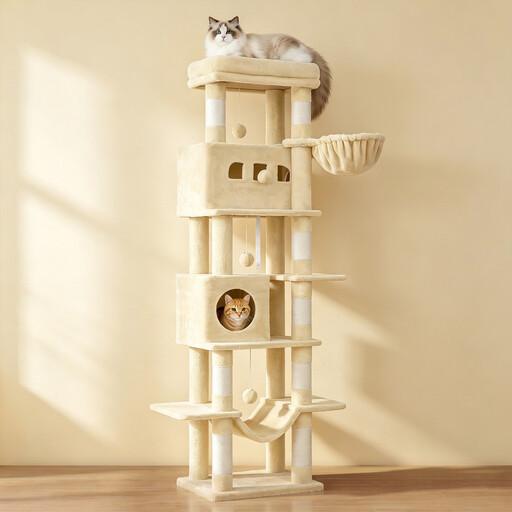
Why it suits this profile: This model is designed for households with several or active cats that make good use of plenty of places to climb, scratch and rest.
The description lists 17 thickened support posts, 8 sisal posts, a double base and a built-in anti-tip lock.
212.5 cm tall, with two cat houses, a hammock, a 30 cm bed and two washable cushions.
We’ve put together a full, up-to-date list of products that meet these strict selection criteria and current European safety requirements.
Place the cat tree on a level surface and tighten all the connections securely. Avoid putting a tall scratching post somewhere people are likely to bump into it. Use the anti-tip feature supplied with the product, if there is one. After assembly and again after a few weeks of use, check that the screws and connections are still secure.
Its lifespan depends on the number of cats, their weight, how much they scratch and the quality of the connections. Sisal upholstery wears more quickly in areas that get a lot of use. A cat tree with replaceable toys, washable cushions and individual replaceable parts may remain practical for longer. Replace any part if the sisal comes loose or a platform is damaged.
It can be, but look beyond the stated weight capacity. Multiple cats benefit from having several places to rest, wide platforms and scratching posts at different heights. This means they’re less likely to have to share the same cat bed or hammock. A wide base and anti-tip fastening are especially important for heavy or very active cats.
