
Vandaag of morgen in huis

Kwaliteit gegarandeerd

Welkomstaanbiedingen ontgrendelen: GRATIS bezorging | Tot 80% korting | Gratis 30 dagen JoyPlus-proefperiode
Download de app
A large cat tree may seem straightforward to choose at first glance. However, many buyers are drawn to a tall tower with attractive photos without checking whether its construction suits their cat, home or household. Small shortcomings can quickly become noticeable, particularly with large, active or multiple cats.
So watch out for these common pitfalls:
A tall cat tree makes use of vertical space and leaves more room to move around on the floor. This is practical in a flat or smaller living room. Beforehand, measure not only the available floor area, but also the ceiling height and the space around the tower.
A stable cat tree generally has a sufficiently broad base and a low centre of gravity. With models from around 160 cm upwards, it is sensible to check whether a wall-mounting system is included or required. Place the cat tree on a level surface and check all connections after assembly.
Do not look only at the general number of cats supported. Also check the recommended weight per cat, the dimensions of the platforms and the maximum static load. A large cat house is not automatically suitable for a heavy cat if the opening or platform is too small.
For multiple cats, different resting zones are useful: a cat hammock, a raised bed and one or more enclosed sleeping areas. This means cats are less likely to have to share the same spot. Bear in mind, however, that the stated weight capacity may be a static value; jumping and movement create a different load.
Natural sisal is intended as a scratching surface and can help make a designated spot more attractive than your furniture. Present this as its intended use, rather than a guarantee that scratching damage will disappear completely. Cats may still prefer a sofa, door frame or carpet.
A cat furniture unit with sleeping areas is more practical when cushions or covers can be removed. Plush surfaces can be vacuumed regularly or cleaned with a lint roller. Check the sisal for fraying and tighten loose components in good time. If a house or toy is damaged, remove or replace the component.
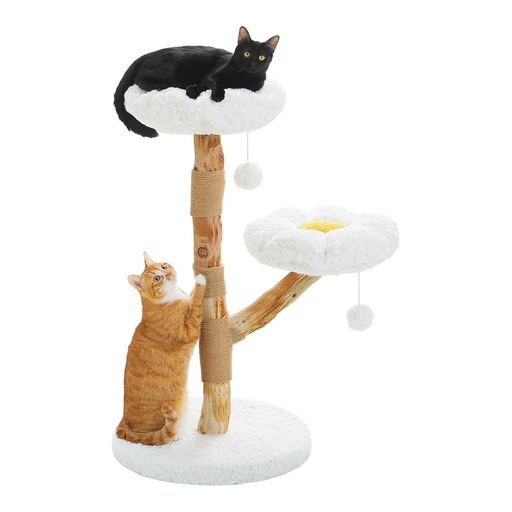
Why it suits this profile: This compact model is designed for small to medium-sized living spaces and cats weighing up to 7,3 kg. The two resting areas offer a manageable starting point for anyone who does not yet have a large cat tree at home.
The product information states that it has a double reinforced base and a wooden frame. Nevertheless, check after assembly that all connections are securely tightened.
Dimensions of 49 × 49 × 90 cm, natural wooden components and a sisal-covered post.
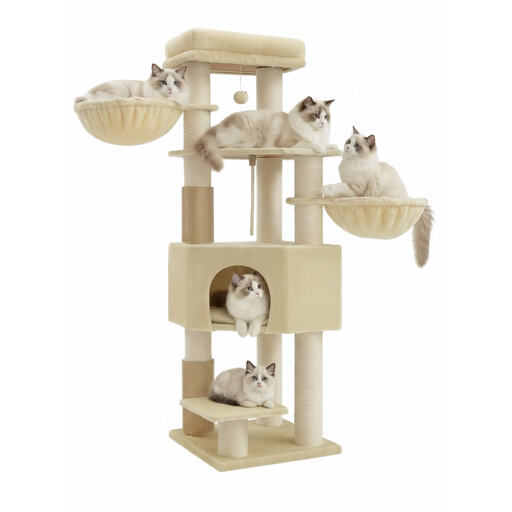
Why it suits this profile: This XXL cat tree combines several scratching, sleeping and play areas with features designed for everyday maintenance. It is well suited to active cats and households where the cat tree will be used extensively.
It has 9 sisal-covered posts and an anti-tip kit. According to the product instructions, the tower must be permanently secured to a load-bearing wall.
Dimensions of 50 × 50 × 160 cm, a static load of 105 kg, a washable mat and a built-in brush.
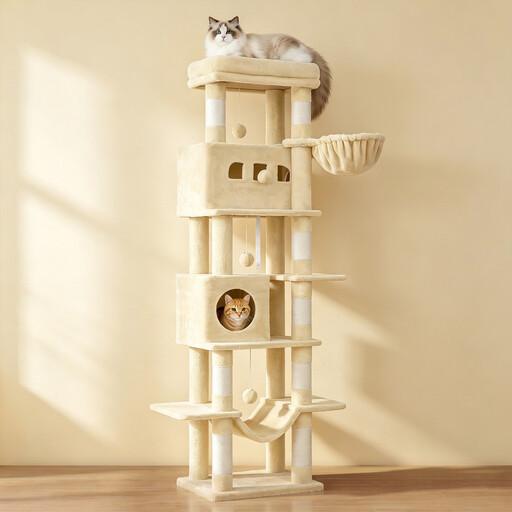
Why it suits this profile: This tall cat climbing tower is designed for multiple cats and intensive climbing. Two cat houses, a bed and a hammock divide the available resting areas.
The stated construction has a double base and an anti-tip feature. At this height, correct assembly and checking the fixings remain important.
Six levels, 8 natural sisal posts, a 65 × 45 cm platform and two enclosed resting areas.
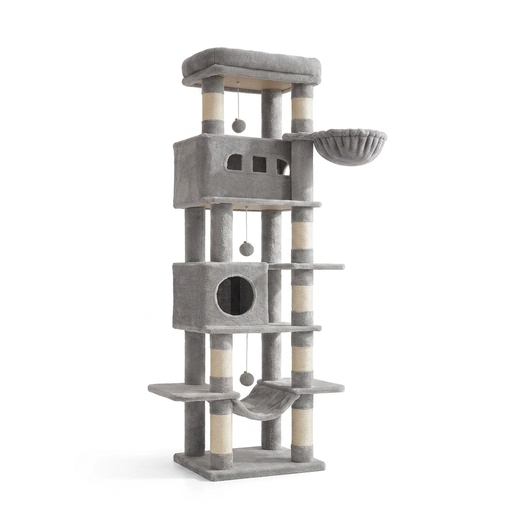
Why it suits this profile: This cat tree for multiple cats offers a vertical layout with a large platform, two enclosures, a bed and a cat hammock. Its design makes use of height without requiring an especially deep floor base.
The description states that it has a widened double base and an anti-tip feature. Eight of the 17 posts are covered in sisal, which is more specific than simply claiming ‘plenty of scratching opportunities’.
Dimensions of 170 × 50 × 40 cm, 6 levels, two washable cushions and stated suitability for up to 6 cats weighing 6,8 kg.
We have put together a complete, up-to-date list of products that fully meet these strict selection criteria and the applicable European safety requirements.
A large cat tree will not automatically last for a fixed number of years. Its lifespan depends on the weight, number of cats, intensity of jumping, and the quality of assembly and maintenance. Replace loose toys or damaged components as soon as you notice fraying, cracks or loose fixings.
Consider your cat’s weight and length, not just the total height. A platform that allows your cat to stretch out fully is more important than an extra level. Also check the recommended load per platform and the total static weight capacity.
It can be, because a cat climbing tower makes use of space mainly vertically. Do measure the floor base, ceiling height and the space available around the furniture. With a tall or narrow construction, wall mounting is particularly important whenever the product instructions specify it.
Remove hair with a vacuum cleaner or lint roller, and carefully trim away loose sisal fibres. Check that the post is still securely attached. In the event of serious wear, replacing the component is preferable to continuing to use damaged material.
