
Vandaag of morgen in huis

Kwaliteit gegarandeerd

Welkomstaanbiedingen ontgrendelen: GRATIS bezorging | Tot 80% korting | Gratis 30 dagen JoyPlus-proefperiode
Download de app
A large cat tree can give cats more room to move without you having to make your home bigger. Active, heavy or curious cats can especially benefit from having several levels. However, a tall cat tree can look more stable in a product photo than it really is in a living room with an uneven floor.
So choosing the right one isn’t just about its height or the number of toys. Pay particular attention to its construction, the size of the resting areas and how the cat tree needs to be secured.
An XXL cat tree measuring two metres or more offers plenty of vertical space, but height alone says little about stability. A narrow base, a heavy top or a large distance between the posts can cause wobbling when a cat jumps up.
So check:
A tall structure should stand on a flat, non-slip surface. For models over 150 cm, the product information often strongly recommends securing them to the wall.
The stated load capacity usually refers to a static load. This doesn’t automatically mean that several cats can safely jump, run and land on it at the same time. So when choosing a cat tree for multiple cats, don’t judge it by the maximum weight capacity alone.
Also check the thickness of the boards, the connections between the posts and the size of the resting areas. A 60 × 40 cm platform gives a large cat more room to move than a small round platform, even if both models have the same stated maximum load capacity.
A cat tree with a hammock, bed and toys may look complete, but cats don’t use every part equally often. They usually scratch where they can stretch out fully. Short or thin posts are less practical for this.
So check:
First, measure the space where you plan to put the cat tree. Take skirting boards, radiators, doors and windows into account. A model measuring 206 cm or 212.5 cm won’t fit in every room. Check the ceiling height too, as well as whether there’s enough room to stand the structure upright during assembly.
In a flat, a vertical cat tree can be more space-efficient than several low scratching posts. Make sure you place it somewhere cats can jump safely, away from any cables, cords or heat sources within reach.
Natural sisal is a commonly used material for a cat scratching post. Its rough texture is suitable for scratching. Product descriptions may use terms such as ‘durable’ or ‘for intensive use’. Treat these as claims made by the brand or seller, and focus on details you can check, such as the number of sisal posts and their dimensions.
Polyester plush is a comfortable choice for the covering, but check how to remove hair and stains. Removable or washable cushions are handy in households with several cats.
A stable cat tree has a wide base and securely fastened connections. Tighten the screws after assembly, then check them again after the first few weeks. Connections can loosen if the tree is moved or used heavily.
An anti-tip kit can provide extra security, but whether you can secure the tree to the wall depends on the type of wall and the fittings used. Always follow the assembly instructions. Stop using the tree if a board is cracked, a post comes loose or a fixing point is damaged.
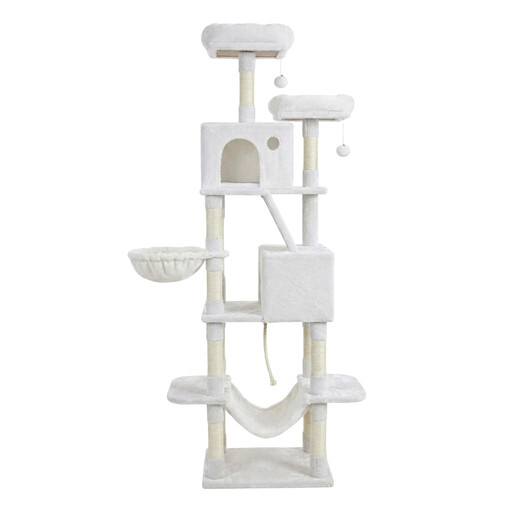
Why it suits this profile: At 206 cm tall, with several resting areas and 13 sisal-covered scratching posts, this tree offers plenty of features in one structure. That’s practical if you’re buying a large cat tree for the first time.
The product details mention a reinforced base, an anti-tip kit and a static load capacity of up to 75 kg. The instructions still recommend securing it to the wall.
13 sisal posts, two enclosed hideaways, a bed, a hammock and two platforms. The product details state that it has a chipboard structure with a plush covering.
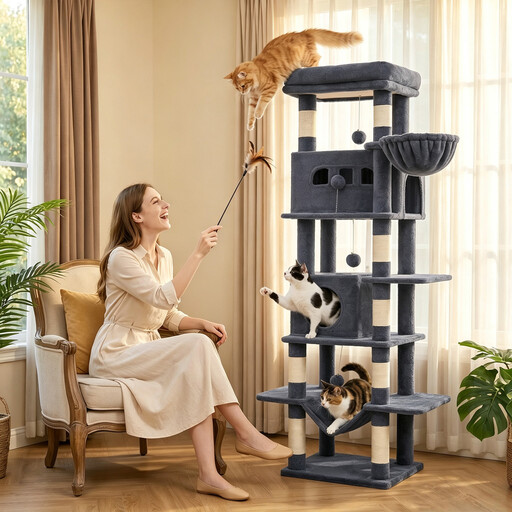
Why it suits this profile: This model is designed for households looking for plenty of vertical space and larger resting areas. According to the product information, the 60 × 40 cm platform gives cats more room to lie down.
The described wide, reinforced base and anti-tip features help address the risk of a narrow, wobbly tower. Be sure to check your available ceiling height before buying.
212.5 cm tall, with six levels, two hideaways, a hammock and a bed. The product information describes the cushions as removable and washable.
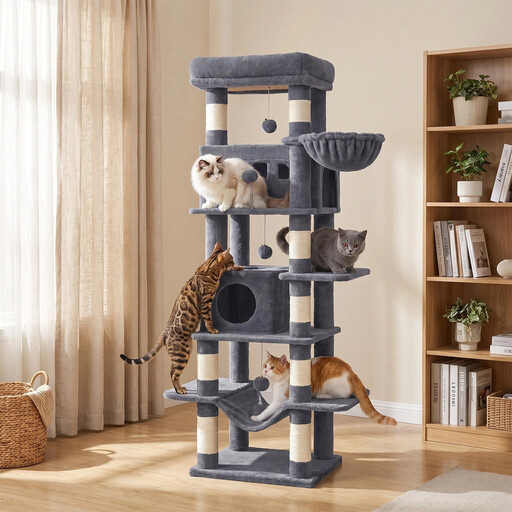
Why it suits this profile: With six levels, two hideaways, a bed and a hammock, this tree is well suited to households looking to create several separate resting and play areas.
According to the product information, 8 of the 17 support posts are covered in natural sisal. The double reinforced base and anti-tip feature are designed to limit movement of the structure.
Measures 170 × 50 × 40 cm, with two removable cushions and eight sisal posts. It’s stated to be suitable for cats weighing up to 6.8 kg each.
We’ve put together a complete, up-to-date list of products that meet these strict selection criteria and the applicable European safety requirements.
Place the tree on a flat, non-slip surface and assemble all the connections according to the instructions. Check the screws again after the first few weeks of use. For a tall cat tree, it’s often a good idea to secure it to the wall using the anti-tip fittings provided or suitable fixings.
Its lifespan depends on the number of cats, their weight, how they jump and the quality of the connections. Regularly check the sisal, plush covering, screws and platforms. Replace worn or damaged parts where possible. If there’s structural damage, it’s not safe to keep using the tree.
The price is mainly affected by the height, materials, number of sisal posts, resting areas and construction. So don’t compare the price alone. Also check the dimensions of the base and resting areas, along with the stated static load capacity. This helps you avoid buying a cheaper model that later proves short on space or stability.
