
Vandaag of morgen in huis

Kwaliteit gegarandeerd

Welkomstaanbiedingen ontgrendelen: GRATIS bezorging | Tot 80% korting | Gratis 30 dagen JoyPlus-proefperiode
Download de app
A large cat tree for multiple cats needs to offer more than extra height. In multi-cat households, queues for a resting spot, disturbances while climbing and wear to the sisal posts can quickly become an issue. Even in a small Dutch flat, a wide cat tree takes up a lot of floor space. A tall, vertical design can therefore be practical, provided the base remains stable.
When comparing products, do not focus only on the number of levels or the appearance. Product pages sometimes use terms such as “XXL”, “heavy-duty” or “for all cat breeds”, while important details such as dimensions, maximum load and wall mounting are less prominently displayed.
A tall cat tree can be appealing to cats that enjoy climbing, but a narrow base or lightweight construction may start to wobble. This is particularly important when several cats jump onto it at the same time. Therefore, check:
An anti-tip kit is not a substitute for correct assembly. Place the cat tree on a level surface and tighten all connections securely after assembly.
A cat tree with multiple levels may appear to offer plenty of space on paper, while cats can still get in each other’s way on narrow platforms. In a multi-cat household, different types of resting spots are useful: open platforms, a hammock, a basket and enclosed cat houses.
Also pay attention to the size of the resting spots. Larger breeds need room to stretch out. A platform measuring 60 × 40 cm or 65 × 45 cm gives you a clearer picture than simply describing it as “spacious”.
The number of sisal posts does not tell you everything. Cats often scratch after sleeping or while climbing. Sisal posts at different heights and along different routes are therefore more practical than just a few posts at the bottom.
Check whether the posts are fully wrapped in sisal, whether the material can be replaced and whether there are horizontal or angled scratching surfaces as well. This helps prevent a cat tree with sisal posts from being left with very little usable scratching space after a short time.
An XXL cat tree measuring approximately 160 to 212.5 cm makes good use of vertical space. This can be suitable as a cat tree for small flats, as it takes up less floor space than a wide play structure. However, measure the ceiling height beforehand and leave enough space around the base.
A layout with levels approximately 20 to 40 cm apart can make climbing up and down more manageable. For older cats or cats that are less agile at jumping, shorter distances and wide intermediate platforms are practical.
Use the stated load capacity as a guideline, not as an invitation to load the structure to its maximum. Look at the difference between maximum static load and the recommended number of cats. Jumping cats create more dynamic load than cats lying still.
For a product described as suitable for up to six cats, each weighing less than 6.8 kg, this is primarily a manufacturer’s product specification. Also check the dimensions and weight of your own cats. For large cat breeds, a smaller, tall cat tree may be less suitable, even when the total load capacity appears sufficient.
Removable cushions, washable covers and smooth platforms make everyday maintenance easier. Plush surfaces can collect hair; a hoover or clothes roller can help remove it regularly.
For some models, wall mounting is mandatory according to the safety instructions. One example is the SONGMICS cat tree with anti-tip kit: according to the product information, it must be permanently attached to a load-bearing wall after assembly. Also check the screws, sisal, baskets and hanging toys regularly for signs of wear.
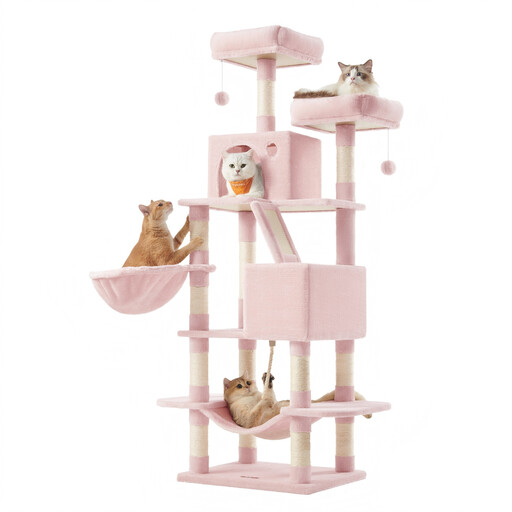
Why it suits this profile: The five levels, two cat houses, basket and hammock provide a practical setup for households looking for several places to rest and play.
The product specification mentions a reinforced base and anti-tip feature. Wall mounting is still required according to the instructions.
168 cm high, 13 scratching posts and 14 stated scratching zones; stated maximum static load: 65 kg.
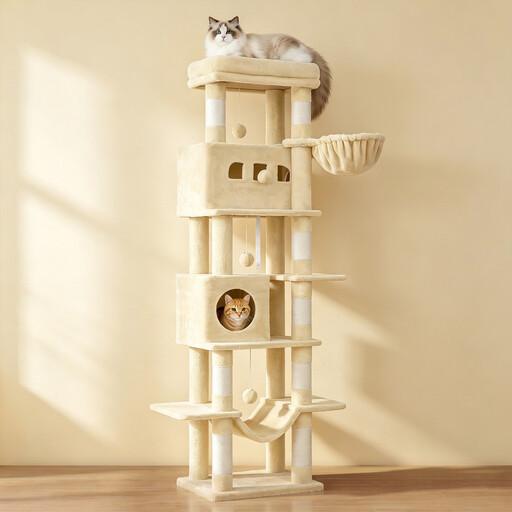
Why it suits this profile: The six levels, double cat houses, hammock and raised basket distribute resting and play space across a tall structure.
The manufacturer states that it has a double base, anti-tip lock and 17 support posts. The stated guideline is a maximum of six cats weighing less than 6.8 kg each.
212.5 cm high, eight stated sisal posts and a platform measuring 65 × 45 cm.
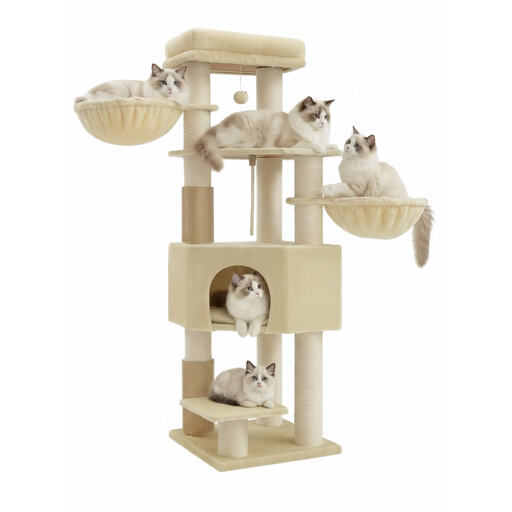
Why it suits this profile: At 160 cm high, with a basket, cat house, brush and nine sisal posts, this model is well suited to active cats and daily use.
The stated base is supplied with an anti-tip kit. The instructions require permanent attachment to a load-bearing wall.
Dimensions 50 × 50 × 160 cm, stated maximum static load of 105 kg and removable mats.
Set up the cat tree in its final position before allowing cats to use it. Then check:
Allow cats to get used to a new cat tree with hammock or cat houses at their own pace. If necessary, place a familiar blanket on a resting spot, but do not force them to use it. Hoover plush sections regularly and wash removable cushions according to the care label.
We have put together a complete, up-to-date list of products that fully meet these strict selection criteria and the applicable European safety regulations.
Consider the available floor space, the cats’ weight and the number of separate resting spots. A vertical cat tree measuring 160 cm or more can save floor space, but it needs a wide, stable base and may require wall mounting.
Its lifespan depends on how it is used, the cats’ weight, the materials and maintenance. Check the sisal wrapping, screws, platforms and cushions regularly. Any part that is loose or damaged should be secured, replaced or taken out of use.
It can be, provided the base is proportionate to the height and there is enough free space around it. Measure the area beforehand, check the ceiling height and choose a model with multiple functions, so one structure combines climbing, scratching and resting.
