
Vandaag of morgen in huis

Kwaliteit gegarandeerd

Welkomstaanbiedingen ontgrendelen: GRATIS bezorging | Tot 80% korting | Gratis 30 dagen JoyPlus-proefperiode
Download de app
A large cat tree needs to do more than provide somewhere to scratch. In a multi-cat household, cats use it to climb, play, sleep and keep an eye on their surroundings. A model that’s too small or wobbly can quickly become overloaded. And even for a large cat, a narrow base can make the tree unstable when they jump down from a higher platform.
When comparing models, look beyond the number of levels and the appearance. The key differences often come down to the construction, the size of the resting areas and how the tree is secured.
A tall scratching post might seem appealing, but height alone says little about stability. A narrow base and heavy upper sections can create an unfavourable centre of gravity. The risk of wobbling is especially high when several cats are moving around at once.
Always check:
Cats often scratch after sleeping or near doorways. A cat tree with just one small scratching area may therefore be less useful than a model with several vertical sisal posts. Check whether the scratching areas are positioned along the routes your cats actually use.
A cat tree with sisal scratching posts provides several designated scratching areas. This can help make the tree more appealing than the sofa, although every cat’s behaviour is different.
A hammock, cat house or top platform might look suitable, but the actual space available for resting matters more than the number of accessories. Measure the resting areas and compare them with your cat’s length and weight. A small basket won’t be practical for larger breeds, even if the cat tree itself is tall.
For a scratching post for multiple cats, wide platforms and enough space between levels are important. Cats should be able to pass one another without always having to use the same narrow route. Product information sometimes states how many cats a model is designed for. Treat this as a guide, and check the permitted weight per cat too.
For a scratching post for large cats, these measurements are particularly relevant:
A larger base generally offers greater stability, but you should still place the scratching post on a level surface.
A sturdy scratching post has a weighted or double base, firmly secured posts and as little play as possible in the joints. For tall models, securing the tree to a wall or ceiling is especially important. A floor-to-ceiling model must be adjusted to suit the height of the room and installed according to the assembly instructions.
After assembly, check that:
Sisal is a popular choice for vertical scratching posts because it provides a clearly defined scratching surface. Check that the sisal wraps around the post and that any loose ends are neatly finished. Soft plush surfaces are comfortable, but need regular vacuuming.
A removable or washable cushion is practical in a multi-cat household. Also check loose toys, cords and fastenings regularly, and replace any that become damaged.
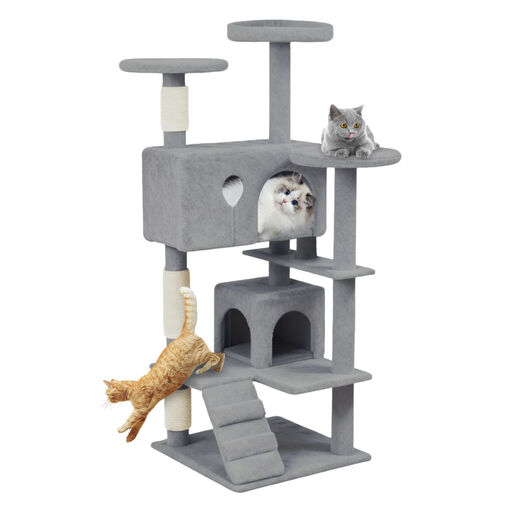
Why it suits this need: This model combines a relatively compact footprint with a height of 130 cm, a cat bed and a scratching post. It’s a practical starting point for one or a few cats in a flat or smaller room.
The precise dimensions make it easier to check in advance whether the base will fit in the space you have available.
Measures 49 × 49 × 130 cm; combines a cat bed and scratching post in one piece of furniture.
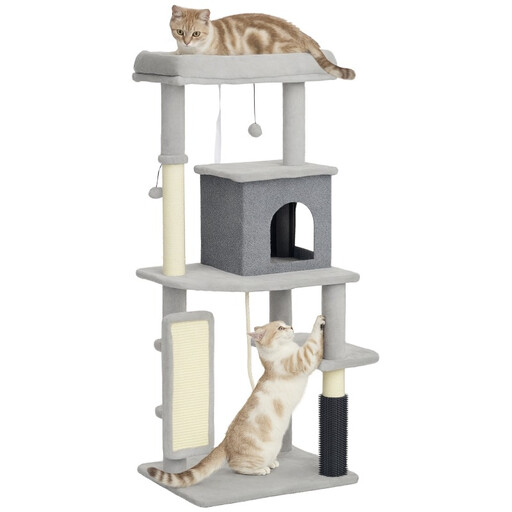
Why it suits this need: This climbing tree is designed for households looking for several features in one model: climbing, resting, scratching and playing.
The product name lists several sisal scratching posts and an anti-tip kit, giving stability and secure fixing as much attention as height.
132 cm tall; product details list sisal scratching posts, a cat house, a bed and an anti-tip kit.
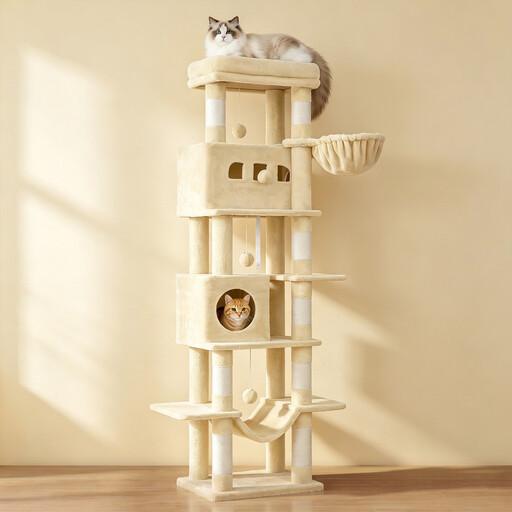
Why it suits this need: The product description lists a 212.5 cm structure with six levels, two cat houses, a hammock and eight sisal posts. That makes it a good match for heavy use and households with several cats.
According to the product description, the model has a double base and a built-in anti-tip lock. Check the assembly and the stated weight limit for your cats.
212.5 cm tall; eight sisal posts; two cat houses and a hammock; product information states it can be used by up to six cats, within the specified weight limit.
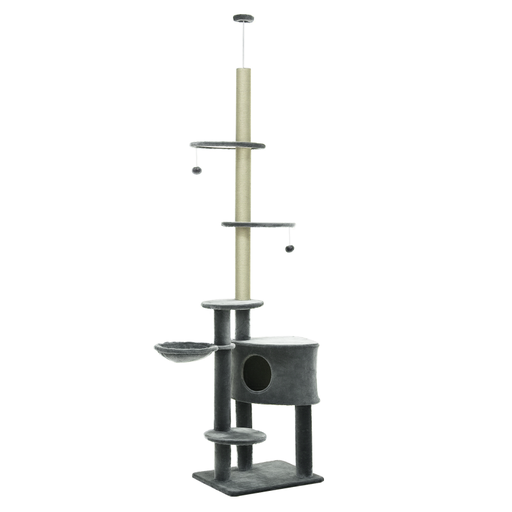
Why it suits this need: This model is designed to be fitted between the floor and ceiling. It’s a good choice for cat owners who want to make use of vertical space and can measure the ceiling height in advance.
The adjustable height of 220–265 cm makes it possible to get a good fit, but you’ll still need to measure your space.
Fits floor-to-ceiling heights of 220–265 cm; the product name lists multiple levels, a cat cave, a hammock and sisal posts.
We’ve put together a complete, up-to-date list of products that meet these strict selection criteria and comply with current European safety regulations.
Place the scratching post where your cats like to spend time, such as by a window or near the living room. Avoid narrow passageways where people are constantly walking past. Put a tall or heavy cat tree on a level floor, and use the included fixing if one is provided.
Tighten the connections again after the initial settling-in period. Vacuum plush sections regularly, and check the sisal, hammocks, toys and fixing points. How long the tree lasts depends on the materials, assembly, frequency of use and your cats’ weight. Don’t continue using a damaged part if it could come loose or make the tree unstable.
If you have several cats, choose a model with multiple resting areas, different scratching zones and enough space between levels. Also check the weight capacity and the size of the base. A tall cat tree without spacious resting areas won’t automatically suit a larger household.
No. Stability depends on the combination of base width, weight, post construction, joints and any fixings to the wall or ceiling. A floor-to-ceiling model may suit a room with a high ceiling, while a shorter model with a wide base may be a better fit for a smaller room.
There’s no set timeframe. Check the tree regularly for loose screws, torn fabric, loose sisal and wobbly parts. Replace it when the structure can no longer be assembled securely, or when parts remain damaged despite regular care.
