
Vandaag of morgen in huis

Kwaliteit gegarandeerd

Welkomstaanbiedingen ontgrendelen: GRATIS bezorging | Tot 80% korting | Gratis 30 dagen JoyPlus-proefperiode
Download de app
A large cat tree can give indoor cats room to climb, scratch, play and rest. However, a tall model won’t automatically suit every home or cat. If you have several cats, heavier cats or a tree that will see daily, intensive use, some technical details matter more than a striking design.
A tall cat tree may look appealing, but a narrow base or limited support can make it wobble. So don’t just look at the height in centimetres: check the width of the base plate, the number of support posts and whether it has an anti-tip feature.
A tall cat climbing tree also needs to suit your space. Measure the ceiling height beforehand and leave enough room to walk around the tree.
Plush may be comfortable, but it’s no substitute for good scratching material. Check how many posts are covered in sisal or similar scratching material, and where they’re positioned. Scratching areas at different heights are more practical than one small patch of sisal at the bottom.
According to the product description, some models have several sisal posts to help protect furniture by encouraging cats to scratch in designated areas. This is a design aim, not a guaranteed result for every cat.
“Suitable for multiple cats” doesn’t tell you much on its own. Check the stated weight limit per cat, not just the total capacity. A cat landing on a platform after a jump puts a different strain on the structure from one that’s resting quietly.
Also check that the screws are tight after assembly. An anti-tip kit is useful for a cat tree for large cats, but still place the tree on a flat surface and follow the assembly instructions.
Active cats benefit from levels with a sensible distance between them. According to the product description, the distance between levels on the 170 cm model is 20 to 30 cm. The 212.5 cm model lists distances of 30 to 40 cm. Consider your cat’s age, agility and size when choosing.
A large cat tree doesn’t necessarily need the most levels. Wider platforms, stable transitions between levels and enough room for a cat to turn around are more important.
Look out for these features:
There’s no universal size that suits every cat. Compare the dimensions with a favourite sleeping spot at home.
A cat tree with a hideaway offers an enclosed spot for cats who like to rest on their own. In a multi-cat household, two hideaways, a hammock and a raised basket can help spread out the resting spots. This won’t automatically prevent conflict, but it does give cats more choice.
Removable, washable cushions are practical. Vacuum or use a lint roller to care for loose upholstery. Before you buy, check whether the parts can be removed and whether replacement toys are available.
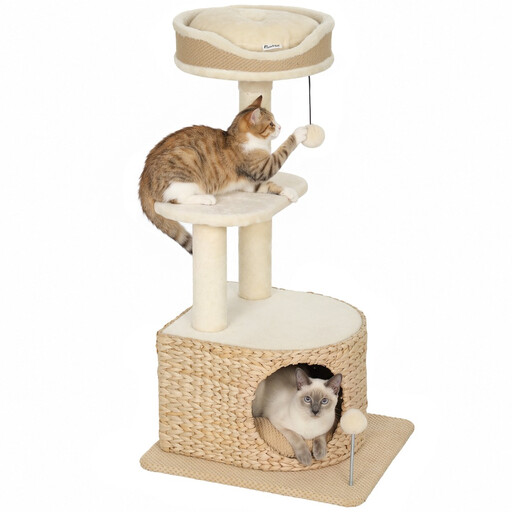
Why it suits this type of buyer: At 87 cm tall, this model is a good choice if you’d like to try a compact indoor cat tree first, perhaps in a flat or smaller living room.
Its modest height means you’re less likely to buy a large tower that won’t fit your available space. Be sure to check the base dimensions and assembly information yourself.
Four levels, a jute scratching post and a hanging resting spot, according to the product name. The neutral beige colour suits many interiors.
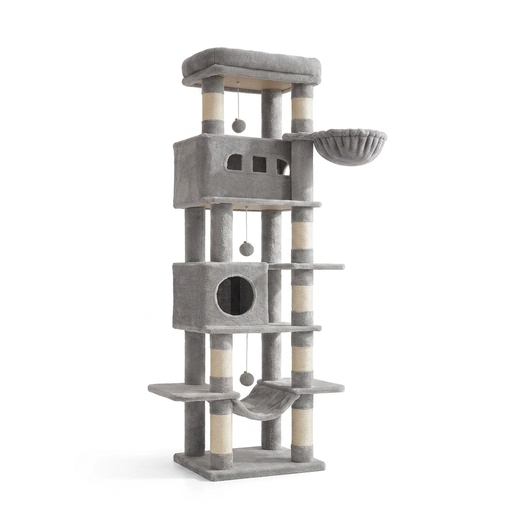
Why it suits this type of buyer: This model combines several resting and play areas, making it a good option for households looking for a large cat tree for multiple cats.
The product description lists 17 support posts, 8 of them covered in sisal, plus a double-reinforced base and an anti-tip feature. Take care when assembling it.
170 cm tall, with six levels, two hideaways, a hammock, a 30 cm basket and two removable cushions. The stated capacity is up to six cats, each weighing 6.8 kg.
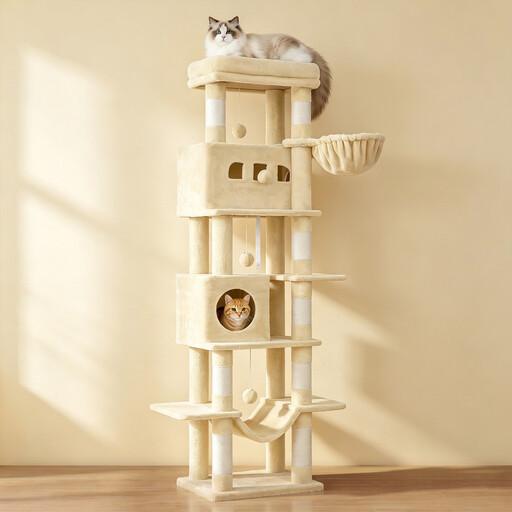
Why it suits this type of buyer: At 212.5 cm tall with six levels, this model is suited to active cats who love to climb and households where the tree will be used every day.
The product description lists 17 reinforced support posts, 8 sisal posts, a double base and an anti-tip lock. You can check these features in the product specifications.
A 65 × 45 cm platform, two hideaways, a hammock, a 30 cm basket and washable cushions. According to the product description, the stated maximum is six cats weighing up to 6.8 kg each.
We’ve put together a complete, up-to-date list of products that meet these strict selection criteria and the applicable European safety regulations.
Place the cat tree on a flat floor, preferably somewhere your cat already likes to spend time. A spot by a window can be appealing, but avoid draughts, radiators and doors that could swing into the structure.
After assembly, check:
Replace damaged toys and retighten the connections if the tree is used intensively.
Consider the number of resting spots, the width of the platforms and the weight limit per cat. Multiple cats benefit from having separate places to lie down, so they don’t all have to share the same level. Also measure the floor and ceiling space available.
Its lifespan depends on the number of cats, their weight and scratching habits, and the quality of the assembly. Sisal wears out faster in areas that are used every day. Regularly tightening screws and replacing loose parts when needed can help extend its useful life.
Choose a model with a wide base and an anti-tip feature. Place it on a flat surface, assemble all the parts according to the instructions and secure the tree where indicated. If you have heavy or very active cats, it’s a good idea to check it again after the first few days of use.
