
Vandaag of morgen in huis

Kwaliteit gegarandeerd

Welkomstaanbiedingen ontgrendelen: GRATIS bezorging | Tot 80% korting | Gratis 30 dagen JoyPlus-proefperiode
Download de app
A large cat tree for large cats needs to offer more than just height. Heavy or active cats place greater strain on platforms, sisal posts and joints. In a multi-cat household, there is even more movement. A model that looks impressive on paper may wobble in practice, offer too little lounging space or be difficult to clean.
So don’t focus only on the number of levels or an eye-catching design. The most important considerations are stability, dimensions, weight capacity and how you secure the cat tree in your home.
A tall cat tree takes up relatively little floor space, but its centre of gravity is higher. This means a narrow base can move more easily when a cat jumps up from the floor. An anti-tip device helps, but it does not replace correct assembly.
So check:
For the SONGMICS Cat Tree, attachment to a load-bearing wall is mandatory according to the instructions for use. This is particularly important for energetic cats that climb or jump at the same time.
A cat tree with several levels can provide plenty of climbing space, but that says little about comfort. A large cat should be able to turn around and stretch out on a platform. So look at the dimensions of the lounging areas rather than just the overall height.
For a cat tree for larger cats, the width and depth of the top platform are particularly important. Cat houses and beds should not be so cramped that they are barely used.
Sisal posts are designed to redirect scratching behaviour towards the cat tree rather than the sofa or curtains. However, placement is more important than the total number of posts. Scratching areas at different heights are practical, as cats each have their own preferences.
Check the number of sisal-covered posts, how they are distributed across the levels and whether individual parts can be inspected or replaced later.
First, measure the area where you want to place the cat tree. Leave enough space around it for climbing and jumping. An extra-large cat tree measuring from 160 to over 210 cm in height can save floor space thanks to its vertical design, but it does require sufficient ceiling clearance.
Also check:
A model measuring 170 cm high with a 50 × 40 cm base requires a different location from a 212.5 cm tree with a wider construction.
Always consider a stated weight capacity in context. Some manufacturers specify a static maximum load, while cats create a dynamic load when jumping. It is sensible not to rely constantly on the maximum value.
The SONGMICS tree lists a maximum static load of 105 kg and is suitable for up to five cats weighing no more than 20 kg each. Other models in this selection specify a maximum of six cats weighing 6.8 kg each. According to the manufacturers’ product information, these are usage guidelines; actual suitability also depends on the assembly, the surface it stands on and your cats’ behaviour.
A sturdy cat tree generally consists of load-bearing panels, supporting posts and sisal covering in areas where cats actually scratch. Check whether the joints are easily accessible for inspection and whether cushions or covers can be removed.
Useful features include:
According to the product descriptions from the brands mentioned, the models offer different combinations of these features. Always check the current product specifications on the product page before purchasing.
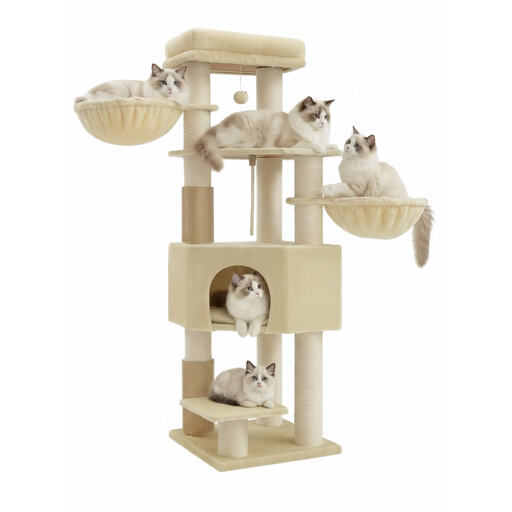
Why it suits this profile: A straightforward choice for anyone looking for a 160 cm cat tree with several features without a very large floor footprint. The combination of a lounging area, cat house and bed is suitable for one or more cats.
The product information lists 9 sisal posts, a reinforced base and an anti-tip kit. The assembly instructions require permanent attachment to a load-bearing wall.
160 cm high, weighing 22.6 kg, with 9 sisal posts, removable mats and a stated maximum static load of 105 kg.
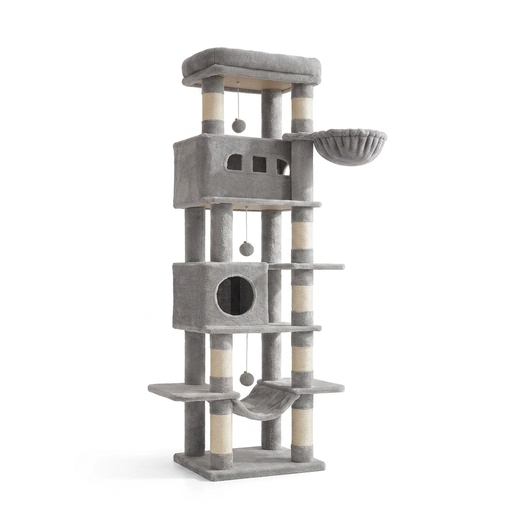
Why it suits this profile: Designed for households that want to combine several resting and play zones. The six levels, two cat houses and hammock make good use of the available space.
The product description mentions a double reinforced base and anti-tip feature. The lounging and hideaway areas are spread across several levels rather than being concentrated on one small platform.
170 cm high, 6 levels, 8 sisal posts, a 50 × 30 cm platform, two washable cushions and a hammock.
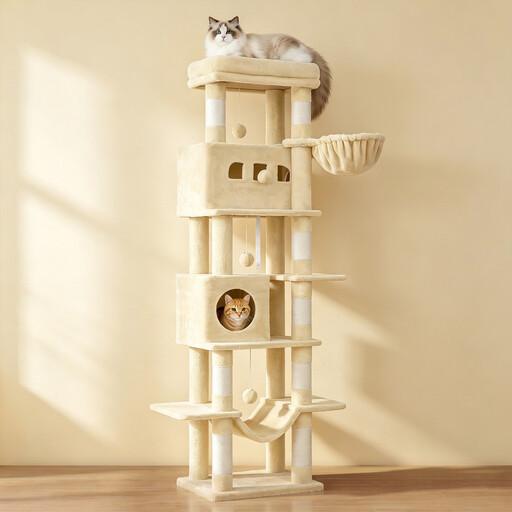
Why it suits this profile: A choice for active cats and households that want plenty of vertical space, two cat houses and several resting areas. Measure the ceiling height beforehand and check the installation location.
The product information mentions a double integrated base, anti-toppling lock and 17 supporting posts. The eight sisal posts are distributed along the climbing routes.
212.5 cm high, six levels, a 65 × 45 cm platform, two cat houses, a bed, a hammock and eight replaceable toys.
Place a stable cat tree with an anti-tip feature on a level surface. Tighten all connections according to the instructions and secure the structure to the wall when required. Check again after a few days to make sure no looseness has developed.
Plan regular maintenance:
A cat tree will generally last longer when loose connections are tightened promptly and worn sisal or toys are not left unattended. Its lifespan depends on how intensively it is used, the cats’ weight, the materials and maintenance.
We have compiled a complete, up-to-date list of products that fully meet these strict selection criteria and the applicable European safety regulations.
It depends on the available space and your cats’ climbing habits. A tree measuring 160 to 170 cm provides vertical activity for many households. Models measuring 212.5 cm offer more height, but require extra attention to ceiling clearance and wall attachment.
Look for several resting areas, wide platforms, enough sisal posts and a stated weight capacity. A cat tree with both a cat house and a hammock means that all the cats do not have to share the same lounging area. Always check the maximum load and the stated number of cats for the specific model.
Expect to vacuum or brush it regularly, and check the connections weekly when the tree is used intensively. Washable cushions reduce the cleaning required. Replace or remove damaged parts promptly, particularly hanging toys and torn fabric.
