
Vandaag of morgen in huis

Kwaliteit gegarandeerd

Welkomstaanbiedingen ontgrendelen: GRATIS bezorging | Tot 80% korting | Gratis 30 dagen JoyPlus-proefperiode
Download de app
A large cat tree needs to do more than provide somewhere to scratch. Active, heavy or multiple cats need plenty of room to climb, along with sturdy resting spots, a secure base and materials that can withstand daily use. However, a larger size won’t automatically make a cat tree right for your home or your cats.
Product descriptions also often use terms such as “extra sturdy” or “suitable for multiple cats”. Always check the measurable specifications. A cat tree measuring over two metres, for example, may offer plenty of vertical space, but without wall fixings it may be less suitable for a home with energetic jumpers.
A tall cat tree takes up relatively little floor space, but its height says nothing about how stable it is. Also check:
For models over 150 cm tall, product information for several models strongly recommends wall fixings. This is especially relevant for cats that jump at the same time or pass each other on the platforms.
The stated weight capacity is often a static load. This doesn’t automatically mean that a cat of the same weight can safely jump from a height onto a small platform. So don’t look only at the maximum total weight: check the size of the resting areas and how the platforms are arranged too.
For a cat tree for large cats, wide resting spots and a low, sturdy base matter more than simply having lots of levels.
A cat house, hammock and basket can make a cat tree more appealing, but cats are more likely to use a scratching post when the scratching surfaces are easy to reach. Vertical sisal posts should be long enough for your cat to stretch out fully. For multiple cats, it’s useful to have scratching spots at different levels, so they’re less likely to block one another.
A stable cat tree should stand on a flat, non-slip surface. A wide or double-reinforced base helps limit movement, but always follow the assembly instructions. Check all the screws and joints after assembly, and repeat these checks regularly.
For an XXL cat tree, an anti-tip kit is essential. Secure a tall structure to a suitable load-bearing wall if the instructions require it. Don’t place the cat tree next to windows with loose cords, heat sources or open flames.
Measure the space available beforehand. Consider not only the footprint, but also the ceiling height and the space around the tree. A 206 cm cat tree needs enough clearance for safe assembly.
Also look for:
A model measuring 160 to 170 cm can be a practical compromise for households that want some height but don’t want a structure over two metres tall.
Sisal is a durable material for scratching, but sisal surfaces will wear over time too. Check whether parts can be replaced, and trim any loose fibres as they appear. Plush and fabric cushions collect hair; removable or washable covers make cleaning easier.
Wooden or chipboard structures should be kept dry. Place the scratching post indoors in a dry spot and inspect its parts for wear. A cat tree will last longer if you tighten any loose joints as soon as you notice them.
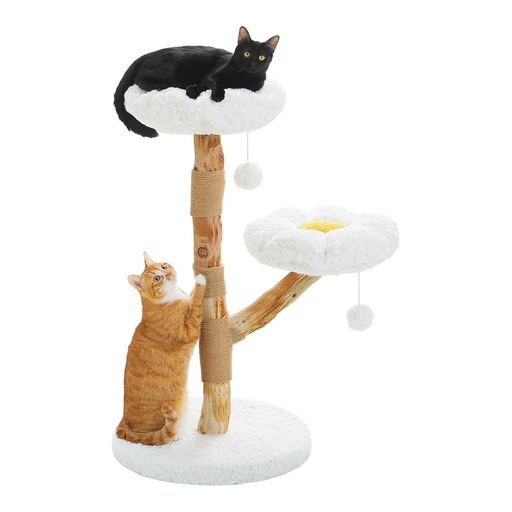
Why it suits this profile: This compact model takes up 49 × 49 cm of floor space and, according to the product information, is suitable for one or two medium-sized to large cats weighing up to 7,3 kg. This makes it a good fit for smaller homes.
The specifications mention a double-reinforced base and a solid wood frame. After assembly, make sure all the joints are secure.
92 cm tall, with two resting platforms, natural wood and a sisal-covered post.
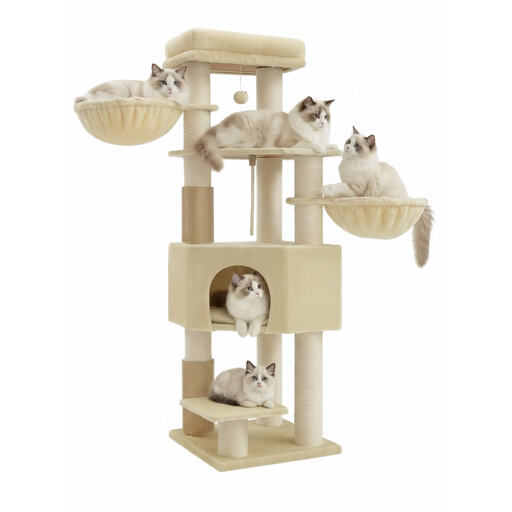
Why it suits this profile: This cat tree combines several resting spots with nine sisal posts, a cat house and a built-in brush. The product information gives a static load capacity of 105 kg and says it can accommodate up to five cats.
It has scratching spots in several places and comes with an anti-tip kit. It must be permanently secured to the wall after assembly.
Washable mats, nine sisal posts, two baskets and an anti-tip base.
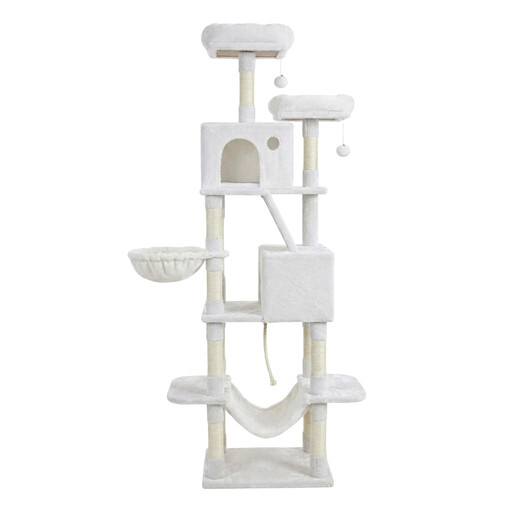
Why it suits this profile: This tall cat tree is designed for active cats and households with multiple cats. It has two platforms, two enclosed dens, a basket and a hammock.
The 13 sisal posts spread the scratching space across the structure. Given its height, the product information strongly recommends securing it to the wall.
206 cm tall, with 13 sisal posts and a stated total static load capacity of up to 75 kg.
We’ve put together a complete, up-to-date list of products that meet these strict selection criteria and comply with the applicable European safety regulations.
Consider the number of cats, their weight and how they like to rest. Several platforms, at least two enclosed resting spaces and scratching surfaces at different levels are useful. Check the stated static load capacity too, but don’t rely on it as your only measure of safety.
Assemble the cat tree exactly as instructed, on a flat surface. Use the anti-tip kit provided if the instructions require it, and secure tall models to a suitable wall. Regularly check the screws, sisal and platforms for wear or loose parts.
Its lifespan depends on the number of cats, their weight, how often they jump and how well it’s maintained. Fabric and sisal wear more quickly in a busy household. Vacuum the resting spots, clean removable covers according to the care label and replace damaged parts promptly.
