
Vandaag of morgen in huis

Kwaliteit gegarandeerd

Welkomstaanbiedingen ontgrendelen: GRATIS bezorging | Tot 80% korting | Gratis 30 dagen JoyPlus-proefperiode
Download de app
A large cat tree can provide a place to climb, rest and scratch all in one. In practice, though, some models can disappoint. A tall tower may take up more room than expected, soft coverings can be difficult to clean, and a narrow base may start to wobble when an active cat jumps up.
If you have large cats, more than one cat or a small flat, it’s especially important to look beyond the number of platforms. Read on to find out which specifications really matter and which pitfalls to avoid when comparing a large cat tree.
A tall cat tree has a high centre of gravity. A narrow or lightweight base can therefore wobble more easily when your cat climbs or jumps. Look out for:
For models over 150 cm, wall fixing is strongly recommended according to the product information for several models. Also place the cat tree on a flat, stable surface and check all the screws after assembly.
A claim such as “suitable for multiple cats” doesn’t always tell you how much weight each individual platform can support. Look at the difference between static weight capacity and everyday use. Static weight capacity refers to a load without jumping or impact. A cat jumping down from a higher level puts different strain on the structure.
So check:
A cat tree for large cats should offer enough room for them to turn around and stretch out. Even a sturdy structure can be uncomfortable if its top platform is too small.
Sisal is a durable material for scratching, but the number of posts alone doesn’t tell you everything. Their position matters too. Scratching posts at different heights and along climbing routes are more practical than several posts grouped closely together in one place.
A sisal scratching post can help encourage your cat to scratch in a designated spot. It won’t guarantee that your cat leaves the sofa completely alone: some cats prefer horizontal scratching boards or a particular sisal texture. A combination of vertical posts and a separate scratching mat can therefore be useful.
First, measure the spot where you plan to put the XXL cat tree. Allow for skirting boards, radiators, doors and walkways. A model measuring 206 or 212.5 cm needs enough clearance not only for its height, but also for safe assembly.
In a flat, a vertical multi-level cat tree may be more space-efficient than several separate pieces of furniture. Just make sure the base is wide enough. A tall post with a base only a few dozen centimetres wide needs particular attention when it comes to anchoring.
Check the materials and joints. Products in this selection use materials including chipboard or solid wood, sisal, plush and metal fixings. During assembly:
A cat tree with a hammock or cat house is especially useful when cats can choose between different places to rest. In a multi-cat household, several resting areas and enclosed spaces are practical. Removable cushions, washable covers and surfaces that can be cleaned with a hoover or lint roller all help keep maintenance to a minimum.
Also look for replaceable parts. With heavy use, sisal and plush may wear out sooner than the base structure.
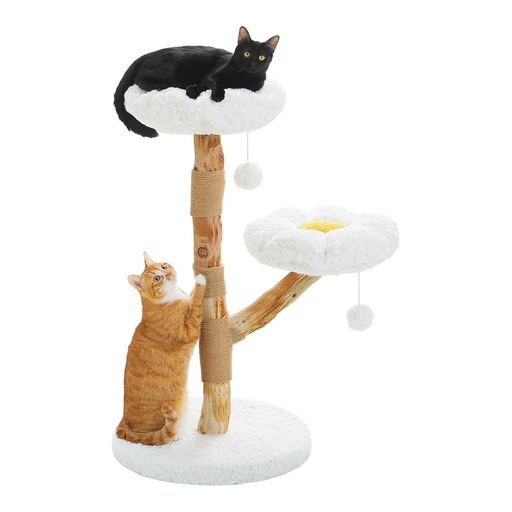
Why it suits this type of buyer: This compact model takes up less floor space and, according to the product information, is designed for medium to large cats weighing up to 7.3 kg, with a maximum of two cats.
The structure has a double reinforced base and a solid wood post wrapped in sisal. At 92 cm tall, it is less prone to the high centre-of-gravity issues associated with tower models.
Measures 49 × 49 × 90 cm, with two resting platforms, a natural wood structure and a sisal covering.
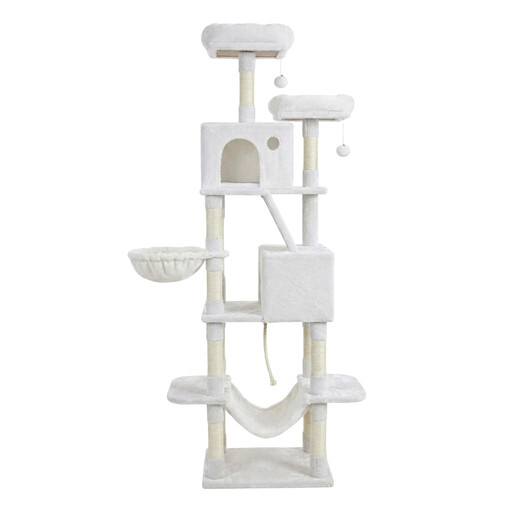
Why it suits this type of buyer: This extra-tall tower offers plenty of vertical space for active cats and households where several cats need to share different areas.
The product information lists a large reinforced base, 13 sisal posts and recommended anti-tip wall fixing.
Two cat houses, two platforms, a basket, a hammock and a stated static weight capacity of up to 75 kg.
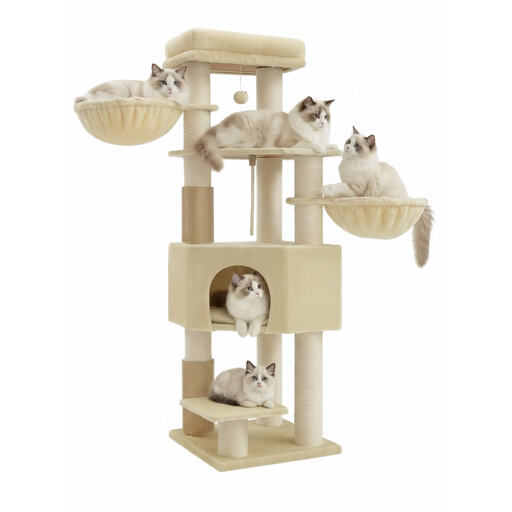
Why it suits this type of buyer: This model is designed for large or active cats who want a den, basket and spacious resting area as well as somewhere to scratch.
The specifications mention an anti-tip base, permanent wall fixing and nine reinforced sisal posts. The covers and mats are removable.
Measures 50 × 50 × 160 cm, with a stated static weight capacity of 105 kg, a built-in brush and washable parts.
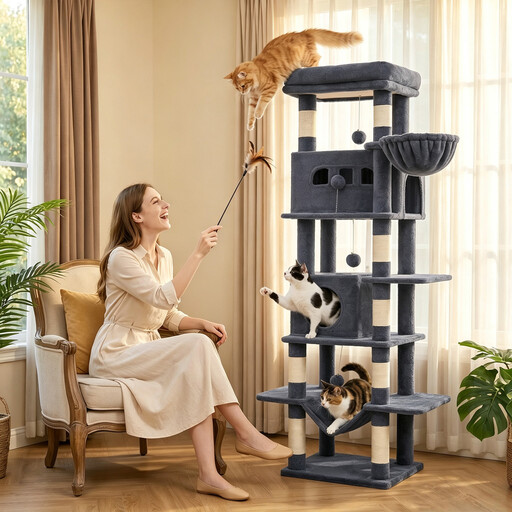
Why it suits this type of buyer: With six levels, two cat houses, a hammock and a wide top platform, this model is designed for several cats to share.
The product description mentions a wider reinforced base, anti-tip features and eight sisal posts. At this height, correct wall fixing remains important.
A 60 × 40 cm resting platform, two dens, a hammock, six levels and a design that keeps the floor footprint relatively small.
We’ve put together a complete, up-to-date list of products that meet these strict selection criteria and the applicable European safety regulations.
Place the cat tree on a flat, non-slip surface and follow the assembly instructions. Check all the joints again after the first few weeks of use. For tall models, fixing the tree to a suitable load-bearing wall is advisable or may be required by the product instructions.
Its lifespan depends on how many cats use it, their weight and how much they jump and scratch. Regularly check the sisal, plush covering, screws and platforms. Replace any loose or damaged parts before using the furniture again.
It can be, as long as its height and base fit the space. Measure not only the floor area, but also the ceiling height and the space needed for wall fixing. A vertical multi-level cat tree can save floor space, but requires extra attention to stability.
