
Vandaag of morgen in huis

Kwaliteit gegarandeerd

Welkomstaanbiedingen ontgrendelen: GRATIS bezorging | Tot 80% korting | Gratis 30 dagen JoyPlus-proefperiode
Download de app
A large cat tree offers more than just somewhere to sharpen claws. For large, active or multiple cats, a tall cat tree can combine resting spots, climbing routes and space to play. However, an impressive height does not tell you everything. A model may look large in the photo but be too narrow, unstable or difficult to clean in practice.
Pay particular attention to these three pitfalls:
Lots of levels, but little usable space
A large cat tree can have several levels without providing enough wide resting areas. Check the dimensions of the platforms, baskets and dens. A heavy cat should be able to turn around and stretch out without being half over the edge.
A tall cat tree without sufficient stability
Height increases the risk of wobbling when cats jump. A wide base and an anti-tip feature are therefore important. With tall models, you should also check whether fixing the tree to the wall is required or strongly recommended.
Lots of accessories, but fragile components
Hanging balls, elastic cords and plush coverings can be appealing, but they should be checked regularly. If a component comes loose, starts to fray or is chewed, remove it immediately. Sisal also wears down with intensive use and requires periodic inspection.
An XXL cat tree often takes up less floor space than several separate accessories because it mainly uses vertical space. Beforehand, measure not only the available area but also the clear space around the furniture. A cat climbing tower, for example, measuring between 160 and 212.5 cm in height needs sufficient clearance from the ceiling, lights and cupboards.
Pay attention to three separate measurements:
A model with several resting places is more practical if cats want to avoid one another. Also check the stated recommendation based on the number and weight of the cats. This information is more useful than simply relying on the general description “for large cats”.
Sisal scratching posts should be positioned where cats actually go: along climbing routes and beside resting places. Do not just look at the total number of posts; consider how they are distributed too. A slope or ramp can provide extra scratching space and make it easier for cats to climb up.
A stable cat tree with an anti-tip feature should be placed on a flat surface. Fit the supplied safety fixing according to the instructions, preferably to a suitable load-bearing wall. After assembly, check all screws and connections. For a large or active cat, a heavy frame with a reinforced base is generally more practical than a narrow base plate.
Plush surfaces collect hair and dust. A removable cover or washable cushion makes daily maintenance easier. Check whether the components can be cleaned with a vacuum cleaner, lint roller or damp cloth, and always follow the care label.
Sisal does not need to be replaced as soon as its appearance changes. However, fraying, loose threads or connections that are coming away are signs that the component should be repaired or replaced. With a cat tree featuring a hammock and cat dens, it is also sensible to inspect the seams, fixings and base regularly.
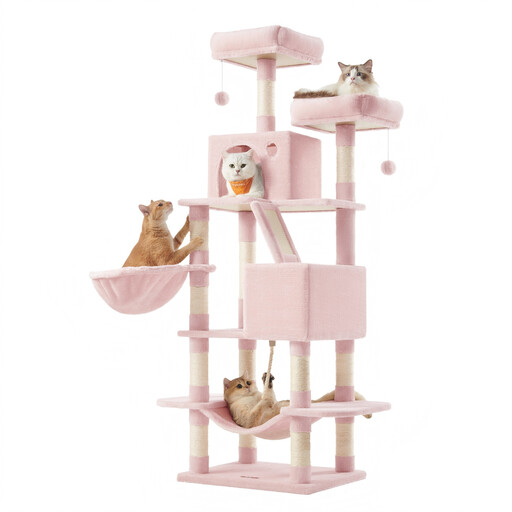
Why it suits this profile: A versatile entry-level choice with five levels, several resting places and a height of 168 cm for households with active cats.
The product specification lists 13 scratching posts plus a ramp, two platforms, two dens, a basket and a hammock. The reinforced base and anti-tip feature should be fixed to the wall according to the instructions.
168 cm high, measuring 55 × 45 cm, weighing 18.4 kg and specified for a maximum static load of 65 kg.
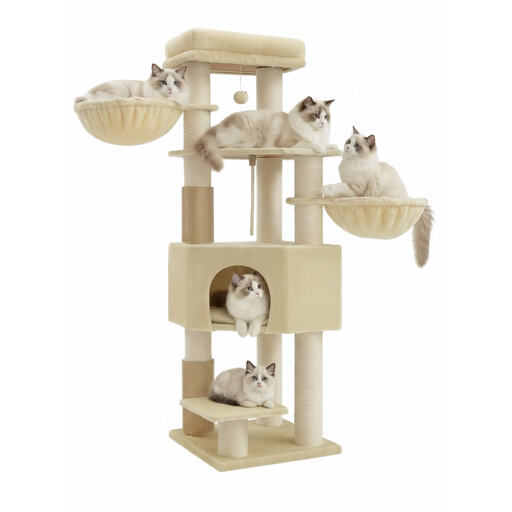
Why it suits this profile: Ideal for buyers who value not only climbing space but also easy maintenance, a spacious resting area and an integrated grooming brush.
The nine reinforced sisal posts are distributed throughout the tree. The product information mentions a reinforced base, anti-tip kit, removable mat and washable covering.
160 cm high, measuring 50 × 50 cm, weighing 22.6 kg and specified for a static load of 105 kg; according to the product information, suitable for up to five cats.
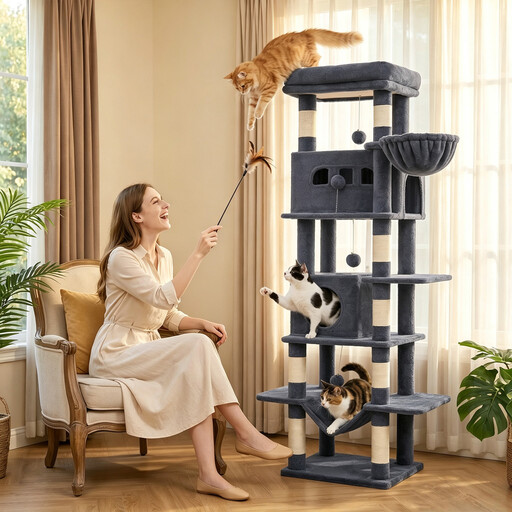
Why it suits this profile: Designed for households with several or very active cats that want to combine height, multiple hideaways and vertical space.
According to the product description, the six levels have a vertical distance of approximately 30–40 cm. Eight sisal posts, two dens, a hammock and a basket distribute the usable space.
A vertical design with a 60 × 40 cm platform, removable cushions and an anti-tip feature for wall mounting.
First place a large cat tree on a flat surface and hand-tighten all the connections before fully securing the structure. Then check that the platforms do not have any play. Do not place the tree directly next to a fragile object or on a smooth surface where the base could slide.
Give your cats time to get used to their new climbing area. A toy or familiar blanket can help make the tree more appealing without forcing the animals to use it. Check the sisal posts, hammock, dens, screws and anti-tip fixing every week. Minor wear is normal, but loose components or a damaged base require immediate attention.
For extra variety, you can use separate toys such as the Meowmagic Feather and Sisal Ball Toy Pack of 4. Keep toys with feathers, string or elastic out of reach when you are not supervising your cat. For cats that do less jumping, you can also find suitable options in toys for older cats.
We have put together a complete, up-to-date list of products that fully meet these strict selection criteria and the applicable European safety regulations.
Do not look only at the overall height. A resting area should suit your cat’s size and provide sufficient support when it turns around and stretches out. Also check the width of the base, the diameter of the posts and the stated load capacity. For multiple cats, several resting places and separate routes are practical.
With tall models, wall fixing is often part of the safety instructions. Use the supplied anti-tip kit and attach it to a suitable load-bearing wall. A heavy base helps prevent wobbling, but it does not replace the recommended fixing.
Its lifespan depends on the number of cats, their weight, how much they jump and how intensively the sisal is used. Regularly checking the screws, cleaning the plush and replacing worn sisal or damaged components in good time will help extend its service life. Before buying, check whether replacement parts and covers are available.
