
Vandaag of morgen in huis

Kwaliteit gegarandeerd

Welkomstaanbiedingen ontgrendelen: GRATIS bezorging | Tot 80% korting | Gratis 30 dagen JoyPlus-proefperiode
Download de app
A large cat tree for multiple cats needs to do more than support a few perches. In a home with several cats, large cats or heavier cats, stability, plenty of places to rest and well-positioned scratching areas are all important. A tall cat tree can also save floor space, but only if its design suits your living space and everyday use.
Look out for these three common pitfalls:
A tall post with a base that’s too small
A 170 or 212,5 cm cat tree might look appealing, but a narrow base is more likely to wobble when your cat jumps on it. Always check the base dimensions and whether an anti-tip device is included.
Lots of levels, but little usable resting space
A 6-tier cat tree isn’t automatically suitable for multiple cats. If the platforms are small or there’s only one enclosed hideaway, cats may get in each other’s way. Look for a mix of open resting spots, cat houses, a hammock and a basket.
Sisal as a marketing detail rather than a proper scratching area
Some models have just one thin sisal post. For everyday use, a cat tree with sisal-covered posts at different heights is more practical when you have several cats. That way, they don’t all have to use the same spot.
First, measure the space where you plan to put the cat tree. Leave enough room around it for your cats to move about, and check that it won’t be in the way of a cupboard, door or radiator. A tall cat tree over two metres makes good use of a room’s height, but needs extra attention when it comes to the base.
According to the product information for the models mentioned, a version with a double or widened base may be suitable for multiple cats. Some models are listed as supporting up to six cats weighing 6,8 kg each. Treat this as a product specification under the stated conditions, not as a general guarantee for every home or cat. Distribute the weight evenly and follow the assembly instructions.
Sisal is a commonly used material for scratching posts. Don’t just look at the number of sisal posts; check where they’re positioned, too. Scratching posts on several levels give cats different options and can help steer them away from sofas, curtains and chairs.
A sturdy cat tree also needs enough support posts. The models below, for example, are listed as having 17 posts, 8 of which are covered in sisal. When your cat tree arrives, check that the sisal is tightly wrapped and the screws are secure. Loose parts can cause extra movement over time.
For a cat tree used by several cats, having multiple private spots is useful. Look for a cat tree with a hideaway, a hammock, a raised basket and wide platforms. A basket of around 30 cm suits many cats, but measure your largest cat curled up and stretched out before you order.
Washable cushions and removable parts save time when cleaning up fur and stains. Soft coverings can usually be cleaned with a lint roller or vacuum cleaner. Check whether the covers really are removable and whether you can rinse a platform with water; always follow the product instructions.
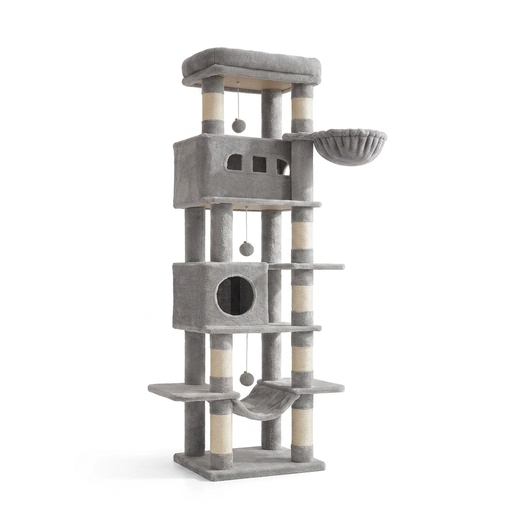
Why it suits this type of buyer: At 170 cm tall and 50 cm wide, it offers plenty of features without taking up the whole floor. That makes it a good choice for households buying a large cat tree for the first time.
According to the product information, it has 17 support posts, 8 sisal posts, a widened double base and an anti-tip device. This means the structure doesn’t rely on a single scratching post.
6 levels, two hideaways, a hammock, a 30 cm basket and two removable, washable cushions.
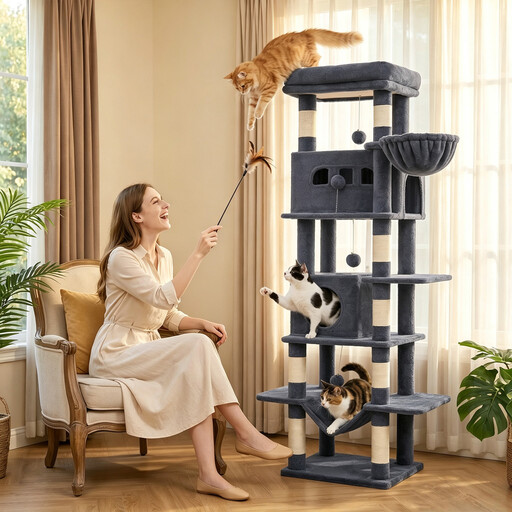
Why it suits this type of buyer: This model is designed for households looking to combine plenty of vertical space with several resting areas, for example those with three or more cats.
The product information lists a 60×40 cm platform, two hideaways, a hammock and a basket. It also mentions a reinforced base and an anti-tip device.
A vertical, space-saving design, washable cushions and 8 sisal-covered posts.
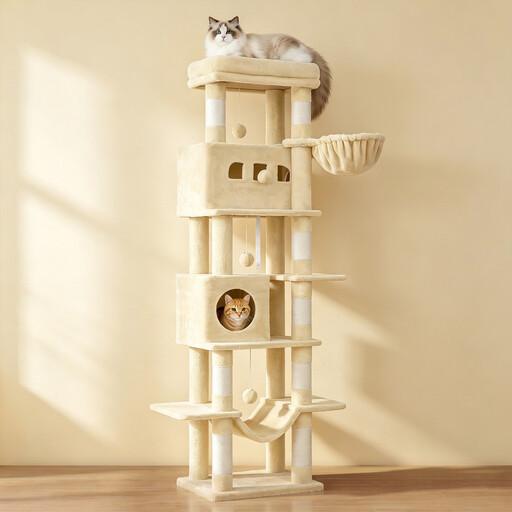
Why it suits this type of buyer: The combination of a wide perch, two cat houses and several scratching areas makes it a good fit for heavy use by large cats or in a busy household.
According to the product information, this model has 17 reinforced posts, 8 sisal posts, a double base and a built-in anti-tip lock.
A 65×45 cm platform, two hideaways, a hammock, a 30 cm basket and two washable cushions.
We’ve put together a complete, up-to-date list of products that meet these strict selection criteria and current European safety regulations.
Before assembling the cat tree, check that all the parts and screws are included. Place it on a level surface and tighten the connections evenly. If you have a very tall cat tree, it may be worth securing it to the wall, especially if your cats are active or the floor is uneven. Only use fixings that are suitable for your type of wall.
Vacuum soft resting areas regularly and remove fur with a lint roller. Check the sisal posts, screws, hanging toys and connections every month. Replace damaged toys and stop using a platform if the material comes loose or the platform visibly bends.
Ideally, choose a model with several resting spots, at least a few spacious platforms and different scratching areas. For large cats, platforms around 50 to 65 cm wide are more practical than small perches. Also check the overall weight capacity and the dimensions of the base.
It can be, as a tall cat tree mainly uses vertical space. Be sure to measure the ceiling height, floor space and walkways, though. A 212,5 cm model won’t fit in every room and needs to stand securely without pressing against furniture or doors.
Its lifespan depends on the number of cats, their weight, how much they jump and how well it’s maintained. A cat tree with several sisal posts spreads wear more evenly. Check the fixings regularly and replace parts as soon as the sisal, covering or screw connections are visibly damaged.
