
Vandaag of morgen in huis

Kwaliteit gegarandeerd

Welkomstaanbiedingen ontgrendelen: GRATIS bezorging | Tot 80% korting | Gratis 30 dagen JoyPlus-proefperiode
Download de app
A large cat tree for multiple cats needs to offer more than just height. In a household with two or more cats, the furniture must cope with climbing, jumping, scratching and resting at the same time. A model that looks impressive on paper can still prove impractical in everyday use: too few resting places, a narrow base or sisal wrapped around just one post.
This practical buying guide helps you compare a tall cat tree, cat tower or multi-level cat furniture based on the features that really matter day to day.
A tall cat tree takes up relatively little floor space, but height alone says nothing about stability. A narrow base combined with a heavy top section can start to wobble when cats make enthusiastic jumps. So pay attention to the dimensions of the base, the thickness of the support posts and whether it has a cat tree with an anti-tip design.
A single hammock or one cat house can quickly lead to competition. For a multi-cat tree, several resting zones are more practical: for example, two cat houses, a basket, a hammock and a spacious platform. This allows cats to spread out rather than constantly competing for the same spot.
‘Extra strong’ is not a unit of measurement. Instead, check the number of sisal posts, the overall construction and the stated maximum weight. The model suitable for up to six cats, for example, specifies a limit of 6.8 kg per cat. That is easier to verify than a general claim that it is suitable for large cats.
Also check whether sisal is fitted along the main climbing routes. A few short strips of sisal provide less scratching area than several fully wrapped posts.
A stable cat tree has a broad or double base, securely tightened connections and preferably an anti-tip strap or wall attachment. Do not place a model directly beside a fragile cabinet or on a slippery surface without first checking that the furniture is firmly positioned.
The floor matters when you are choosing a tall cat tree. A level, dry indoor location helps to limit wobbling. After assembly, check all the screws again and inspect the connections regularly to make sure they have not come loose.
The ideal height depends on both your space and your cats. A 170 cm cat tree already provides several climbing levels, while a 212.5 cm model makes more use of vertical play space. Do not look only at the highest platform; consider the distance between each level too. Jumps of around 20 to 40 cm may be easier for different cats to manage than large, uneven gaps.
A step-by-step layout is useful for kittens and adult cats. Older or less mobile cats will also benefit from wide platforms and easily accessible resting areas.
A good cat tree with sisal posts spreads the scratching area across several heights. Look out for:
A cat tree with a hammock and cat houses offers more variety, but check whether the fabric is easy to vacuum. Loose hairs are less likely to remain on removable cushions than on fixed, deeply upholstered sections.
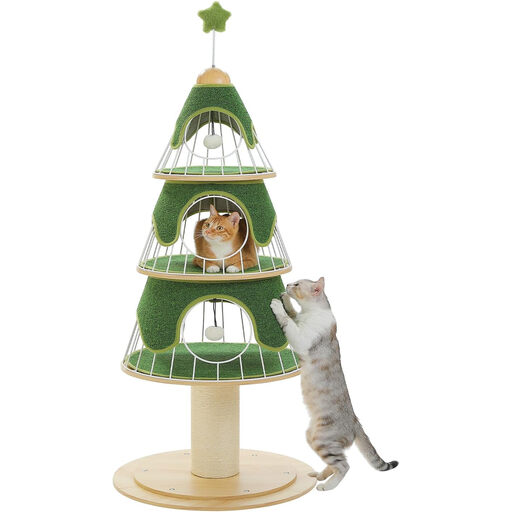
Why it suits this profile: The 130 cm height and 60 × 60 cm base offer a manageable starting point for households looking for a cat tree without immediately opting for a very tall model.
The broad base is clearly specified. The description also mentions a central post measuring 12.5 cm thick and recommends checking the connections and adding wall attachment if necessary.
130 cm high, three levels, three cat houses and sisal covering on the posts. Designed for indoor use.
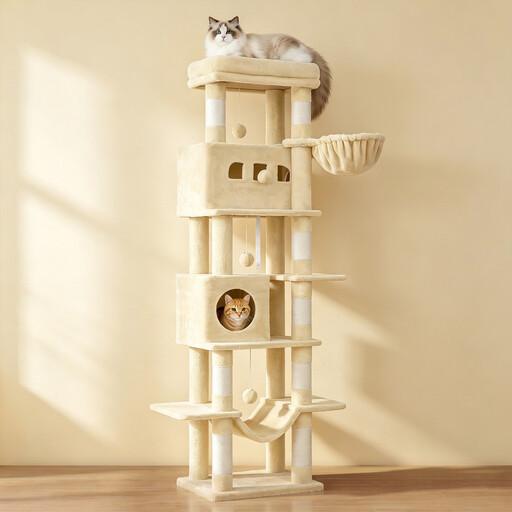
Why it suits this profile: This model combines a tall structure with several resting and play zones. It is ideal for multiple active cats and owners who want plenty of features in a single piece of cat furniture.
The specifications list 17 support posts, eight sisal posts, a double base and a built-in anti-tip lock. A maximum capacity of six cats weighing less than 6.8 kg each is also stated.
212.5 cm high, six levels, two cat houses, a hammock, a 30 cm basket and two washable cushions.
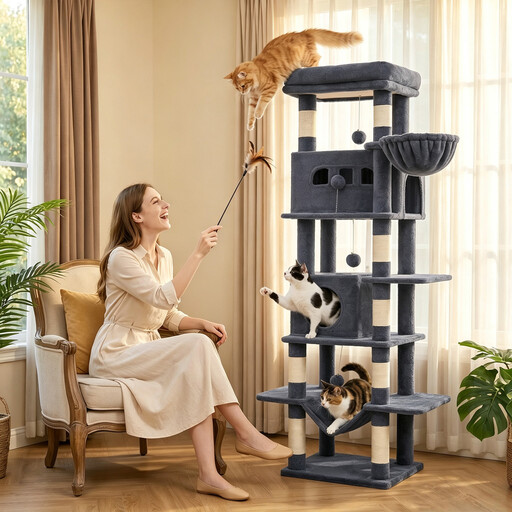
Why it suits this profile: The vertical, space-saving layout is suitable for small flats where floor space is limited but cats still want to climb and relax.
The description mentions a widened, reinforced base and anti-tip features. However, check the stability yourself after assembly on the chosen floor.
Six levels, eight sisal posts, two private spaces, a hammock and a 60 × 40 cm platform with a removable cushion.
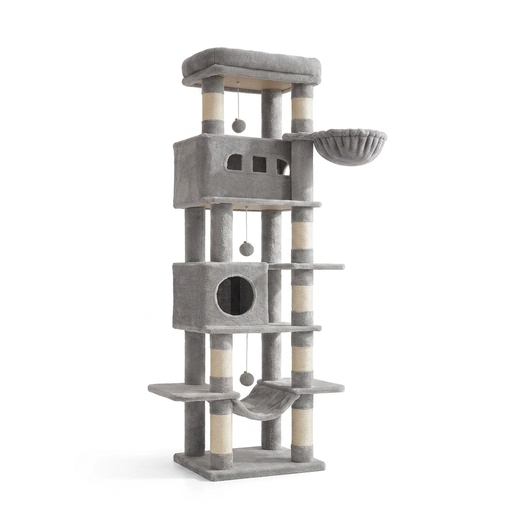
Why it suits this profile: The combination of a spacious platform, a larger cat house, a basket and a hammock provides different resting options for large or sturdy cats.
The product information lists 17 support posts, eight sisal-covered posts, a double reinforced base and an anti-tip feature. The stated capacity is up to six cats weighing 6.8 kg each.
170 cm high, six levels, a 50 × 30 cm platform, a 50 × 40 cm cat house, a hammock and two removable cushions.
We have put together a complete, up-to-date list of products that fully meet these strict selection criteria and the applicable European safety regulations.
Place a tall cat tree in its final position before allowing cats to use it. Assemble all components according to the instructions and retighten the screws after a few days. When choosing a cat tree for kittens and adult cats, check any loose toys carefully: replace hanging balls if the material tears or comes loose.
For everyday maintenance, the following is usually sufficient:
The lifespan depends on how intensively the tree is used, the cats’ weight, the materials and the level of maintenance. Replace a component or stop using the tree if a post becomes loose, a platform cracks or the structure is no longer stable.
Look beyond the height alone. A model with several levels, at least two resting places and multiple scratching zones distributes use more effectively. Also check the dimensions of the base and the maximum weight capacity per cat.
A sturdy, level indoor floor is the starting point. Many cats enjoy a spot with a view, but leave enough distance from windows, doors and fragile furniture. With a very tall cat tree, wall attachment is advisable if the manufacturer provides for it.
Assemble all the components fully, tighten every fastening securely and use an anti-tip strap or wall attachment if available. Then inspect the cat tree regularly, particularly when several cats jump and play on it at the same time.
