
Vandaag of morgen in huis

Kwaliteit gegarandeerd

Welkomstaanbiedingen ontgrendelen: GRATIS bezorging | Tot 80% korting | Gratis 30 dagen JoyPlus-proefperiode
Download de app
A large cat tree for multiple cats needs to offer more than height alone. In a household with several or larger cats, a cat tree is subjected to jumping, climbing, scratching and resting every day. A narrow base, limited resting space or thin sisal rope can quickly cause problems.
The product descriptions of the models below mention features including multiple sisal posts, cat houses, hammocks and anti-tip fittings. Before buying, always check the current dimensions, maximum load, fixing method and included components on the product page.
A tall cat tree takes up relatively little floor space, but height alone says nothing about stability. A tower measuring over two metres needs a wide, weighted base and well-distributed support posts. Also consider where you will place it: a slippery floor, uneven surface or limited space around the tree can make it less safe to use.
A statement such as ‘suitable for multiple cats’ is only useful if it also specifies the number of cats and the maximum weight. Some models, for example, are rated for cats weighing up to 6.8 kg per animal. That does not automatically mean they are suitable for six larger cats of a different weight.
Therefore, check:
A cat tree with cat houses, toys and a hammock may look appealing. However, scratching space remains important. Cats do not always use the same post and, in a multi-cat household, may sometimes share their favourite spot. Multiple sisal posts, spread across different levels, provide more choice and can help redirect scratching away from the sofa or curtains. This is not a guarantee against scratching damage; acclimatisation and your cat’s preferences also play a part.
A six-tier model with a step distance of approximately 20 to 40 cm offers different climbing routes. Smaller distances may be more practical for kittens, older cats or animals that do not jump as high. Check that the levels are wide enough for cats to turn around and land safely. A tall cat tree is not automatically suitable for a large cat if the platforms are narrow.
For large or active cats, these points are relevant:
A sturdy scratching post uses sisal where cats actually scratch and climb. Check the number of sisal-covered posts, the thickness of the posts and how they are attached to the baseboard. A model with 17 support posts may have a structurally different design from a model with just a few load-bearing columns.
Sisal is subject to wear. After assembly, regularly check whether the rope is coming loose and whether the screw connections are still tight. Replace or repair damaged components in accordance with the manufacturer’s instructions.
A cat tree with multiple resting areas reduces the need for cats to share a single platform. Consider a combination of open platforms, enclosed houses, a bed and a hammock. For larger cats, the dimensions of these areas are more important than the number of accessories.
Removable, washable cushions are practical in a Dutch household where hair and dust can quickly build up. Covers can usually be cleaned with a lint roller or vacuum cleaner, but always follow the washing instructions. Hanging toys should be removed as soon as they become damaged or contain loose parts.
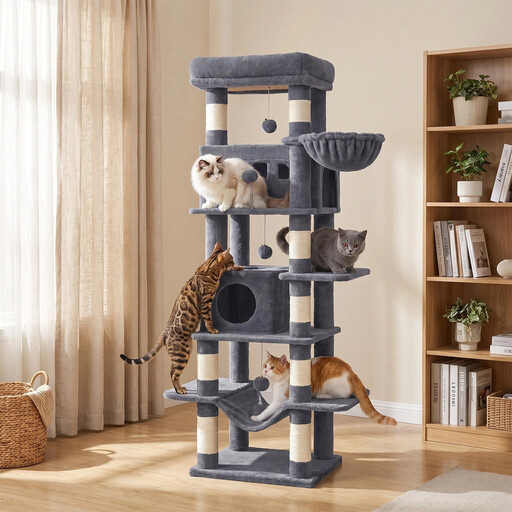
Why it suits this profile: This 170 cm-high model offers six levels, one large and one smaller cat house, a hammock and a bed. It is a practical choice for anyone looking for multiple features without immediately opting for the tallest XXL cat tree.
The product description lists 17 support posts, eight of which are covered in natural sisal, along with a double reinforced base and anti-tip fitting.
170 cm high, eight sisal posts, two removable cushions and a stated capacity of up to six cats weighing no more than 6.8 kg each.
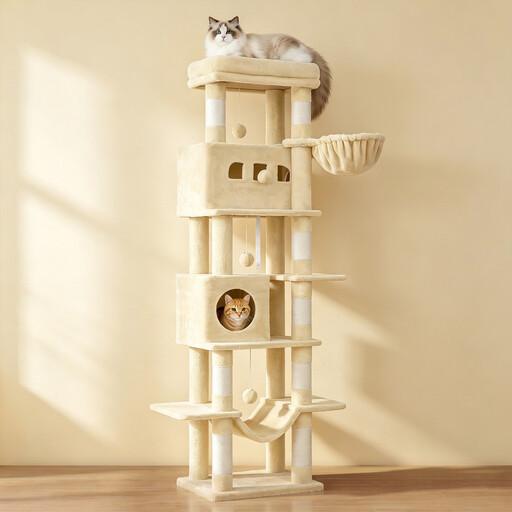
Why it suits this profile: The combination of a height of 212.5 cm, two cat houses, a hammock, a bed and spacious platforms is ideal for households looking to combine plenty of vertical and horizontal resting space.
The stated construction uses 17 thickened support posts, an integrated anti-tip lock and a double base. The stated capacity is up to six cats weighing less than 6.8 kg each.
65×45 cm platform, two enclosed houses, 30 cm cat bed, eight sisal posts and two washable cushions.
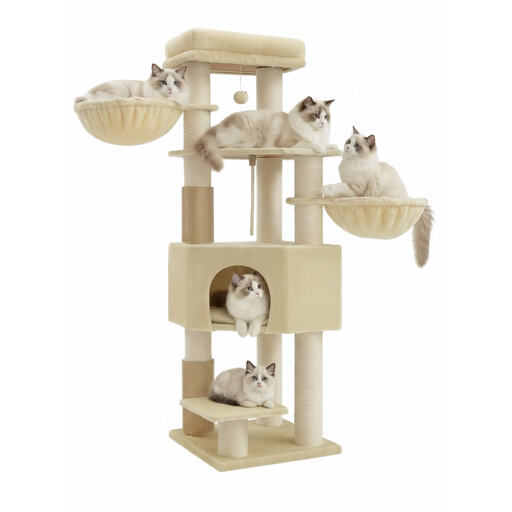
Why it suits this profile: This cat furniture for multi-cat households is designed for intensive daily use, with a brush, nine sisal posts, washable components and a secure wall fixing.
The manufacturer lists an anti-tip kit and instructs users to permanently secure the tower to a load-bearing wall after assembly. This is an important consideration for active cats.
Dimensions of 50×50×160 cm, nine sisal posts, a stated static load of 105 kg and a recommendation for up to five cats weighing no more than 20 kg each.
We have compiled a complete, up-to-date list of products that fully meet these strict selection criteria and the applicable European safety regulations.
Place a large cat tree for multiple cats on a level surface and tighten all connections securely. For models with an anti-tip kit, check that the wall is suitable for mounting. Leave enough clear space around the cat tree for jumping, and do not leave loose cables or fragile objects nearby.
Check regularly:
A cat tree will last longer when cats have multiple scratching zones and damaged components are replaced promptly. Its actual lifespan depends on the materials, assembly, intensity of use and the cats’ weight.
Do not look only at the overall height. For multiple cats, several resting areas, wide platforms and enough sisal posts are important. A model measuring between 160 and 212.5 cm may be suitable, provided the base is stable and the resting areas are appropriate for the size of your cats.
That depends on its dimensions and load limit. Pay particular attention to the width of the platforms, the diameter of the cat bed and the maximum weight per cat. A narrow, tall tower may be less suitable for heavier cats than a slightly lower model with a wide base.
Remove cat hair regularly with a vacuum cleaner or lint roller. Washable cushions and covers should be cleaned according to the care label. Check the sisal posts and screw connections at regular intervals, and stop using the cat tree if any component is damaged or unstable.
