
Vandaag of morgen in huis

Kwaliteit gegarandeerd

Welkomstaanbiedingen ontgrendelen: GRATIS bezorging | Tot 80% korting | Gratis 30 dagen JoyPlus-proefperiode
Download de app
A large cat tree for multiple cats needs to offer more than just a few sisal posts and a soft place to lie. When you have several cats, larger breeds or active climbers, stability, load capacity and a well-planned layout matter more than eye-catching looks.
There are, however, a few common pitfalls:
For a sturdy cat tree, the base is the first thing to check. A wide or double base reduces the risk of wobbling. An anti-tip feature can provide extra support, but it must be fitted correctly.
Place a tall cat tree on a level surface. For models with wall fixing, check that the wall is suitable and that the fittings are used correctly. Product information about load capacity is generally based on a specific load or usage scenario. Treat it as a guideline rather than a guarantee for every home or cat.
When choosing a cat tree for large cats, pay attention to:
A tall cat tree makes use of vertical space, which can make it suitable for a small home. At the same time, the climbing route should remain logical. Platforms that are too far apart are less practical for older, heavier or less agile cats.
A multi-level cat tree provides variety for climbing, playing and resting. Check the dimensions of the lounging platforms too. A 60 × 40 cm platform gives a large cat more room than a small round platform.
A large cat tree measuring around 160 to 212.5 cm also requires sufficient ceiling clearance. Measure the surrounding area as well: cats need room to approach the tree and should not be able to jump into lamps, shelves or windows.
A cat tree with sisal posts helps redirect scratching behaviour to a designated area. According to the product descriptions of the models featured, the number of sisal posts ranges from eight to nine. Check whether the posts are positioned along multiple climbing routes and whether they can be replaced when the sisal becomes worn.
For households with several cats, separate resting zones are useful. A cat tree with a hammock, basket, platform and cat houses gives cats the option of resting at the same time without having to share the same spot. Removable cushions and covers make cleaning more practical. Use a hoover or lint roller to remove loose fur, and regularly check the screws, connections and any damaged parts.
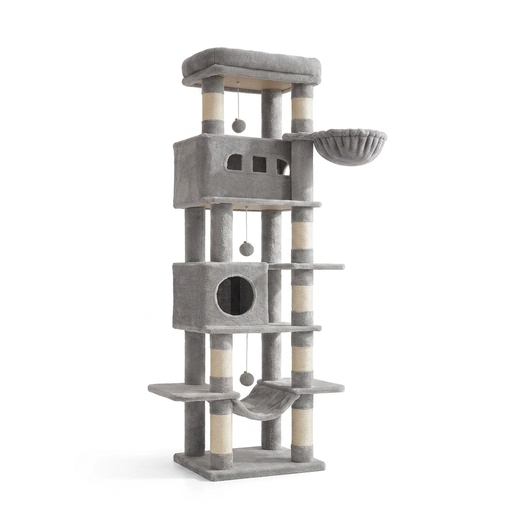
Why it suits this profile: A practical choice for anyone looking for a complete cat tree with six levels, several resting areas and a vertical layout without opting for the largest model.
The description mentions a double reinforced base and anti-tip feature. After assembly, check for yourself that all connections are secure.
170 cm high, six levels, eight sisal posts, two cushions, a hammock and a 30 cm cat basket.
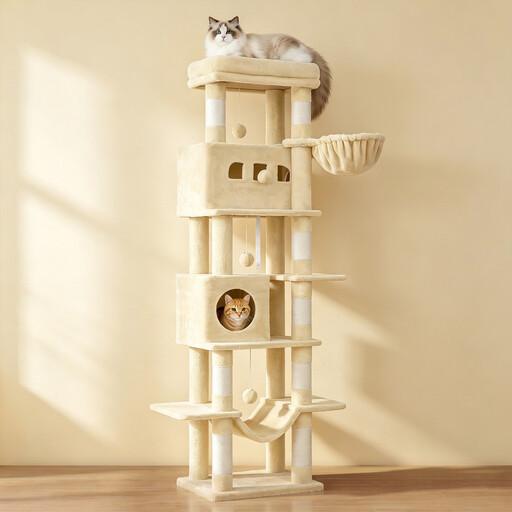
Why it suits this profile: Ideal for a household looking for a tall, complete cat tree with two cat houses, plenty of scratching zones and several places to rest.
The product description refers to a double integrated base and built-in anti-tip lock. The stated usage is for up to six cats, each weighing less than 6.8 kg.
212.5 cm high, six levels, eight sisal posts, two cat houses, a hammock and a basket with a diameter of 30 cm.
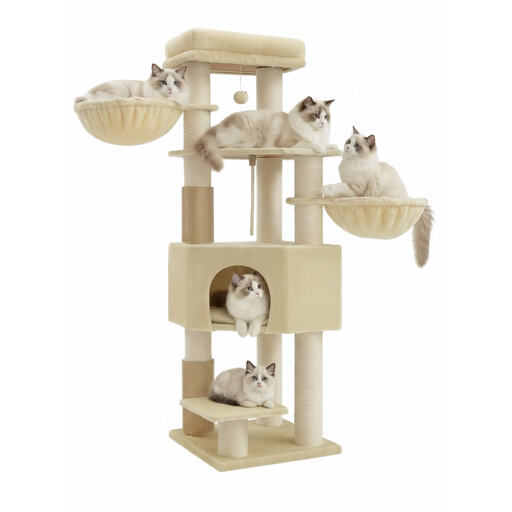
Why it suits this profile: Suitable for active or larger cats, and for owners who want to factor maintenance and wall fixing into their purchasing decision.
The instructions state that the tower must be permanently secured to a load-bearing wall after assembly. This is important when cats jump on it energetically.
160 cm high, nine sisal posts, a large lounging area, cat cave, baskets, removable mats and a stated static load capacity of 105 kg.
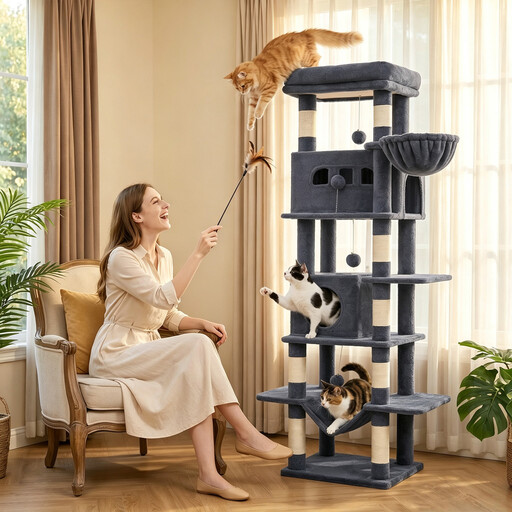
Why it suits this profile: Its vertical design takes up little floor space while providing a large viewing platform, two caves, a hammock and a cat basket.
The description mentions a reinforced base and anti-tip features. The removable cushions also reduce the maintenance required.
A 60 × 40 cm platform, eight sisal posts, six levels and a design that, according to the product description, is suitable for five to six cats.
We have put together a complete, up-to-date list of products that fully meet these strict selection criteria and the applicable European safety regulations.
Do not look only at the height. Also check the width of the base, the size of the platforms and the number of separate resting areas. For several cats, two cat houses, a hammock and a spacious platform are more practical than one large resting area. Also measure the available ceiling and floor space before ordering.
Remove fur regularly with a hoover or lint roller. Where possible, choose removable and washable cushions. Check the sisal for loose threads and trim away any frayed strands. Retighten screws and connections over time, especially if the cat tree is used daily by several cats.
Its lifespan depends on the cats’ weight and activity levels, the quality of assembly and the maintenance it receives. A model with several sisal posts distributes wear more effectively. Replace damaged toys, loose upholstery or unstable parts promptly, and use wall fixing when required by the product instructions.
