
Vandaag of morgen in huis

Kwaliteit gegarandeerd

Welkomstaanbiedingen ontgrendelen: GRATIS bezorging | Tot 80% korting | Gratis 30 dagen JoyPlus-proefperiode
Download de app
A large cat tree for multiple cats needs to do more than provide somewhere to scratch. In a household with large, stocky or active cats, plenty of places to rest, sturdy joints and a wide base are important. Yet many cat trees look more spacious and stable on paper than they are in practice.
So don’t focus only on the number of levels or the colour of the covering. The biggest differences often lie in the supporting structure, the size of the resting areas and how the cat tree is secured.
A tall cat tree takes up little floor space, but a narrow base can wobble when cats jump on it. For models measuring 150 cm or more, an anti-tip device is a sensible choice. Some manufacturers also recommend securing the cat tree to a load-bearing wall.
So check:
A tall cat tree without a good base isn’t automatically suitable for multiple cats.
A cat tree may have several platforms, cubbies and hammocks, yet still be too cramped for an adult cat. When choosing a cat tree for large cats, check the length and width of the main resting areas. For example, a 60 × 40 cm platform offers more room to move around than a small round perch, but check the dimensions of the cubbies and beds too.
For multiple cats, it’s also useful to have separate resting areas. That way, cats can give each other space while resting at different heights.
Plenty of sisal posts are useful, but where they’re positioned matters just as much. Scratching surfaces on different levels give cats more opportunities to scratch vertically or horizontally. Check the thickness of the posts too, and make sure the sisal is wrapped securely around them.
According to the product descriptions of the models available, sisal posts are designed to encourage cats to scratch the cat tree. This can help make sofas and curtains less appealing, although every cat behaves differently.
A multi-level cat tree measuring around 160 to 212.5 cm offers plenty of vertical space. That’s handy in homes where you want to keep the floor clear. As well as the height, check:
Levels spaced around 20 to 40 cm apart may be easier for different cats to access than a design with big jumps between platforms. Wide intermediate platforms are useful for older cats or those who aren’t as agile.
A sturdy cat tree usually has thick panels, securely fitted posts and a reinforced base. Check the stated static weight capacity, but don’t treat it as a guarantee for every situation. Jumping, running and playing together put different stresses on the structure than simply lying still.
A weight capacity of 75 or 105 kg is a product specification taken from the relevant product description. Even so, place a tall tree on a level surface and check the screws, joints and platforms regularly.
Plush coverings collect hair and dust. Removable cushions, washable covers and surfaces that can be cleaned with a vacuum cleaner or lint roller make everyday care easier. Check the washing instructions before getting any parts wet.
Replace or remove hanging toys as soon as they come loose or become damaged. Trim fraying sisal fibres, and stop using the cat tree if a platform, post or cubby cracks.
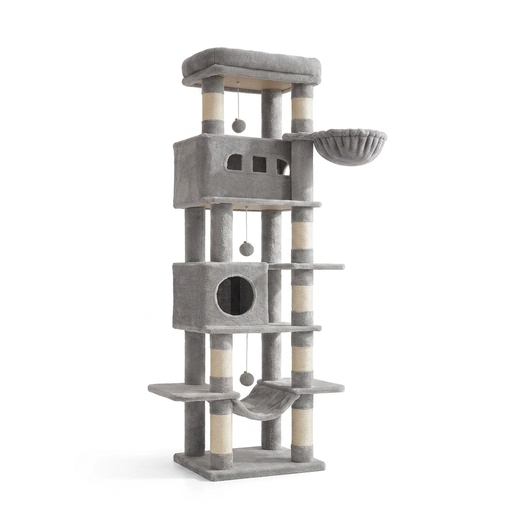
Why it suits this profile: This six-level cat tree combines several resting spots with a hammock, bed and cat cubbies. According to the product description, it has 17 support posts, 8 of which are covered in sisal.
The product specifications mention a double-reinforced base and an anti-tip device, so you don’t have to rely on height alone.
Measures 170 × 50 × 40 cm, with two removable cushions and a 50 × 30 cm platform.
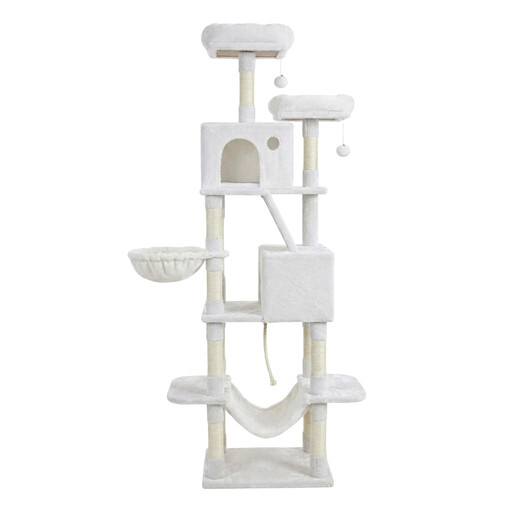
Why it suits this profile: This extra-tall cat tree has two platforms, two cat cubbies, a bed and a hammock. The product description lists 13 natural sisal posts and a total static load capacity of up to 75 kg.
The recommended wall fixing and wide, reinforced base help reduce the risk of a tall cat tree wobbling.
206 cm tall, with 13 sisal posts and several separate resting areas for a multi-cat household.
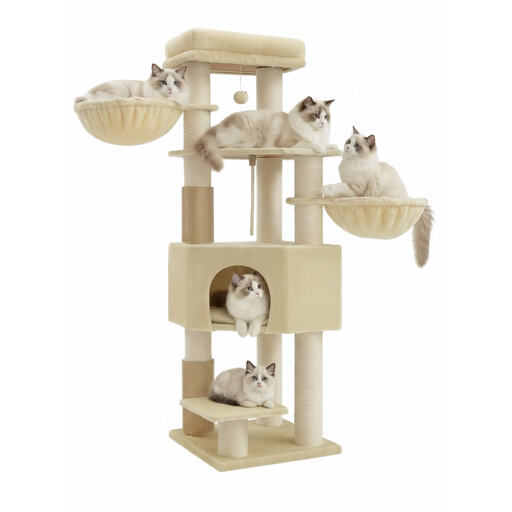
Why it suits this profile: The combination of 9 sisal posts, a built-in brush, a cubby and removable mats makes it a good fit for intensive everyday use.
The easy-care features and required wall fixing, as set out in the product instructions, help limit problems caused by hair, wear and movement.
Measures 50 × 50 × 160 cm, with a stated static load capacity of 105 kg and washable parts.
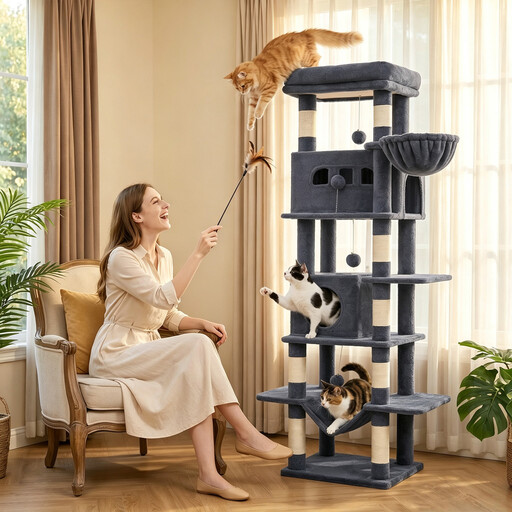
Why it suits this profile: Its vertical layout takes up little floor space and includes two cat cubbies, a hammock and a 60 × 40 cm platform.
According to the product description, the wide, reinforced base and anti-tip features are designed to limit movement when cats climb and jump.
212.5 cm tall, with six levels, 8 sisal posts and a space-saving design.
We’ve put together a complete, up-to-date list of products that meet these strict selection criteria and the applicable European safety regulations.
Don’t look at the height alone. Check the number of resting spots, the dimensions of the platforms and cubbies, and the weight capacity. For large cats, wide resting areas and several separate zones are usually more practical than lots of small perches.
Place the tree level on a non-slip floor and use the anti-tip kit supplied, if there is one. Wall fixing is often recommended for tall models. Also check all the joints regularly.
Its lifespan depends on the number of cats, their weight, how often it’s used and how well it’s maintained. Sisal wears down with scratching, while plush can be damaged by jumping or biting. A model with replaceable toys, washable cushions and easy-to-reach screw joints is simpler to maintain.
