
Vandaag of morgen in huis

Kwaliteit gegarandeerd

Welkomstaanbiedingen ontgrendelen: GRATIS bezorging | Tot 80% korting | Gratis 30 dagen JoyPlus-proefperiode
Download de app
A large cat tree for multiple cats needs to offer more than just height. In a multi-cat household, the furniture is used more intensively: cats jump, scratch, sleep and sometimes look for their own space at the same time. A narrow post with a small platform can therefore quickly become unstable or go unused.
When comparing models, don’t just look at the number of levels or an attractive product photo. The key differences are often found in the construction, the size of the resting areas and how the furniture is secured to the wall.
A cat tree measuring 160 or 212.5 cm takes up little floor space, but its high centre of gravity requires a sturdy base. A narrow bottom plate can cause movement when a cat climbs enthusiastically. Therefore, check:
A stable cat tree should be placed on a level surface. An anti-tip kit is not a substitute for correct assembly.
A cat scratching post with sisal is only practical when cats can reach the material along their climbing routes. Check how many posts are actually wrapped in sisal and where they are positioned. Vertical sisal posts are suitable for full-length scratching, while horizontal or angled sections may appeal to different preferences.
Product information may state that sisal furniture helps protect against scratching damage. This describes its intended use, not a guaranteed result. Cats may continue to spread their scratching behaviour across several places in the home.
A small hammock or narrow top platform is not automatically suitable for large cats. Look at the size of the resting areas and compare them with your cat’s body length. In a cat tree for large cats, wide platforms, sturdy connections and sufficient space between levels are more important than overall height alone.
For multiple cats, distribution is also important. A combination of cat houses, a hammock, a basket and open platforms reduces the chance of all the cats choosing the same resting place.
Always check whether the stated load capacity refers to a static load or the recommended number of cats. These are different specifications. Furniture described as suitable for multiple cats still needs to be assembled correctly and checked regularly.
A double or widened base helps distribute the weight more evenly. An anti-topple lock or wall mounting may also be relevant, particularly with a tall cat tree. Do not place the furniture directly next to a window, radiator or open fire.
A multi-level cat tree is more versatile when cats do not have to make only large jumps. Spacing of around 20 to 40 cm between steps can be practical for many cats, but age, weight and mobility vary from one animal to another.
Also consider the route to the top. A platform that can only be reached via a steep or narrow post may be used less by older or heavier cats. A tiered layout often provides more choice.
Plush feels soft, but it collects hair. Removable cushions, washable covers and surfaces that can be cleaned with a vacuum cleaner or lint roller make everyday maintenance easier.
Check hanging toys regularly. As soon as a ball, elastic or sisal wrapping comes loose, remove the component. Tighten the fixings after assembly and regularly inspect the posts, platforms and baskets for signs of wear.
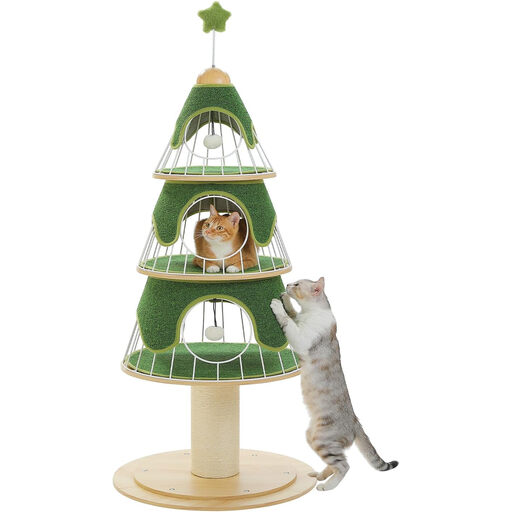
Why it suits this profile: This compact cat tree is 130 cm tall and has three levels, with three cat houses per level. The base measures 60 × 60 cm, making it potentially suitable for households looking for their first indoor cat tree.
The wide base and central sisal post provide more specific stability information than a height claim alone. The product information also recommends assembly with an anti-tip feature where available.
130 cm tall, 60 × 60 cm base, three levels and a 12.5 cm-thick central post with sisal covering.
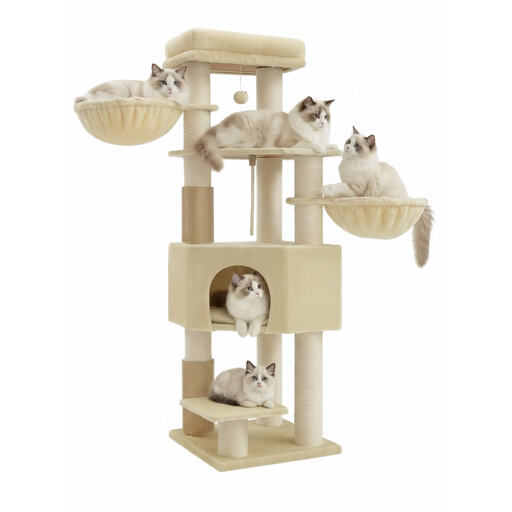
Why it suits this profile: This 160 cm cat tree combines a large resting area, a cat house, baskets and an integrated brush. It measures 50 × 50 × 160 cm and has a stated static load capacity of 105 kg.
The specifications list nine sisal posts, an anti-tip kit and mandatory permanent wall mounting. This makes it clear which safety step is required during assembly.
Nine sisal posts, removable mats, an integrated brush and a maximum static load capacity of 105 kg according to the product information.
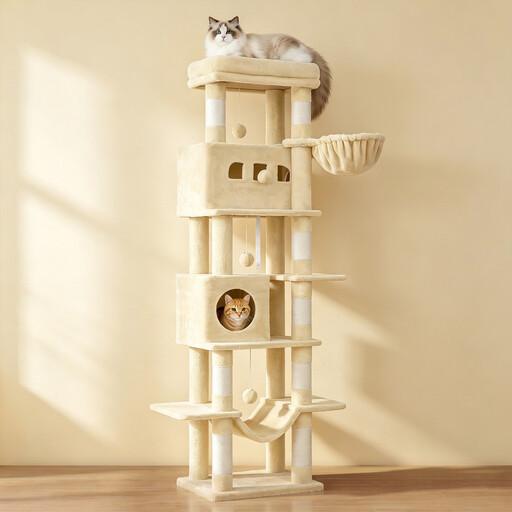
Why it suits this profile: Standing 212.5 cm tall, with six levels, two cat houses, a hammock and a 30 cm basket, this model is designed for active households with multiple cats.
According to the product description, the six levels are spaced approximately 30 to 40 cm apart. The double base and integrated anti-topple lock are designed to limit movement during use.
Eight sisal posts, two cat houses, a hammock, two washable cushions and a wide 65 × 45 cm platform.
We have compiled a complete, up-to-date list of products that fully meet these strict selection criteria and the applicable European safety regulations.
Assemble a large cat tree loosely at first, then check that all the parts fit together straight and securely. Only fully tighten the connections once the structure is correctly aligned. Place the furniture on a level, dry floor and attach any supplied anti-tip kit according to the instructions.
Allow cats to get used to the new furniture gradually. A blanket or toy carrying a familiar scent can help make the different levels more appealing. Check the screws and connections again after a few days. If you notice visible cracks, loose posts or unstable platforms, stop using the tree until the part has been replaced or repaired.
Consider your cats’ weight and size, not just their number. Choose several separate resting areas, a wide base and plenty of scratching space. For large or active cats, wide platforms and thick posts are generally more practical than a compact model with lots of small accessories.
Its lifespan depends on assembly, intensity of use, moisture, weight and maintenance. Sisal wears down through scratching, while plush can collect hair and dirt. Regularly retighten the connections and replace loose toys or damaged parts immediately.
Not every model has the same assembly requirements. With tall or narrow models, wall mounting may be strongly recommended or mandatory according to the product instructions. Check this before buying and use only a suitable, load-bearing fixing point.
