
Vandaag of morgen in huis

Kwaliteit gegarandeerd

Welkomstaanbiedingen ontgrendelen: GRATIS bezorging | Tot 80% korting | Gratis 30 dagen JoyPlus-proefperiode
Download de app
A large cat tree for multiple cats needs to offer more than just height. In a household with several or heavier cats, your choice should focus on stability, enough resting areas and scratching options that can withstand daily use. A tall cat tree that wobbles, has sleeping areas that are too small or quickly comes loose will ultimately offer little value.
So before you order, look out for these common pitfalls.
A 200 cm cat tree may look impressive, but height alone says nothing about how practical it is. If the levels are too close together, the jumps are awkward or the base is narrow, cats may not be able to move around comfortably. Large, older or less agile cats in particular benefit from a multi-level cat tree with clear, manageable steps between levels.
Many models are marketed as XXL cat trees for large cats, even though the top platforms or houses offer barely enough room to turn around and stretch out. So check the dimensions of each sleeping area individually. A wide platform measuring, for example, 60 × 40 cm or 65 × 45 cm provides more practical space than a general description such as ‘extra large’.
When only one post is covered in sisal, several cats cannot use it comfortably at the same time. A cat tree with sisal posts spread across different levels provides more dedicated scratching areas. Also look for a wide, reinforced base and a supplied anti-tip mechanism. A product description may promise stability, but always check that the construction is genuinely suitable for your cats’ weight and behaviour.
A tall cat tree makes use of vertical space and can be particularly useful in flats. Measure the ceiling height beforehand and take skirting boards, sloping ceilings and walkways into account. The models discussed here range from approximately 160 to 212.5 cm in height.
The distance between levels is just as important. Product information for some models states a gap of around 20 to 30 cm, while others offer approximately 30 to 40 cm. Smaller gaps may be more accessible, while larger ones are better suited to cats that enjoy jumping. Consider your cats’ age, mobility and build.
A sturdy cat tree needs more than thick posts. Check:
The SONGMICS model states a maximum static load of 105 kg and requires permanent attachment to a load-bearing wall. This is an important difference from models that mention an integrated anti-tip feature. Place a tall cat tree on a level surface and use the supplied fixings according to the instructions.
Sisal is designed for scratching, but where it is placed determines how useful it is. Eight sisal posts spread across climbing routes may be more practical than several posts in one location. Also check whether the cushions are removable and washable. Plush surfaces collect hair; a vacuum cleaner or clothes roller can help with daily maintenance.
A cat tree with cat houses and a cat tree with a hammock offers more variety when it comes to resting. Privacy is useful in multi-cat households, but houses need to be large enough for the animals using them. Hanging toys are appealing for play, but remove any parts as soon as they start to fray or come loose.
The selection below is based on the dimensions, materials, accessories and safety features stated in the product information. Always check the current product specifications, stock availability and assembly instructions before buying.
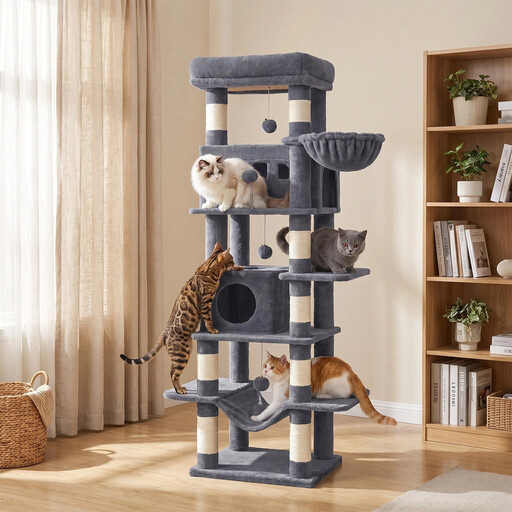
Why it suits this profile: A practical choice for anyone looking for several features without opting straight for the tallest model. This cat tree is 170 cm high and has two houses, a hammock and a basket.
The product description lists 17 support posts, eight of which are covered in sisal, along with a double reinforced base and anti-tip feature.
170 cm high, with a 50 × 30 cm platform, two removable cushions and a removable top platform.
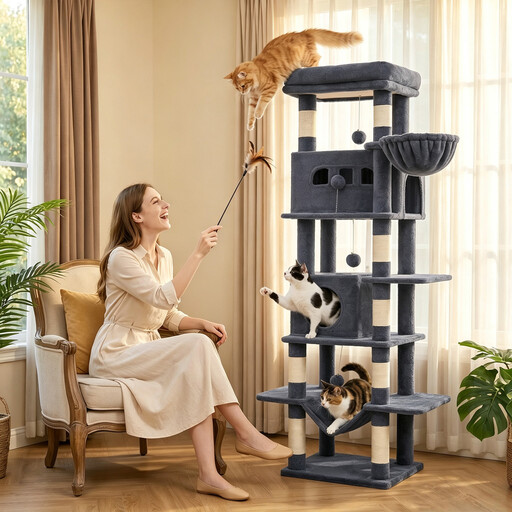
Why it suits this profile: Suitable for households looking to combine plenty of vertical space, multiple resting areas and a low-maintenance design.
The specifications list six levels, a 60 × 40 cm platform, eight sisal posts, two dens and an anti-tip feature.
Removable cushions, space-saving vertical design and accessories for assembly, according to the product description.
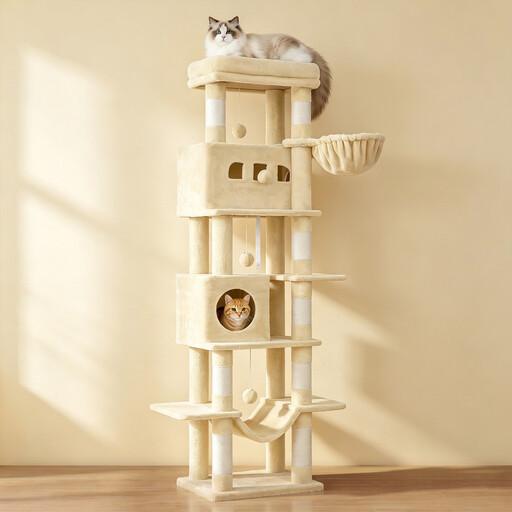
Why it suits this profile: Designed for active cats and multi-cat households that need several climbing, play and resting areas.
The product information lists a double integrated base, a built-in anti-tip lock and a stated capacity of up to six cats weighing under 6.8 kg each.
212.5 cm high, with two cat houses, a hammock, a 30 cm basket and eight sisal zones.
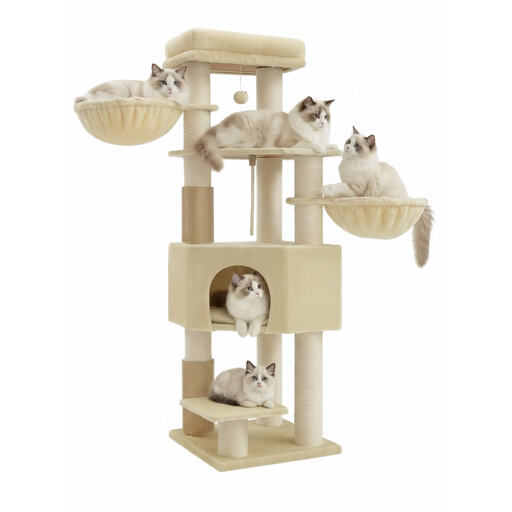
Why it suits this profile: Ideal for owners looking for a compact cat tree with scratching posts, washable parts and additional maintenance features.
The product information lists nine sisal posts, a reinforced base and an anti-tip kit. Permanent wall attachment is required according to the instructions.
Measures 50 × 50 × 160 cm and includes a removable cover and mat, plus a built-in grooming brush according to the product description.
We have put together a complete, up-to-date list of products that fully meet these strict selection criteria and the applicable European safety regulations.
Don’t look at height alone. Make sure it also has several sleeping areas, wide platforms and different scratching zones. For large cats, a sleeping area of approximately 50 × 30 cm or larger is more practical than a narrow platform. Also check the stated maximum weight and number of animals.
Place the cat tree on a level floor, tighten all the connections securely and check them again after the first few weeks of use. Use a supplied anti-tip strap or wall fixing if the instructions require it. Do not place the cat tree on a slippery rug that could move.
Its lifespan depends on the number of cats, their weight, scratching habits and the quality of the connections. Regularly check the sisal, hanging toys, cushions and screws. Replace or repair parts as soon as they start to fray, split or come loose. This helps prevent an initially suitable stable cat tree from becoming less reliable.
