
Vandaag of morgen in huis

Kwaliteit gegarandeerd

Welkomstaanbiedingen ontgrendelen: GRATIS bezorging | Tot 80% korting | Gratis 30 dagen JoyPlus-proefperiode
Download de app
A large cat tree for multiple cats needs to do more than look impressive. Several cats often use different parts of it at the same time: one may want to climb, while another is looking for a quiet place to sleep. For large or heavy cats, a narrow base, thin posts or loose joints can quickly become a problem.
So don’t just look at the number of platforms. Check the dimensions, stated weight capacity, scratching materials and stability. That way, you can avoid a cat tree that wobbles after a few months, goes unused or offers little protection for your furniture against scratches.
A tall scratching post may have several levels, but the resting areas might be too small for adult cats. Check the dimensions of the platforms, baskets and hideaways. A 50 × 30 cm platform offers a very different experience from a small lookout platform.
The distance between levels matters too. A cat tree with multiple platforms is more practical if cats can move between levels without having to make big jumps.
A tall scratching post has to withstand more movement. If the base is narrow or lightweight, the structure may wobble when a cat jumps up. Check whether the product has a wide base, a double baseboard or an anti-tip feature.
Place a tall cat tree on a level surface. If you have a particularly active group of cats, securing it to the wall may be a good idea, provided the product instructions allow this.
A soft cat tree isn’t automatically suitable for scratching. Look for sisal posts at multiple heights, so cats can scratch both vertically and while climbing. Also check that the sisal is wrapped securely around the posts and that replacement toys are available.
Some models’ product descriptions state that parts of the scratching material or hanging toys can be replaced. Always check the latest product information before ordering.
For multiple cats, a combination of height and floor space is important. A model that is 170 cm tall with six levels offers different options from a compact 74 cm cat tree. Look out for:
A stated weight capacity doesn’t guarantee that the tree won’t move in every situation. Spread out the resting spots and, after assembly, check that all the joints are secure.
For a sturdy scratching post, thick posts aren’t the only thing to consider. Look at the baseboard, joints and any wall fixings too. A double or reinforced base can help keep the centre of gravity low.
An anti-tip strap or similar feature is especially useful on tall models. Fit it according to the instructions and regularly check that the screws haven’t come loose.
A good indoor cat tree combines several features:
If the covering is fluffy, consider how easy it is to maintain. A surface that can be cleaned with a vacuum cleaner or lint roller is more practical in a household with multiple cats.
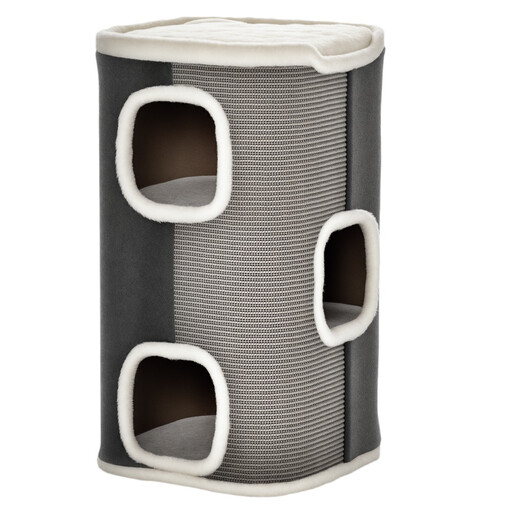
Why it suits this type of buyer: At 74 cm tall with a footprint of 40 × 40 cm, this compact model is easier to fit into a smaller flat or a room with limited floor space.
The product name and specifications mention both plush and natural sisal. It also has two large connected openings and three play areas, rather than just one small resting platform.
Compact size, three levels, two openings and sisal for scratching.
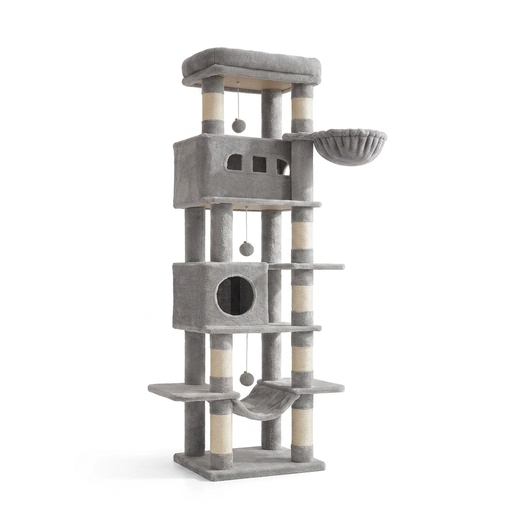
Why it suits this type of buyer: This model combines six levels with two cat hideaways, a hammock, a 30 cm basket and two removable cushions. This gives multiple cats a choice of places to rest and climb.
The specifications list 17 support posts, eight of which are wrapped in sisal, as well as a widened double base and an anti-tip feature. The stated guideline is a maximum of six cats, each weighing 6.8 kg.
170 cm tall, six levels, eight sisal posts, two hideaways, a hammock and washable cushions.
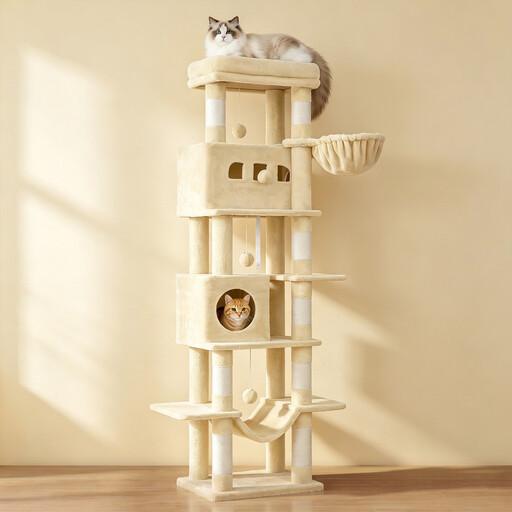
Why it suits this type of buyer: At 212.5 cm tall, this six-tier design is aimed at households with several active cats and plenty of demand for climbing, scratching and separate places to rest.
The description lists 17 thickened support posts, eight sisal posts, a double base and an anti-tip lock. It also has two hideaways, a hammock and several cushions.
212.5 cm tall, eight sisal posts, two cat hideaways, a hammock and a 65 × 45 cm platform.
We’ve put together a complete, up-to-date list of products that meet these strict selection criteria and the applicable European safety regulations.
Don’t place a large cat tree right next to a radiator or where it blocks a walkway. Cats may enjoy sitting by a window, but make sure the structure doesn’t rub against an opening window or curtain.
Retighten the screws a few days after assembly. After that, check the joints, sisal wrapping and anti-tip fixing every month. Washable cushions and removable parts make cleaning easier. Replace a part if the sisal comes completely loose or a platform becomes damaged.
It depends on the number of cats, their weight and the space available. For several adult cats, multiple resting spots, a wide base and different scratching areas matter more than height alone. Always check the stated dimensions and weight limit.
Assemble all the parts according to the instructions on a level floor. Use the anti-tip feature supplied and, if the instructions allow, secure the tree to the wall. Check the screws and joints regularly.
Its lifespan depends on how intensively it’s used, your cats’ weight, the materials and how well it’s maintained. A model with several sisal posts may stay in use for longer if the wear is spread across them. Before deciding to replace a part, check the base, posts and resting platforms.
