
Vandaag of morgen in huis

Kwaliteit gegarandeerd

Welkomstaanbiedingen ontgrendelen: GRATIS bezorging | Tot 80% korting | Gratis 30 dagen JoyPlus-proefperiode
Download de app
A large cat tree for multiple cats needs to offer more than a tall post with a few platforms. In a household with several cats, large cats or active cats, climbing, scratching, playing and resting can all happen at once. A tree that’s too small or wobbly can quickly be ignored, damaged or unsafe to use.
So don’t focus only on the number of levels or how it looks. The base, where you place it, and how the resting and scratching areas are arranged are what make a large cat tree practical.
A model measuring 168 cm to well over 212 cm offers plenty of vertical space, but a high centre of gravity puts greater demands on the base. A wide base plate helps, but it doesn’t guarantee that the tower won’t tip over if a cat jumps onto it from the side.
So check:
For tall models, wall mounting is strongly recommended. This is especially important with multiple cats, heavier cats and active climbers.
A product may have six or seven levels and still not offer enough room for large cats. Narrow platforms and small houses are less likely to be used. So check the dimensions of the resting areas, not just the total number of levels.
A platform measuring, for example, 60 × 40 cm or 65 × 45 cm gives a larger cat more room to turn around and stretch out. Several resting spots are also useful when cats want to find their own space.
A scratching post with cat houses and toys may look appealing, but check where the sisal is positioned. Scratching surfaces should be easy to reach from the routes cats use to move around. It’s also worth checking whether the posts are thick enough to support climbing.
A model with eight to thirteen sisal posts spreads scratching across the structure more effectively. Also check whether parts can be replaced, and regularly inspect the ropes, hanging toys, screws and joints.
An XXL cat tree measuring 170 cm or more is especially suitable for cats that enjoy climbing and surveying their surroundings. A shorter cat climbing tower may be more practical in a home with limited ceiling height, or for cats that find jumping more difficult.
Check the distance between levels. A layout with steps of around 20 to 40 cm can make climbing up and down easier. For kittens, older cats or those that move cautiously, wide intermediate platforms and a less steep route are practical.
A stated weight capacity is usually a static load. That doesn’t automatically mean the same load is suitable for several cats jumping at once. Use the figure as a guide, and also look for:
Product 1 lists a total static load of up to 75 kg. Product 4 lists a total static load of up to 65 kg. These figures shouldn’t be taken as a guarantee for every movement or situation.
Plush feels soft, but it collects hair. Removable cushions are therefore useful. Cleaning surfaces with a lint roller or vacuum cleaner helps prevent dirt from building up. Place a large scratching post indoors on a dry, level surface, away from radiators, open flames, loose cables and window-blind cords.
According to the product information for the models mentioned, screws and joints should be checked regularly. Stop using the tree if a platform is cracked, a post comes loose or a hanging part is damaged.
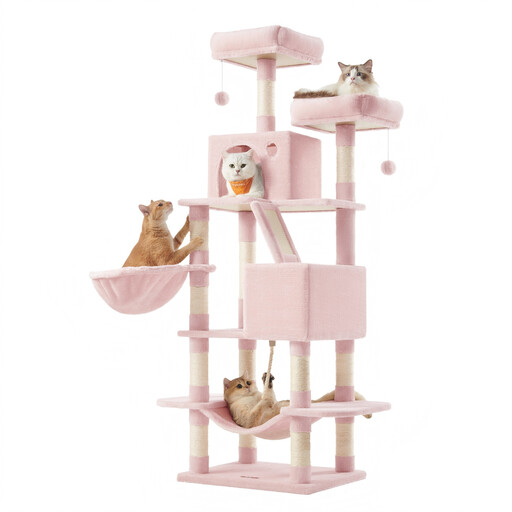
Why it suits this type of household: This 168 cm-high multi-level scratching post has five levels, two houses, a basket and a hammock, without taking up as much floor space as a very wide cat tree.
The product information lists a reinforced base, an anti-tip device and 13 sisal posts, plus a sisal ramp. The instructions state that it still needs to be fixed to the wall.
168 cm high, 13 scratching posts, two houses, a basket and a hammock; stated static load of up to 65 kg.
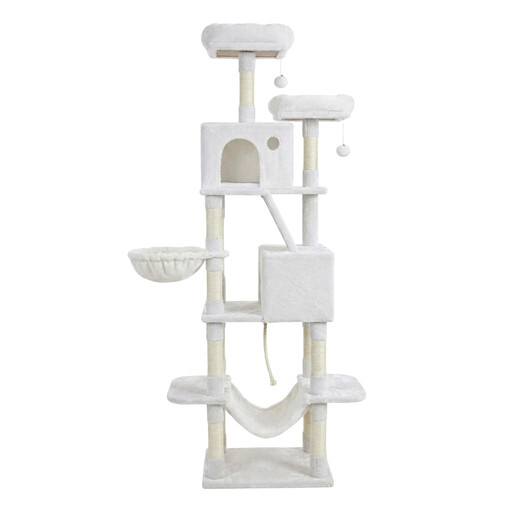
Why it suits this type of household: A household with several cats gets plenty of vertical space and a choice of resting spots, including two cat houses, a basket and a hammock.
The structure has 13 posts wrapped in natural sisal and a reinforced base. Given its height, it’s important to fit the included anti-tip kit.
206 cm high, two platforms, two houses, a basket and a hammock; stated total static load of up to 75 kg.
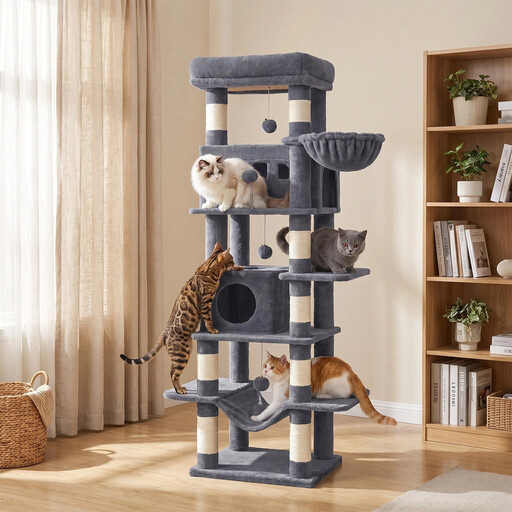
Why it suits this type of household: This cat climbing tower combines six levels with two cat houses, a large basket, a hammock and two removable cushions.
The double reinforced base and anti-tip device are designed to reduce wobbling. Eight of the 17 support posts are covered in natural sisal.
Six levels, a 50 × 30 cm platform, two houses, a hammock and washable cushions; listed as suitable for up to six cats weighing 6.8 kg each.
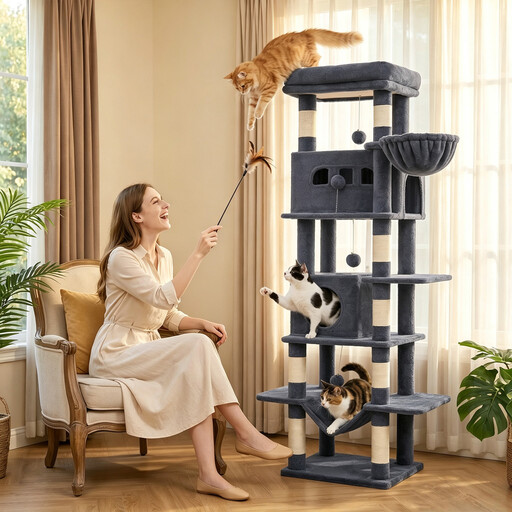
Why it suits this type of household: The vertical design takes up relatively little floor space and offers a wide platform, two cat caves and a hammock for households with multiple cats.
The base is wider and reinforced, and anti-tip features are included. The 60 × 40 cm resting area means cats aren’t limited to narrow platforms.
212.5 cm high, six levels, eight sisal posts, two caves and a large platform with a removable cushion.
We’ve put together a complete, up-to-date list of products that meet these strict selection criteria and the current European safety requirements.
Consider the number of cats, their weight and their behaviour. For several or active cats, a model with multiple resting spots, wide platforms and several sisal posts is more practical than one with a single central resting area. Also check the available ceiling height and leave clear space around the base.
Place the cat tree on a level, non-slip surface and follow the assembly instructions. Use the included anti-tip kit if there is one. Wall mounting is strongly recommended for a tall scratching post. After assembly, and regularly thereafter, check all the screws, joints and support posts.
Its lifespan depends on the number of cats, their weight, how often it’s used and how well it’s maintained. Sisal wears out more quickly when several cats scratch it every day. A structure with replaceable parts may be more practical. Vacuum the covering regularly, and replace or repair damaged parts before letting the cats use the tree again.
