
Vandaag of morgen in huis

Kwaliteit gegarandeerd

Welkomstaanbiedingen ontgrendelen: GRATIS bezorging | Tot 80% korting | Gratis 30 dagen JoyPlus-proefperiode
Download de app
A large cat tree for multiple cats needs to offer more than just height. In a household with several or heavy cats, a cat tree has to cope with climbing, jumping, scratching and resting every day. A base that is too narrow, thin posts or too few resting areas can quickly lead to frustration.
When comparing models, don’t just look at the number of levels or the overall appearance. The following pitfalls are common:
With a stable cat tree, the base and centre of gravity matter more than the overall height alone. Therefore, check:
A tall cat tree should be placed on a level surface. With active or heavy cats, additional wall anchoring may be advisable, even if the product has an anti-tip mechanism. Regularly check the screws, connections and posts for any looseness.
A cat tree with sisal posts offers more ways to use it when the sisal is distributed across different heights. Cats do not all scratch in the same place or position. Look at:
Eight sisal posts, as found on some of the models below, provide more designated scratching zones than a single central scratching surface. This may help redirect your cats’ attention from sofas and curtains to their indoor cat furniture. It is no guarantee that furniture will never be used again, so place the cat tree somewhere your cats already enjoy spending time.
A tall cat tree is most useful when the levels are sensibly arranged. For many cats, a distance of around 20 to 40 cm between levels may be easier to manage than large jumps. Also consider the width of the platforms, especially when choosing a cat tree for large cats.
Several resting options are useful for multiple cats:
A cat tree with cat houses and a cat tree with a hammock gives cats the option of avoiding one another. This is useful when cats prefer different places to sleep.
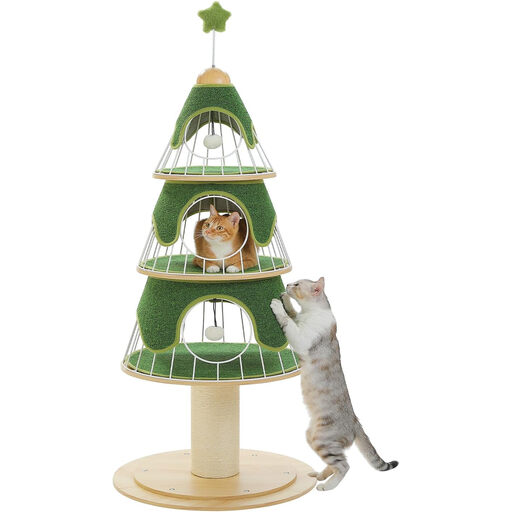
Why it suits this profile: This model is 130 cm tall and has a 60 × 60 cm base. It is a straightforward entry-level choice for indoor use, for example in a smaller household or for cats that mainly rest and scratch.
The wide base and central sisal post make the structure less reliant on a narrow footprint. The product information does advise checking the connections and using an anti-tip device where available.
130 cm tall, three levels, three cat houses, a 60 × 60 cm base and a 12.5 cm-thick sisal-covered post.
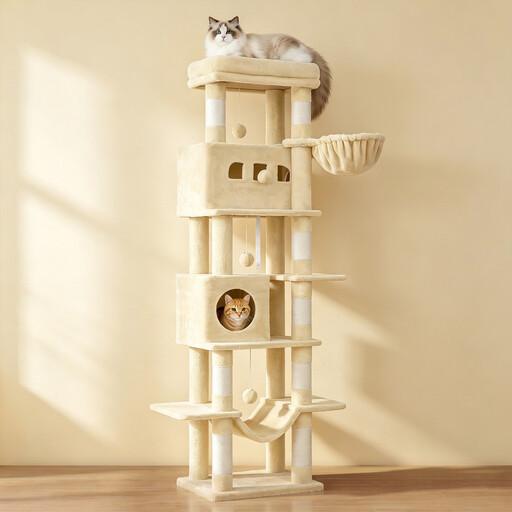
Why it suits this profile: The six levels and 212.5 cm height provide plenty of vertical space. The combination of two cat houses, a hammock, a basket and a wide platform suits a household where cats alternate between play and rest.
The product description lists 17 reinforced posts, a double integrated base and a built-in anti-tip lock. The stated capacity is a maximum of six cats, each weighing less than 6.8 kg.
212.5 cm tall, eight sisal posts, two cat houses, a 65 × 45 cm platform, a hammock and washable cushions.
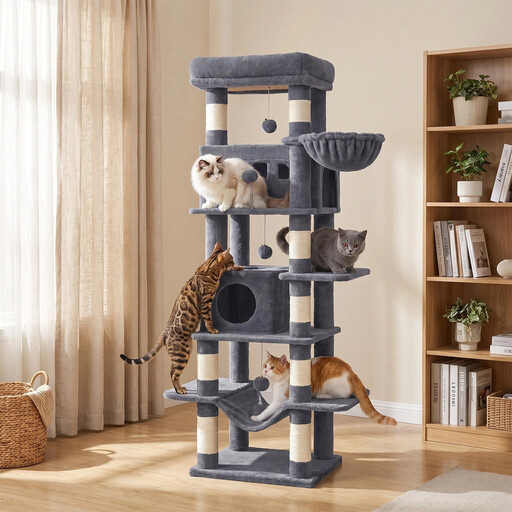
Why it suits this profile: This cat tree combines six levels with two cat houses, a hammock and a basket. It is suitable for active cats and households looking to combine several functions within a single footprint.
There are 17 support posts, eight of which are covered with natural sisal. The double reinforced base and anti-tip device are designed to limit movement and prevent tipping.
170 cm tall, a 50 × 30 cm platform, two cat houses, eight sisal posts, two removable cushions and a stated capacity of up to six cats weighing 6.8 kg each.
We’ve put together a complete, up-to-date list of products that fully meet these strict selection criteria and the applicable European safety regulations.
Place a large cat tree in a stable, dry spot where cats have enough room to approach it. A location next to a window, sofa or favourite sleeping spot may encourage them to use it. Leave enough space around the tree so that cats do not jump into furniture or walls.
Check weekly:
The lifespan depends on the number of cats, their weight, their scratching behaviour and the quality of assembly and maintenance. Replace loose or damaged parts promptly and do not use a cat tree if the structure is unstable.
Don’t look at height alone. For multiple cats, a wide base, several resting areas and separate cat houses are important. Also check that the platforms are large enough for the biggest cat in your household.
It can be, provided the levels are sensibly arranged and the jumps are not too large. A model with intermediate platforms, a wide base and an easily accessible resting point is more practical than a tower with large open gaps.
Assemble all parts according to the instructions, place the tower on a level surface and check the connections regularly. Use the supplied anti-tip device when necessary. With heavy or very active cats, anchoring the tree to the wall can provide extra peace of mind.
