
Vandaag of morgen in huis

Kwaliteit gegarandeerd

Welkomstaanbiedingen ontgrendelen: GRATIS bezorging | Tot 80% korting | Gratis 30 dagen JoyPlus-proefperiode
Download de app
A large cat tree for multiple cats needs to do more than look impressive. In a home with several cats, or larger cats, it will be used every day for climbing, jumping, scratching and sleeping. A tall cat tree that looks as though it has plenty of features on paper may still be awkward or unstable in practice.
So, before you buy, look out for these common pitfalls.
A multi-level cat tree may look suitable for several cats, but small platforms and narrow cat houses can soon become crowded. Larger cats in particular need room to turn around and stretch out.
So, check more than just the overall height. Look at:
A multi-level cat tree is more practical when cats can pass one another and do not all have to share the same top spot.
A tall scratching post can wobble if its base is too narrow or too light. The risk increases when several cats jump up at once. An anti-tip feature can help, but only if the tree is assembled correctly and placed on a suitable surface.
Check the information about:
According to the manufacturer's product description, some models are suitable for up to six cats, each weighing less than 6.8 kg. Treat this as a product specification and compare it with your cats' actual weight and behaviour.
A single sisal post at the bottom may not be enough to steer scratching away from your furniture. Cats often scratch after sleeping, while climbing or in places they regularly pass through. A cat tree with sisal posts on several levels offers more designated scratching areas.
Also check whether parts can be replaced. Dangling balls, cushions and sisal covering can wear out over time. A product with replaceable toys or removable cushions is easier to maintain.
A tall cat tree measuring around 170 to 212.5 cm makes use of the room's height and lets more cats climb and rest at the same time. This saves floor space, but you'll need to choose a safe spot for it. Don't put the cat tree right next to a window that opens, a narrow passageway or an unstable piece of furniture.
A tiered layout with gaps of around 20 to 40 cm can make climbing up and down easier to navigate. Consider your cats' age and mobility, too. An older or less agile cat will benefit from shorter jumps and wide intermediate platforms.
A stable cat tree relies on more than a heavy baseboard. The joints, screws and vertical posts all affect how sturdy it remains. The models listed include designs with 17 support posts, 8 of which are covered in natural sisal.
According to the product description, a wide, double base lowers the centre of gravity. After assembly, check regularly that the screws are still tight. If you spot cracks, loose parts or damaged fixings, stop using the tree until the affected part has been replaced or repaired.
A cat tree with cat houses and a cat tree with a hammock offers different types of resting spots. Some cats prefer an enclosed space, while others would rather lie somewhere high and open. This variety is useful for multiple cats, as they won't all need to share the same spot.
Removable, washable cushions make everyday cleaning easier. You can usually remove dust, hair and sisal fibres with a vacuum cleaner or lint roller. Check the specific care instructions for each model, and don't use harsh cleaning products on plush fabric.
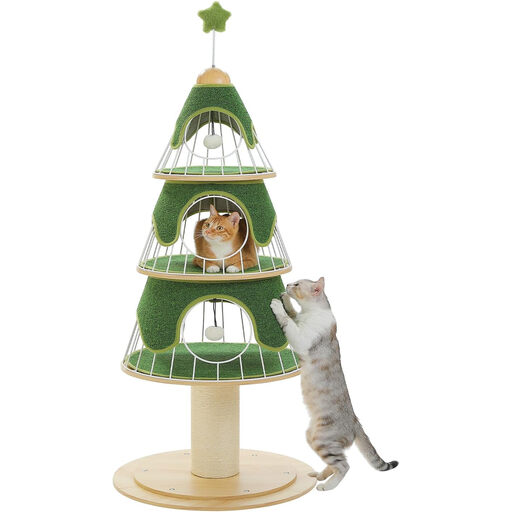
Why it suits this type of buyer: This shorter model is a good choice if you're looking for your first cat tree and have less vertical space available. It has three levels and three cat houses.
According to the product information, the base measures 60×60 cm and the central post has a diameter of 12.5 cm. Check that its capacity is suitable for the weight and number of cats in your home.
130 cm tall, with three large cat houses and sisal-covered scratching surfaces. The base takes up relatively little space.
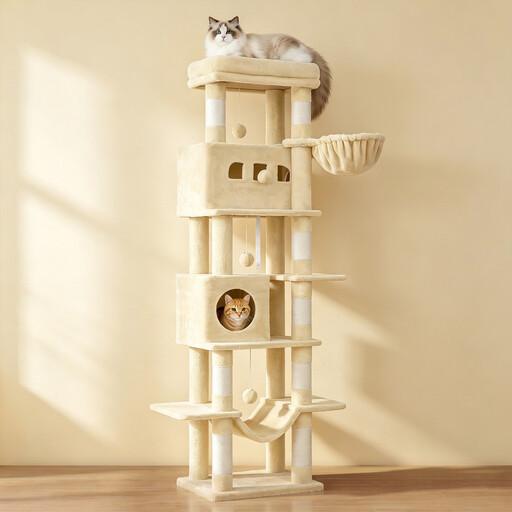
Why it suits this type of buyer: At 212.5 cm tall, with six levels, two cat houses and a wide platform, this model is well suited to homes looking to combine several resting and play areas.
The product description lists 17 thickened support posts, 8 sisal posts and a double integrated base with an anti-tip lock. Assemble and check the tree according to the instructions.
65×45 cm platform, two enclosed cat houses, a hammock, a basket and two washable cushions. According to the product information, it can support up to six cats, each weighing less than 6.8 kg.
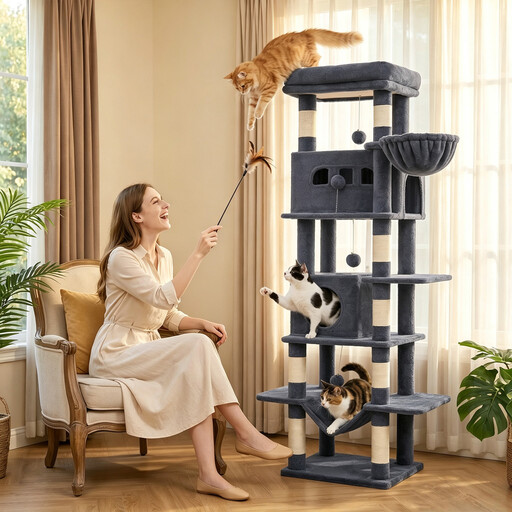
Why it suits this type of buyer: This vertical model is designed for homes with active, large or multiple cats, and for spaces where you'd rather make use of height than take up more floor space.
The description mentions a widened, reinforced base, anti-tip features and thick boards. Carefully check the wall clearance, ceiling height and connections during assembly.
60×40 cm viewing platform, two private cat houses, a hammock and a cat basket. The cushions are removable and, according to the product information, suitable for cleaning.
We've put together a complete, up-to-date list of products that meet these strict selection criteria and the applicable European safety regulations.
Place a large cat tree for multiple cats on a flat, dry surface with plenty of clear space around it. Ideally, put it somewhere your cats already like to spend time, such as by a window or in the living room. Make sure it doesn't block escape routes or walkways.
After assembly, check:
A cat tree will generally last longer if you regularly remove hair and dust and spot wear early. Its lifespan depends on the number of cats, their weight, scratching habits and the quality of the connections. Replace damaged parts promptly.
A model measuring 170 cm or more provides extra climbing space, but height alone doesn't determine whether a cat tree is suitable. Also consider the base width, weight capacity, distance between levels and number of resting spots.
Assemble all the parts according to the instructions, place the tree on a flat surface and use any supplied anti-tip mechanism if recommended. Check the connections regularly, especially after vigorous jumping or play.
Choose a cat tree with several sisal areas along routes your cat uses to walk and climb. Put it near the spot where your cat already scratches and make the designated areas appealing with toys. Results vary from cat to cat; replace damaged sisal covering when it starts to wear out.
