
Vandaag of morgen in huis

Kwaliteit gegarandeerd

Welkomstaanbiedingen ontgrendelen: GRATIS bezorging | Tot 80% korting | Gratis 30 dagen JoyPlus-proefperiode
Download de app
A large cat tree for multiple cats needs to offer more than just height. In a household with several or heavier cats, the structure has to cope with climbing, jumping, scratching and resting at the same time every day. A cat tree that appears spacious on paper may therefore wobble in practice, wear out quickly or provide too few separate resting spots.
Pay particular attention to three common pitfalls:
The right choice therefore depends on the balance between height, footprint, materials and the number of resting and scratching zones.
A tall cat tree or XXL cat tree makes use of the vertical space in your home. This is practical in a flat, but the taller the climbing tree, the more important the base and fixing become.
Check the following before buying:
A stable cat tree should stand on a flat, non-slip surface. For models from around 150 cm upwards, wall mounting is often advisable according to the product information, especially for active cats. Check the screws and connections regularly, particularly after assembly and during the first few weeks of use.
Several cats need not only more square centimetres, but also multiple places to move away from one another. So look for:
A multi-level cat tree is more convenient when cats do not have to pass one another on a single narrow route. For senior cats or cats that do not jump as high, steps with a moderate distance between them are more practical than a design with large leaps.
A cat tree with sisal posts provides several designated scratching spots. Pay attention to the number of sisal posts and their position. Sisal at different heights and along several climbing routes makes it easier to spread scratching behaviour throughout the tree.
Soft plush covering is comfortable, but requires maintenance. Remove hair with a hoover or lint roller and wipe local stains according to the product instructions. Removable, washable cushions are a practical advantage. Stop using the cat tree if a post, platform, rope or connection becomes damaged.
The choices below are based on the stated product specifications, such as height, number of sisal posts, platform dimensions and stated load capacity. Always check the current product page, assembly instructions and dimensions before buying.
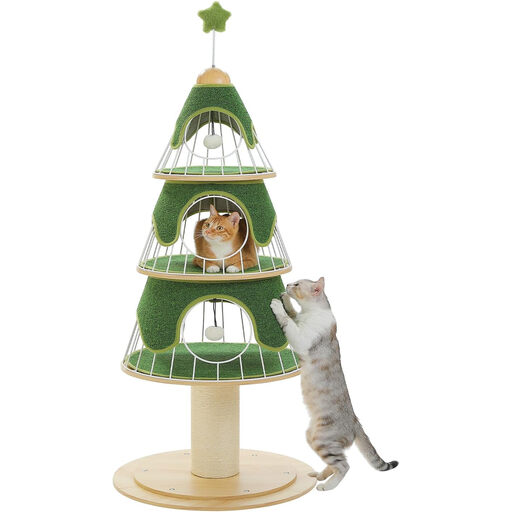
Why it suits this profile: At 130 cm, this model is lower than many XXL cat trees and has three levels and three large cat houses. The base measures 60 × 60 cm and the central post is 12.5 cm thick.
The wide base means you are not looking at height alone. The product information also recommends checking the connections and, if necessary, using wall mounting.
60 × 60 cm base, three large houses and sisal-covered posts for indoor use.
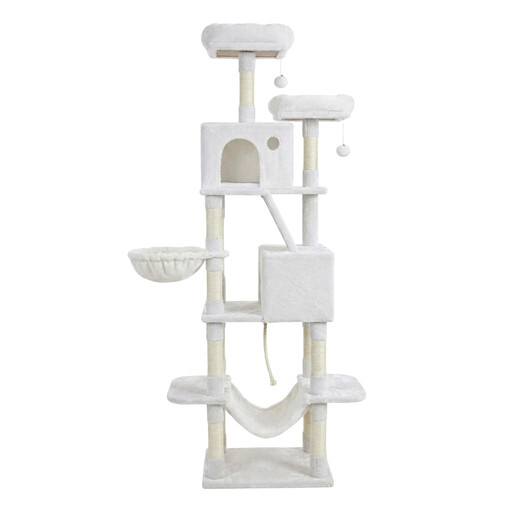
Why it suits this profile: This 206 cm cat tree combines two platforms, two cat houses, a basket and a hammock. According to the product information, the total static load capacity is up to 75 kg.
The 13 sisal posts distribute the scratching zones throughout the structure. The recommended anti-tip kit helps when positioning a tall climbing tree.
206 cm high, 13 sisal posts and several resting zones; according to the description, the covers can be spot-cleaned.
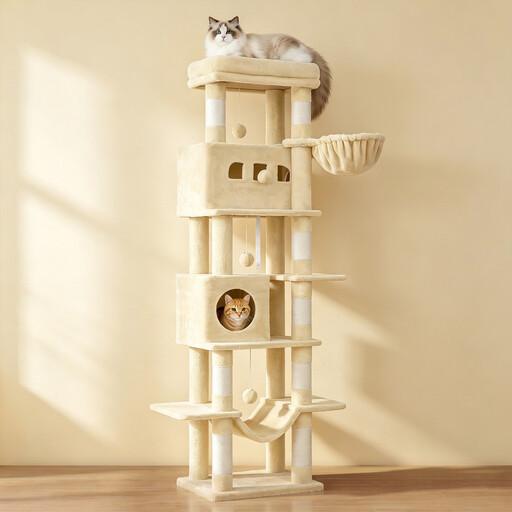
Why it suits this profile: This model is 212.5 cm high and has six levels, two cat houses, a hammock and a basket. Its stated capacity is up to six cats, each weighing less than 6.8 kg.
The double base, 17 reinforced support posts and built-in anti-tip lock are designed for intensive use by multiple cats. Positioning and assembly remain crucial.
Eight sisal posts, a 65 × 45 cm platform, two houses and eight replaceable toy balls.
Before buying, measure the ceiling height and take skirting boards, doors and walkways into account. A large indoor cat tree is best placed somewhere cats can reach easily, but where they cannot jump onto a radiator, open window or cables.
Place the base completely flat and tighten all connections securely. A tall cat tree should not be able to rub against a cupboard or windowsill. Check the following monthly:
A cat tree will last longer when damaged sisal or plush parts are replaced promptly. Its service life depends on the cats’ weight, the number of cats, how intensely they jump and the quality of the assembly.
We have compiled a complete, up-to-date list of products that fully meet these strict selection criteria and the applicable European safety requirements.
That depends on the number and size of the cats. Ideally, choose several resting spots, wide platforms and different scratching zones. For large or active cats, a model with a wide base and several sisal posts is more practical than a compact post with a single resting spot.
Wall mounting is often recommended for tall models. This reduces the risk of tipping when cats jump at the same time or land on the top platform. Follow the supplied instructions and check that the wall and fixing materials are suitable.
Check a new cat tree after assembly and then regularly, for example once a month. With intensive use, more frequent checks are advisable. Look out for loose screws, torn fabric, loose sisal and damaged toys. Stop using the cat tree if the structure is unstable or damaged.
