
Vandaag of morgen in huis

Kwaliteit gegarandeerd

Welkomstaanbiedingen ontgrendelen: GRATIS bezorging | Tot 80% korting | Gratis 30 dagen JoyPlus-proefperiode
Download de app
A large cat tree for multiple cats needs to offer more than a place to scratch. In a multi-cat household, a cat tree is used for climbing, playing, sleeping and taking a break from one another. A model that appears spacious on paper may still wobble in practice, offer too few usable resting spots or wear out quickly.
That is why it is wise to look beyond height or the number of levels. The construction, the size of the resting areas and the way the cat tree is anchored determine whether it is a good fit for your cats and your home.
A tall cat tree measuring 160 or 200 cm may sound appealing, but height without a wide base can lead to instability. Active or heavier cats, in particular, put considerable force on the upper platforms when jumping. Always check the base dimensions, the weight of the cat tree and whether an anti-tip system is included.
A cat tree with one long sisal post may suit a single calm cat, but it is less practical for multiple animals. Cats often scratch after waking up or before they start playing. With multiple sisal posts distributed across different levels, there is less competition between cats. Also pay attention to the thickness and positioning of the posts: they should provide enough vertical space for cats to stretch out fully.
A platform designed for multiple cats may sound spacious, but not every cat wants to sleep alongside another. A cat tree with cat houses, a hammock and several lounging areas allows each cat to choose its own spot. An enclosed house provides privacy, while a high platform is ideal for cats that like to keep an eye on their surroundings.
Look beyond the stated maximum number of cats. Check the following:
The product information determines which cat weights are permitted. For example, the reinforced cat tree measuring 212.5 cm in height is listed as supporting up to six cats weighing no more than 6.8 kg each. This is a product specification, not a general guarantee for every home or usage scenario.
A cat tree for large cats needs to provide enough room for turning, lying down and jumping. A small platform can be uncomfortable or unsafe for a large cat. Pay attention to the dimensions of:
A multi-level climbing structure is not only appealing to young cats. According to the product description, a stepped layout with distances of approximately 30 to 40 cm can make climbing up and down more manageable. Always take your cats’ age, mobility and jumping habits into account.
Sisal is designed as a scratching surface, while plush or cushions provide comfort for resting. Check whether the cushions are removable and washable. This is particularly practical when dealing with hair, dust and accidents.
With daily use, sisal and fabric will naturally wear over time. Carefully trim away loose fibres and replace components when the material starts to come apart. An indoor cat scratching post will remain usable for longer when placed on a dry, level surface and vacuumed regularly.
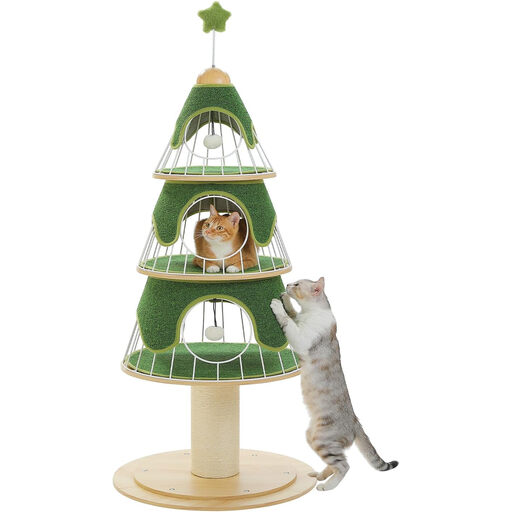
Why it fits: A more compact model for households looking to add vertical space without installing an exceptionally tall cat tree. According to the product information, this tree has a 60 × 60 cm base and three spacious cat houses.
The wide base prevents you from judging the tree by height alone. The manufacturer also recommends wall anchoring when an anti-tip system is available.
130 cm high, 60 × 60 cm base, three levels and a central 12.5 cm-thick sisal post.
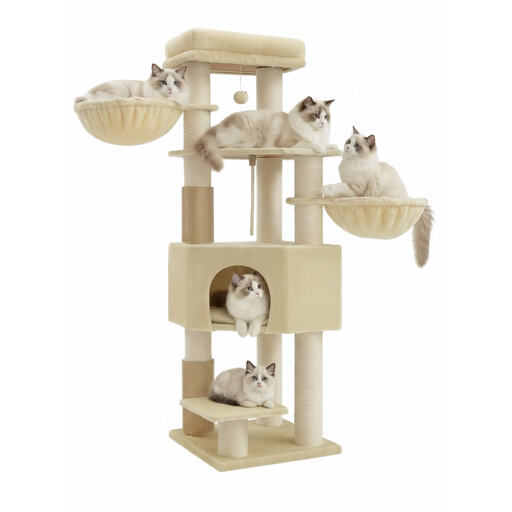
Why it fits: This 160 cm model is designed for large or active cats and combines a lounging area, a hideaway, baskets and an integrated grooming brush.
The nine sisal posts create multiple scratching zones. According to the instructions, the model must be permanently secured to a load-bearing wall.
Measures 50 × 50 × 160 cm, with nine sisal posts, removable mats and a stated static load capacity of 105 kg.
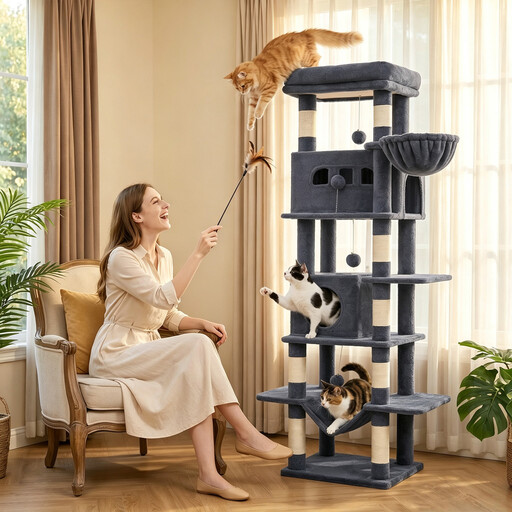
Why it fits: The tall vertical design makes efficient use of limited floor space and provides six climbing levels for multiple cats.
The product description mentions a reinforced base and anti-tip features. After assembly, still check every connection and follow the anchoring instructions.
212.5 cm high, six levels, eight sisal posts, two cat houses and a 60 × 40 cm platform with a removable cushion.
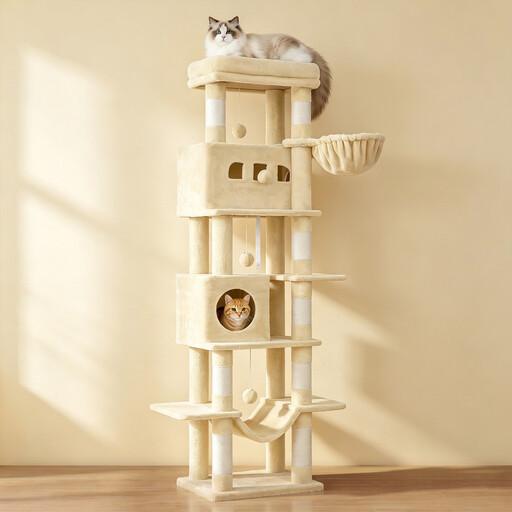
Why it fits: A versatile choice for households looking for multiple climbing, scratching and resting areas in one generously sized cat tree.
According to the product information, the scratching zones are positioned along the climbing route. The double base and integrated anti-tip lock are designed for use with multiple cats.
Six levels, two cat houses, a hammock, a 30 cm bed, two washable cushions and a stated capacity of up to six cats weighing no more than 6.8 kg each.
Place a large cat tree on a level surface, ideally somewhere cats can enjoy a view without being exposed to draughts or direct heat from a radiator. Measure the ceiling height in advance. With a 212.5 cm model, you also need to leave enough room for safe installation.
Let your cats get used to the new tree at their own pace. A toy or familiar blanket can help make the different levels more appealing. Check the screws, sisal fibres, hanging balls and cushions weekly. Stop using the tree if a platform becomes loose or a house is torn.
Would you like to add a small toy alongside a cat tree? The ZEZE Lemon Silvervine Cat Toy is a standalone cat toy measuring 90 × 100 mm and filled with silvervine, catnip and crinkle paper. According to the product information, supervision is recommended during the first use; replace the toy if it tears or the filling begins to come loose.
Explore a current selection of products suited to different needs related to play, rest and cat care.
Install the cat tree on a level surface and tighten all connections securely. Use the included anti-tip kit whenever the instructions require it. With tall models, anchoring the tree to a suitable load-bearing wall is an important safety measure.
Its lifespan depends on the number of cats, their weight and how intensively they jump and scratch. Regular maintenance makes wear easier to identify. Replace or repair components as soon as the sisal, plush, cushions or connections become damaged.
A cat tree does not use electricity. Ongoing costs mainly consist of cleaning products and any replacement sisal posts, cushions or toys. When purchasing, check whether individual replacement parts are available; replacing a component can be more economical than buying an entirely new cat tree.
