
Vandaag of morgen in huis

Kwaliteit gegarandeerd

Welkomstaanbiedingen ontgrendelen: GRATIS bezorging | Tot 80% korting | Gratis 30 dagen JoyPlus-proefperiode
Download de app
A large cat tree for multiple cats needs to offer more than just scratching space. In a household with several, heavier or active cats, climbing areas, resting spots and enough distance between levels are just as important. Yet many cat trees look sturdier and more spacious at first glance than they are in everyday use.
So watch out for these common pitfalls:
A tall post with too small a base
A cat tree measuring 170 or 212.5 cm may look appealing, but without a wide or reinforced base, the furniture can wobble when cats jump and land on it. An anti-tip feature helps, but the floor surface and correct assembly remain important.
Lots of components, little usable space
A cat tree with houses, a hammock and toys sounds complete. Also check the dimensions of the platforms, openings and resting areas. Large cats need room to turn around and stretch out.
Sisal in the wrong places
A single thin sisal post at the bottom offers few options for cats that want to scratch at different heights. Spread the scratching zones along the climbing route and check that the posts are thick enough for everyday use.
A tall cat tree is particularly suitable for cats that like to keep an eye on their surroundings. Don’t just look at the overall height; also consider the distance between the platforms. For many cats, a jump of around 20 to 40 cm can be easier to manage than one uninterrupted vertical climb.
A six-level model with a stepped layout provides several routes up and down. This is practical for a cat tree for multiple cats, as cats are less likely to block one another on a single narrow passage. For older or less agile cats, wide intermediate platforms and a logical layout are more useful than extra height alone.
Check the dimensions of the base, the thickness of the boards and whether an anti-tip lock is included. A stable cat tree should not wobble noticeably after assembly when a cat jumps onto a platform.
Product descriptions may state a maximum occupancy. Treat this as a product specification under the stated conditions, not as a guarantee for every home or cat. For the 212.5 cm model, the product information states a capacity of up to six cats, each weighing less than 6.8 kg. In practice, distribute the weight across the different levels and use a wall fixing if one is supplied or recommended.
Place the cat tree on a flat, dry floor and check all connections again after a few days. This is particularly relevant with intensive use.
Sisal scratching posts provide a familiar surface for scratching behaviour. Eight sisal posts or sisal zones spread across several levels give cats more choice than one central post. This can help direct their attention towards the cat climbing furniture rather than sofas, curtains or chair legs. However, it cannot guarantee that furniture will not be scratched, as every cat responds differently.
Also look for removable cushions and detachable components. A cat bed, hammock or cushion that you can vacuum or wash is more practical in a multi-cat household. Check hanging cat toys regularly and replace components as soon as the sisal starts to fray or a cord comes loose.
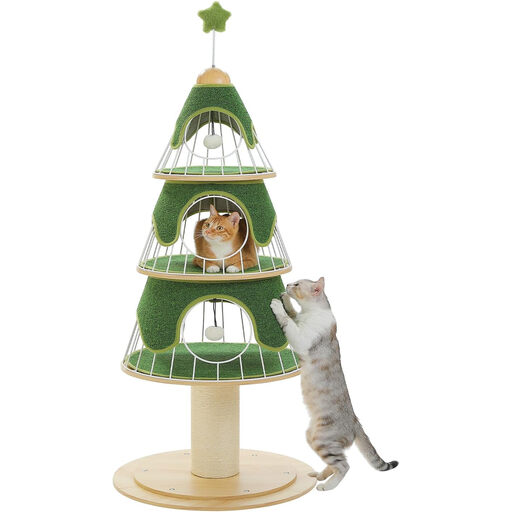
Why it suits this profile: This compact model is suitable as a first cat tree or for a smaller living space. Its height of 130 cm, three levels and three cat houses provide opportunities for climbing and resting without taking up a very large amount of floor space.
According to the product information, the base measures 60 × 60 cm and the central post has a diameter of 12.5 cm. This provides clearer stability information than simply describing it as “sturdy”.
Three large hiding places, a wide base and sisal-covered scratching posts. Check the assembly and use the recommended anti-tip feature.
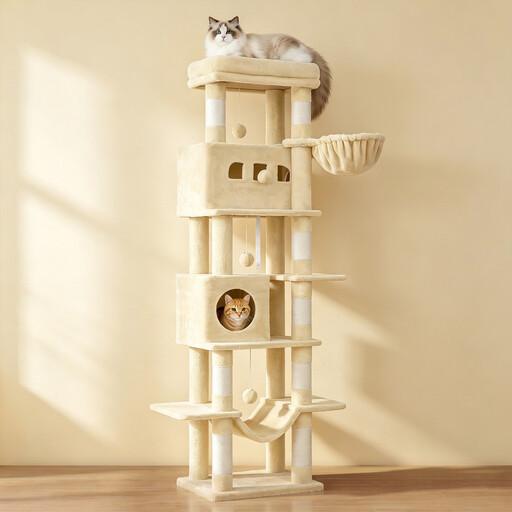
Why it suits this profile: The combination of a height of 212.5 cm, six levels, two cat houses and a hammock is ideal for households looking for one fully equipped piece of cat climbing furniture for climbing, scratching and sleeping.
The product information states that it has a double base, an anti-tip lock and 17 supporting posts. The eight sisal posts are distributed across key climbing areas.
A 65 × 45 cm platform, two enclosed resting areas, a 30 cm basket and two washable cushions. According to the product description, the model is designed for up to six cats weighing under 6.8 kg each.
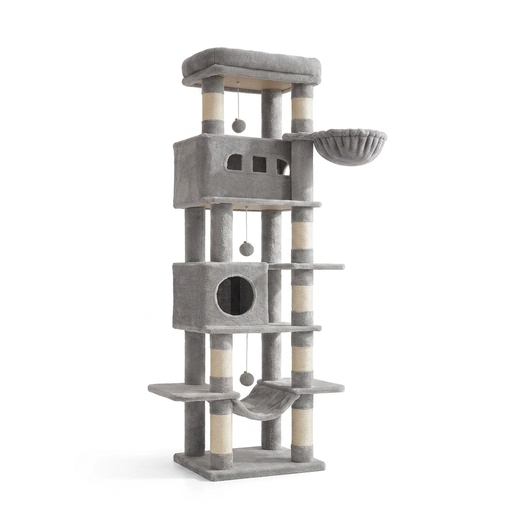
Why it suits this profile: This six-level large cat tree is designed for multiple cats, large cats and cats that like to alternate between climbing and resting. Its vertical design makes use of height rather than taking up a lot of floor space.
There are 17 supporting posts, eight of which are covered in sisal. The double reinforced base and anti-tip design are intended to limit wobbling during intensive use.
A 50 × 30 cm platform, a 50 × 40 cm cat house, a hammock, a 30 cm basket and removable cushions. The product description states a load capacity of up to six cats weighing 6.8 kg each.
Before buying, measure the ceiling height and leave enough clearance around the cat tree. Don’t place a tall cat tree directly next to a delicate cupboard or a window that can be opened. A wall fixing is advisable if your cats jump frequently or the floor is slippery.
Vacuum plush surfaces regularly and remove hair with a lint roller. Spot-clean stains according to the product instructions. Check every few weeks:
Loose components can usually be replaced, but stop using the cat tree if a load-bearing part is broken or unstable. With additional toys, such as sisal balls or a teaser wand, supervision during the first play sessions is advisable.
We have put together a complete, up-to-date list of products that fully meet these strict selection criteria and the applicable European safety regulations.
Consider the number of cats, their weight and their behaviour. For several or large cats, ideally choose a model with multiple platforms, at least one wide lying area per resting zone and several scratching posts. A taller tree is not automatically more suitable if the base or resting areas are too small.
Assemble all parts according to the instructions, place the base on a level surface and check the connections after the initial period of use. Use a supplied or suitable anti-tip feature when indicated by the manufacturer. On a slippery floor, you may need to pay extra attention to grip.
Its lifespan depends on the number of cats, their weight, how intensively it is used and how well it is maintained. Daily scratching wears down sisal more quickly, while loose cushions and toys may need replacing sooner. Regularly tightening the connections and replacing damaged parts promptly can help extend its service life.
