
Vandaag of morgen in huis

Kwaliteit gegarandeerd

Welkomstaanbiedingen ontgrendelen: GRATIS bezorging | Tot 80% korting | Gratis 30 dagen JoyPlus-proefperiode
Download de app
A large cat tree for multiple cats needs to offer more than just scratching space. In a household with several or heavier cats, there should be enough room for climbing, sleeping and playing without the animals constantly getting in each other’s way. A tall cat tree can also make good use of vertical space, but only if the construction is sturdy enough.
Many buyers focus mainly on the height and number of accessories. This can lead to disappointment. The following pitfalls are common:
A 212.5 cm tall cat tree offers plenty of climbing opportunities without taking up a large amount of floor space. However, measure the ceiling height beforehand and take skirting boards, sloping ceilings and doors into account. The stated height needs to fit the space where you want to assemble the cat tree.
Also look for:
A stable cat tree should not move noticeably from side to side after assembly. Place the furniture on a level floor and check all screws regularly. With very active cats, permanent attachment to a load-bearing wall may be particularly important. Always follow the manufacturer’s assembly and safety instructions.
With a cat tree with sisal posts, it is not just the number that matters. Pay attention to their positioning, thickness and accessibility. Eight sisal posts spread along the climbing route will generally provide more useful scratching zones than a cluster at the bottom.
The product information for the models below states that they have eight sisal posts. The SONGMICS cat tree has nine reinforced sisal posts. These figures are verifiable product specifications; however, they do not automatically indicate how long the material will last. This depends on usage, the cats’ weight and the quality of the assembly.
A cat tree can help protect furniture by giving cats a designated place to scratch. This is no guarantee that a cat will never scratch a sofa or curtain again. So place the tree somewhere your cats already like to spend time and reward appropriate use.
A multi-level cat tree works better in a multi-cat household when cats can move away from one another. Useful combinations include:
For larger cats, pay particular attention to the platform dimensions. A product with a 60 × 40 cm or 65 × 45 cm platform offers more room for lying stretched out than a compact model. Also check the stated load capacity. Treat claims about the number of cats as guidance from the product description, and take your own animals’ weight and behaviour into account.
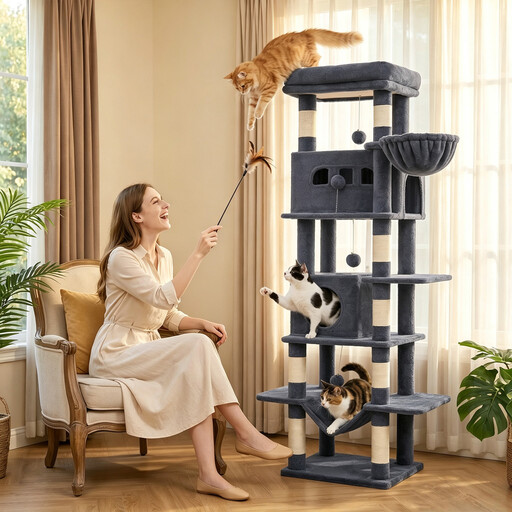
Why it suits this profile: This model combines six levels with a vertical design, making it suitable for households looking to save floor space. The removable cushions are practical for regular cleaning.
The description mentions a widened, reinforced base, anti-tip features and eight sisal posts. This provides more support than a tall, narrow post without additional stability information.
212.5 cm tall, six levels, 60 × 40 cm platform, two cat caves and a hammock.
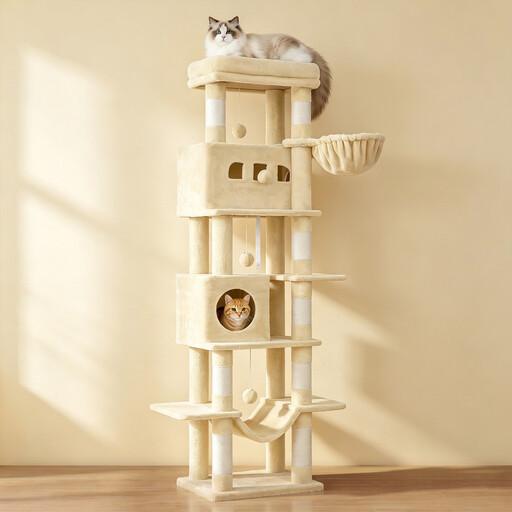
Why it suits this profile: The combination of two cat houses, a wide platform, basket and hammock provides several resting options. This is ideal for cat owners who value comfort and a well-organised layout.
The stated construction consists of 17 thickened posts, including eight sisal posts, plus an integrated anti-tip lock. The manufacturer states that it is suitable for up to six cats, each weighing less than 6.8 kg.
Six levels, 65 × 45 cm platform, two houses, washable cushions, basket and eight replaceable hanging balls.
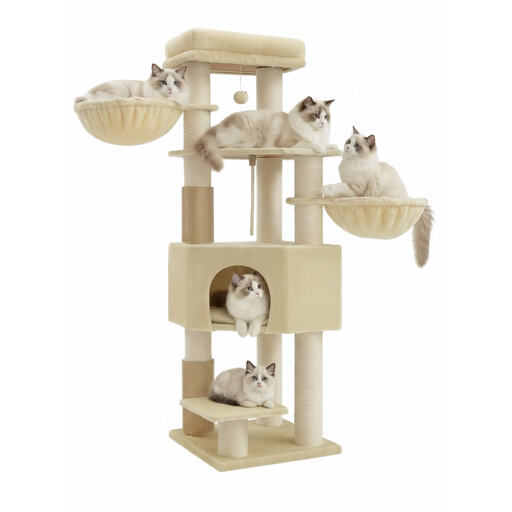
Why it suits this profile: This model is designed for large or active cats that need a wide resting area, sisal posts and easy-care components. The integrated brush provides an additional way to play and groom.
The product information mentions a reinforced base, anti-tip kit and nine sisal posts. The manufacturer also states a maximum static load capacity of 105 kg and recommends it for up to five cats.
Dimensions of 50 × 50 × 160 cm, nine sisal posts, wide resting area, cat cave, basket, removable mat and washable cover.
We have put together a complete, up-to-date list of products that fully meet these strict selection criteria and the applicable European safety regulations.
Place a large cat tree in its final position before tightening all the components. Check that the floor is level and that cats cannot jump from the top platforms onto lamps, windows or fragile decorations.
When using an anti-tip kit, choose a suitable load-bearing wall. Wall mounting does not replace correct assembly of the base. Check all screws again after the first few days; new plush and sisal can put the connections under strain.
For everyday maintenance, the following is usually sufficient:
Replace damaged parts before allowing cats to use the cat tree again. Pay particular attention to loose ropes, torn houses and toys that could be bitten loose.
That depends on the ceiling height and the available space. A 212.5 cm model will only fit if there is enough free space above the tree. Measure from the floor to the ceiling and allow for assembly and any wall attachment.
Its lifespan varies depending on how intensively it is used, the cats’ weight, the materials and maintenance. Sisal posts wear out more quickly when several active cats use the same area every day. A model with replaceable toys and easily accessible scratching zones may be more practical to maintain. Check the connections and sisal regularly rather than relying solely on the stated lifespan.
A spot near a window, a well-used route or a favourite resting place often works better than an out-of-the-way corner. Make sure there is enough space around it for jumping and that cats have several escape routes. In multi-cat households, several houses, platforms and resting places can help reduce congestion around a single resting spot.
