
Vandaag of morgen in huis

Kwaliteit gegarandeerd

Welkomstaanbiedingen ontgrendelen: GRATIS bezorging | Tot 80% korting | Gratis 30 dagen JoyPlus-proefperiode
Download de app
A large cat tree for multiple cats can make a big difference in a busy household. Your cats get room to climb, rest and scratch, while your sofa, curtains and chairs are less likely to become scratching spots. However, a tall cat tree isn’t automatically suitable for multiple cats or heavier cats.
Many models look similar in photos and adverts. The differences often lie in the finish, how the resting spots are arranged and how stable the structure is. Use these checks to avoid buying one that wobbles, wears out or barely gets used after a few months.
A cat tree measuring 170, 206 or even 212.5 cm offers plenty of vertical space, but height alone says little about how easy it is to use. Also look at the distance between levels, the width of the platforms and how cats get from one level to another.
A tall, narrow cat tree can be awkward for larger or older cats, or when cats meet on the way up or down. A well-designed indoor climbing tree has several accessible routes and resting spots.
A claim such as ‘suitable for multiple cats’ is only useful if you check the technical details too. A total static load capacity of, for example, 70 or 75 kg doesn’t automatically mean that each platform can support that weight on its own.
So check:
According to the product descriptions, the JOYFURNOS models have total static load capacities of up to 70 and 75 kg respectively. The description also states that the first model can support around 10 kg per level. Use this information as a guide and always follow the assembly and safety instructions.
A post with just one thin sisal-covered area can quickly become less appealing when several cats use it every day. Check the number of sisal posts, their diameter and where they’re positioned. Scratching options at different heights are more practical than a single central post.
A cat tree with sisal posts and a scratching ramp gives your cats more choice. This is especially useful if one cat prefers to scratch horizontally while another likes to stand upright.
An XXL cat tree makes use of a room’s height, but usually needs a wide base. Measure not just the available floor space, but also:
A 170 cm cat tree will often fit more easily into a flat than a model measuring over two metres. A 206 cm or 212.5 cm cat tree offers more climbing space, but requires extra care with assembly and tip-over protection.
Look for a reinforced base, sturdy connectors and an anti-tip feature. Place the cat tree on a flat, non-slip surface. For tall models, wall fixing is strongly recommended according to the product information.
The models mentioned use materials including particleboard, plush covering, natural sisal rope and metal fixings. Check all screws and connections regularly after assembly, especially during the first few weeks. Stop using the tree if a board develops cracks or a part comes loose.
A cat tree with a hammock, cat houses, baskets and several platforms means your cats don’t all have to share the same spot. Check the dimensions of the resting areas. A large breed or a cat with a sturdy build will benefit more from a wide platform than a small, high-up perch.
Enclosed cat houses can offer privacy, while open platforms are ideal for watching the room. The right combination depends on your cats’ behaviour.
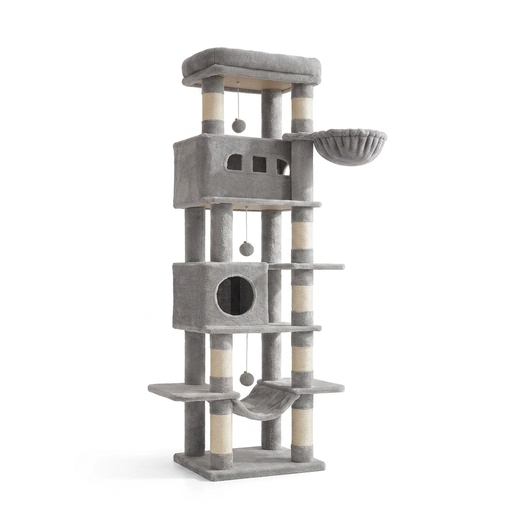
Why it suits this type of buyer: A straightforward 170 cm cat tree with several resting and scratching areas for households looking for a tall cat tree without going straight for the largest model.
The product description lists six levels, a reinforced double base and an anti-tip feature. Eight of the 17 posts are also covered in sisal.
170 cm tall, with two cat houses, a hammock, a 30 cm basket and two removable cushions.
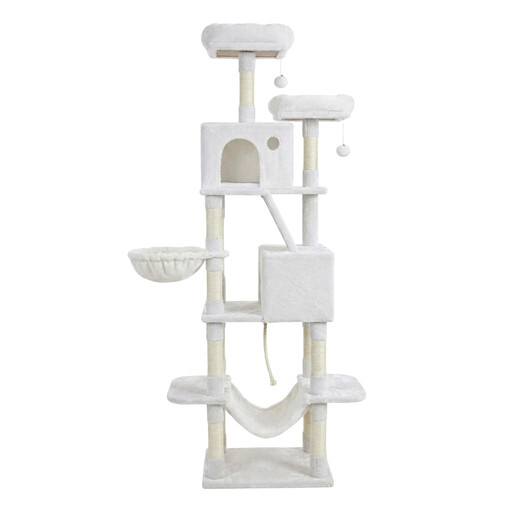
Why it suits this type of buyer: This model is designed for anyone who values plenty of vertical space, several resting spots and a high stated load capacity.
The product description lists 13 natural sisal posts, two cat houses, a basket and a hammock, providing several places to scratch and rest.
206 cm tall, with 13 sisal posts and, according to the product description, a total static load capacity of up to 75 kg.
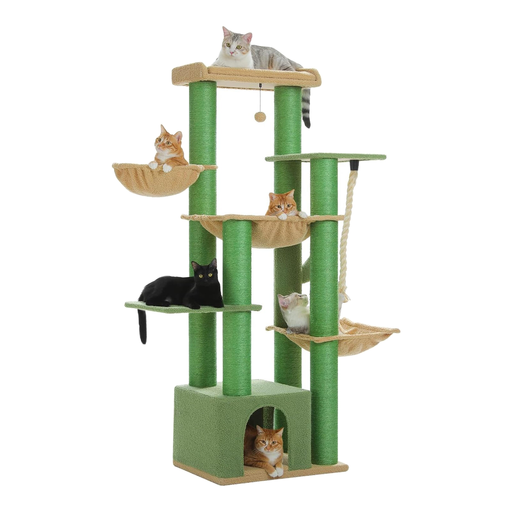
Why it suits this type of buyer: A good choice for active cats and households that need plenty of scratching space, large resting areas and washable parts.
The product description lists 13 sisal posts with a diameter of 11 cm and three hammocks. According to the stated product specification, the tree is designed for cats weighing up to 10 kg each.
Three extra-large resting areas, a large cat house and removable, washable parts.
Place the stable cat tree on a flat surface, ideally somewhere your cats already like to spend time. Positioning it next to a window or near a favourite resting spot can make it more appealing. Keep the tree away from damp, open flames, radiators, cables and blind cords.
Check these parts monthly:
The lifespan depends on the number of cats, their weight, how they play and how well the tree is maintained. You may be able to replace a worn sisal post, but if a load-bearing part is cracked, stop using the product.
We’ve put together a complete, up-to-date list of products that meet these strict selection criteria and the applicable European safety regulations.
For active indoor cats, 170 cm already offers plenty of climbing space. Models measuring 206 cm or 212.5 cm are worth considering if you want to make the most of the room’s height. Always check that the ceiling height, base and wall fixings are suitable.
Assemble the tree exactly as instructed, place it on a flat, non-slip surface and use the supplied anti-tip kit if one is included. Wall fixing is strongly recommended for tall models. Retighten the connections after the first few weeks of use.
That depends on the stated load capacity and the size of the platforms. Don’t just check the total load capacity; also look at the maximum load per level, if stated. For large cats, wide resting areas and thick sisal posts are generally more practical than a narrow, tall structure.
