
Vandaag of morgen in huis

Kwaliteit gegarandeerd

Welkomstaanbiedingen ontgrendelen: GRATIS bezorging | Tot 80% korting | Gratis 30 dagen JoyPlus-proefperiode
Download de app
A large cat tree for large cats needs to do more than provide somewhere to scratch. Heavy cats need space to turn around, jump and stretch out. In a multi-cat household, several resting spots and plenty of scratching surfaces are important too. However, a strikingly tall cat tree can disappoint in practice if its base is too narrow or its platforms are too small.
So don’t focus only on the number of levels or the colour of the covering. The construction, dimensions and ease of maintenance all play a major part in whether a cat tree remains practical for everyday use.
A tall cat tree may look appealing, but height without enough support increases the risk of wobbling. Check the dimensions of the base, the thickness of the support posts and whether an anti-tip kit is included. A wide or double-reinforced base will generally offer more support than a narrow board.
Also, place the tree on a level floor. A carpet may provide extra grip, but it won’t compensate for a poorly balanced structure.
“Six levels” tells you nothing about the size of the platforms. For a large cat, a narrow shelf may only be suitable as a step, not as a place to sleep. Check the dimensions of the platforms, cat house and basket.
A cat tree with a sleeping basket, hammock and wide top platform makes better use of the available space. In a multi-cat household, it helps if they don’t all have to share the same resting spot.
Not every vertical post is covered in sisal. A cat tree with just one small scratching surface may quickly become less appealing, leaving your furniture at risk. Check how many posts are actually covered in sisal and where they are positioned.
According to the product information for the selected models, some versions have several sisal-covered posts spread across different levels. This gives cats more opportunities to stretch while scratching.
Measure the space where you plan to put the cat tree. Allow room to walk around the base, especially if the tree will sit next to a cupboard or window. For large cats, platforms around 40 to 65 cm wide are more appealing than very compact shelves.
The weight capacity should suit how the tree will actually be used. In a multi-cat household, take the cats’ combined weight into account. A product description may, for example, specify a maximum number of cats at a certain weight. Treat this as the stated product specification, not a general guarantee for every situation.
Look out for:
A sturdy cat tree shouldn’t move noticeably from side to side during normal use. With a tall model, fixing it to the wall is an extra sensible precaution, particularly if you have active or heavy cats.
Sisal is designed for scratching, while soft plush covering is mainly for resting spots. Check whether the sisal wraps all the way around the post and whether any loose toys can be replaced.
Removable, washable cushions are practical in any household, as mud, fur and dust can quickly get into soft materials. A cat tree with cushions is easier to look after if the covering can be cleaned with a vacuum cleaner, lint roller or damp cloth. Always follow the manufacturer’s specific cleaning instructions.
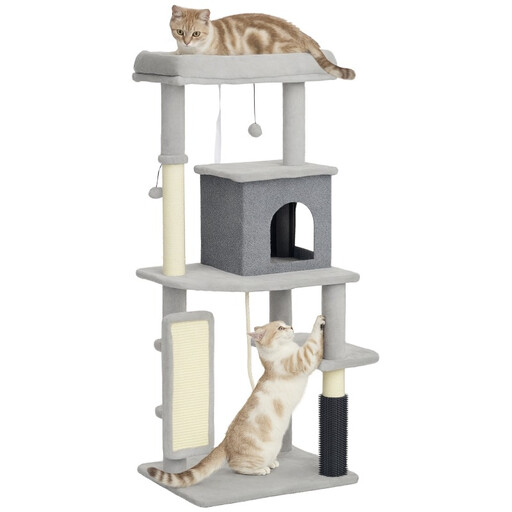
Why it suits this profile: At 132 cm tall, this cat tree combines a cat bed, hideaway, jumping platform and sisal scratching posts in a relatively compact design. The included anti-tip kit is handy as a first cat tree or for a flat with limited space.
The product name specifies sisal scratching posts and an anti-tip kit, so you don’t have to judge it by height alone. Before buying, check the exact weight capacity and platform dimensions.
132 cm tall; includes sisal scratching posts, a cat bed, condo, jumping platform and anti-tip kit.
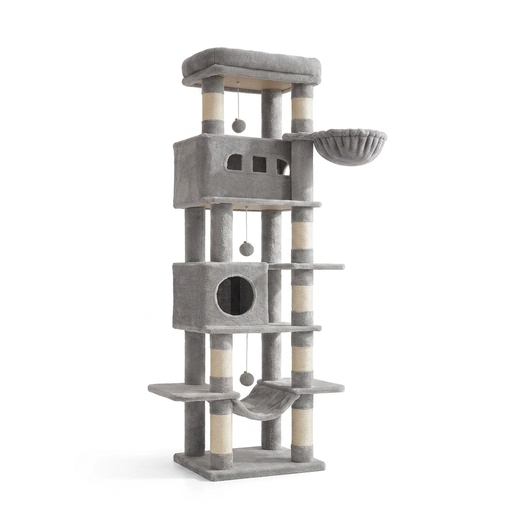
Why it suits this profile: This large, 170 cm cat tree has six levels, a large and a small cat house, a hammock, a 30 cm basket and two removable cushions. It’s a good fit for a household where cats like to take turns climbing, hiding and sleeping.
The product information specifies 17 support posts, 8 of them sisal-covered, as well as a wider, double-reinforced base and an anti-tip feature. The cushions are removable, and the product description says they are washable.
Measures 170 × 50 × 40 cm; six levels; eight sisal posts; two cat houses; hammock; two removable cushions.
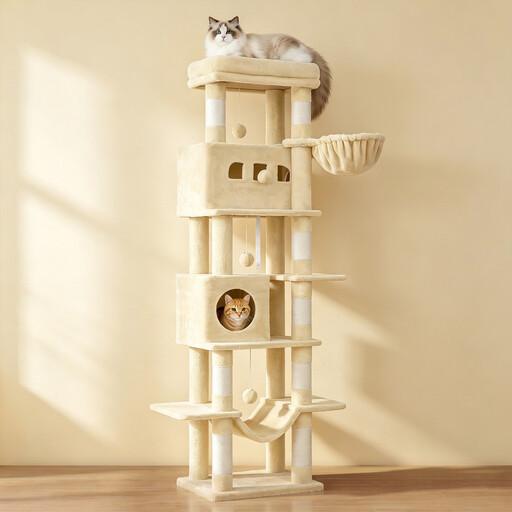
Why it suits this profile: At 212.5 cm tall, with six levels, two cat houses and a hammock, this model is designed for active cats and multi-pet households. The stated product information says it can accommodate up to six cats, each weighing less than 6.8 kg.
The product description specifies 17 thickened support posts, 8 sisal posts, a double base and a built-in anti-tip lock. The separate resting and scratching spots mean cats don’t all have to rely on one platform.
212.5 cm tall; two cat houses; hammock; eight natural sisal posts; two washable cushions; stated capacity of six cats weighing up to 6.8 kg each.
We’ve put together a complete, up-to-date list of products that meet these strict selection criteria and comply with current European safety regulations.
Put the cat tree somewhere your cats like to spend time, such as by a window or in a quiet corner of the living room. Avoid busy walkways where people often pass by. After assembly, check all the screws and joints, then check them again after a few weeks of use.
A few practical habits can help:
There’s no set height that suits every cat. A stable base, sufficiently large platforms and safe distances between levels are more important. A model measuring 130 to 170 cm may suit many homes. For a model over 200 cm, you’ll need to pay extra attention to ceiling clearance and wall fixings.
Assemble all the parts according to the instructions and check that the base is completely level. Use the anti-tip kit provided, if there is one. A sturdy wall fixing can offer extra support for a tall cat tree. Don’t place loose risers under the base to make up for an uneven floor.
Its lifespan depends on the number of cats, their weight, how often it’s used and the quality of the joints. Replace it if the base cracks, posts come loose, the sisal is no longer secure or the tree continues to wobble after you’ve tightened it. Cushions and loose toys can sometimes be replaced separately, so you may not need to replace the whole cat tree straight away.
