
Vandaag of morgen in huis

Kwaliteit gegarandeerd

Welkomstaanbiedingen ontgrendelen: GRATIS bezorging | Tot 80% korting | Gratis 30 dagen JoyPlus-proefperiode
Download de app
A large cat tree offers more than somewhere for your cat to sharpen its claws. The right cat tree gives indoor cats room to climb, play, sleep and retreat. But a model that looks appealing can disappoint in practice. For larger or more active cats in particular, stability, size and materials matter more than appearance alone.
A cat tree can be impressively tall, but without a wide base or anti-tip feature, the structure may wobble when your cat leaps onto it. So, check more than just the height. Look at:
A tall cat tree should suit your cat’s weight and activity level. If you have several cats, consider both the total weight and whether there are enough spots for them to rest at the same time.
A cat tree with just one thin sisal post can wear out more quickly if several cats use the same spot. Check how many sisal scratching posts there are and how they are spread across the different levels. Scratching surfaces at different heights also make it easier to encourage your cat to climb and scratch on the cat tree.
Sisal is hard-wearing under normal use, but no scratching post lasts forever. Check whether worn parts can be replaced and whether the sisal is wrapped tightly around the post.
A hammock, hideaway or toy ball may look appealing, but its size will determine whether your cat actually uses it. Larger breeds and heavier cats need enough room to lie down comfortably. Check the dimensions of the platforms, beds and hideaways. A small entrance can also be a problem for adult cats.
A model measuring 130 to 170 cm will usually offer several levels to climb without taking up the full height of the room. The distance between levels matters too: on the models described here, for example, it ranges from around 20 to 40 cm. Evenly spaced levels help cats move up and down with confidence.
A shorter cat tree may be more practical for kittens or older cats. Active indoor cats may prefer several levels, wide platforms and different routes to explore.
Use the stated weight capacity as a guide, not as an invitation to put the structure under maximum strain. A model described as suitable for up to six cats weighing 6.8 kg each has different specifications from a compact scratching post for one kitten.
You can recognise a sturdy cat tree by features such as:
Place the cat tree on a level floor. If it is particularly tall, securing it to the wall may be a sensible extra precaution, especially in a home with several active cats.
Plush feels soft, but it collects hair. A removable cushion or a surface you can clean with a vacuum cleaner or lint roller will make maintenance easier. Washable covers are practical if the cat tree gets a lot of use.
Check the condition of hanging toys too. Replace any loose or damaged parts straight away, especially if your cat chews or pulls at them.
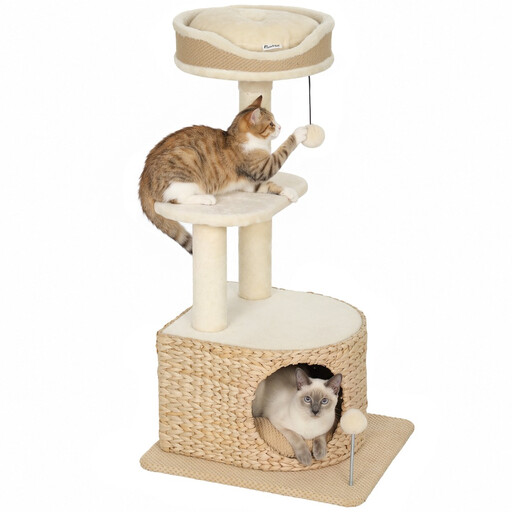
Why it suits this profile: At 87 cm tall, with four levels, this is an easy-to-manage cat tree for a first purchase, a smaller home or a kitten.
Its shorter design avoids the risks of starting with an excessively tall, unstable option. Be sure to check the base dimensions and fixings before buying.
Four levels, a jute scratching post and a compact design with soft beige covering.
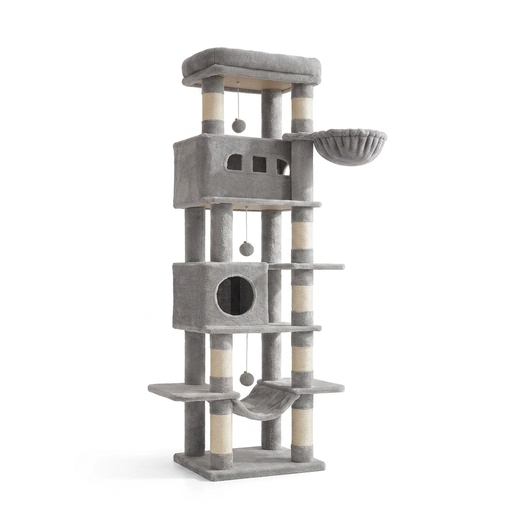
Why it suits this profile: The six levels, two hideaways, hammock and wide resting areas offer plenty of variety for indoor cats that enjoy climbing and changing where they relax.
The product information lists 17 support posts, eight of which are wrapped in sisal, as well as a double-reinforced base and an anti-tip feature.
Six levels, two cushions, a 30 cm bed, a hammock and, according to the product information, a weight capacity of up to six cats weighing 6.8 kg each.
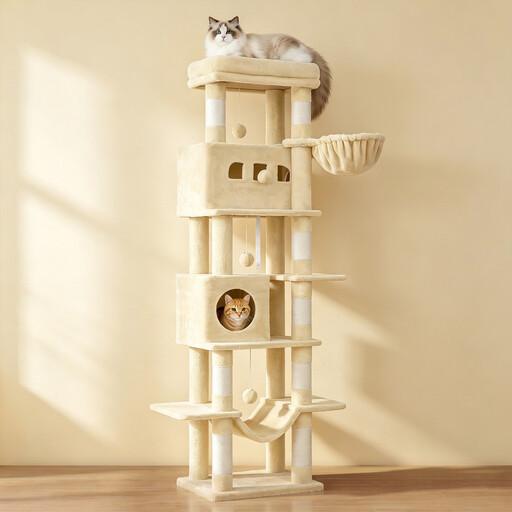
Why it suits this profile: At 212.5 cm tall, this model is designed for homes with several or active cats that make use of plenty of vertical space, scratching options and separate places to rest.
According to the product description, the six levels are spaced 30 to 40 cm apart. The double base and built-in anti-tip lock are designed to provide extra stability.
Two hideaways, a hammock, eight sisal posts, two washable cushions and a 65 × 45 cm platform.
We’ve put together a complete, up-to-date list of products that meet these strict selection criteria and current European safety regulations.
Place a large cat tree somewhere your cat already enjoys spending time, such as by a window or near the living room. Avoid narrow walkways where people could easily bump into it. After assembly, check all the connections and tighten the screws if the structure starts to wobble.
Vacuum the covering regularly and check the sisal, cushions, hammock and toys. It’s usually better to replace a damaged post or loose part than to keep using it. If you have a tall model, make sure there’s enough clear space around it too.
Don’t just look at the overall height. Several cats also need multiple places to lie down and enough space between levels. A model with two hideaways, a wide platform and a hammock means they don’t all have to share the same resting spot.
Its lifespan depends on your cats’ weight, how many you have, how much they scratch and how well the tree is assembled. Pay particular attention to the sisal covering, screw connections and base. Washable cushions and replaceable toy balls can make maintenance easier.
Yes, a cat tree with a hideaway gives indoor cats more options for climbing, scratching and retreating. Just make sure the entrance and resting area are the right size for your cat. For a large or heavy cat, wide platforms and a stable base matter more than soft covering alone.
