
Vandaag of morgen in huis

Kwaliteit gegarandeerd

Welkomstaanbiedingen ontgrendelen: GRATIS bezorging | Tot 80% korting | Gratis 30 dagen JoyPlus-proefperiode
Download de app
A large cat tree can be a practical combination of climbing space, a place to rest and a piece of cat furniture with sisal. However, some models can disappoint in practice. A tall cat tree that wobbles, has beds that are too small or quickly develops loose covering takes up space without offering much comfort.
So don’t focus only on the number of levels or the appearance. To make the right choice, look at the dimensions, the construction and how your cat will use the tree.
A tall scratching post catches the eye, but a narrow or lightweight base can make it unstable. Cats that land on an upper platform after jumping put extra strain on the structure. So always check:
A sturdy cat tree doesn’t necessarily have to be the tallest option. A wide base and well-spaced levels are just as important.
A product may have several platforms, toys and hideaways, while still having small resting areas. That can be a problem for large or heavy cats. Check the dimensions of the largest platform, cat bed and cat house. A resting spot should have enough room for your cat to turn around and stretch out.
The layout is especially important if you have more than one cat. A cat tree for multiple cats is more practical when it has several resting spots. That way, the cats don’t always have to share the same top spot.
Sisal is designed to provide a scratching surface, but the number of sisal posts doesn’t tell you everything. Check how many posts are actually covered in sisal and where they are positioned. Cats often want to stretch out fully while scratching, so short strips of sisal on the lowest level alone may not be much use.
Also check how the posts are attached and whether parts can be replaced. A hanging toy that can be replaced is more practical than a fixed feature that makes the whole cat tree less useful if it gets damaged.
First, measure the spot where you plan to put the cat tree. Leave enough room around it for climbing and jumping. A model that’s 170 cm tall may suit a living room with a high ceiling, but be less suitable under a low window or in a narrow corner.
As well as the overall height, check:
For a cat climbing tower, the product description will typically give distances of around 20 to 30 cm between levels as a guide for cats that enjoy climbing. Whether the tree is suitable will still depend on your cat’s age, mobility and size.
A manufacturer may state a load capacity, but don’t automatically divide this between all your cats without checking further. See whether the stated weight applies to one cat, several cats or a specific load. An anti-tip kit is useful if the scratching post is tall or your cats are active jumpers.
Ideally, place a tall scratching post on a level surface. A rug with deep folds or an uneven floor can affect stability. Tighten the screws regularly after assembly, especially if the structure starts to move.
A piece of cat furniture with sisal often combines sisal for scratching with plush or fleece for resting areas. Check whether the cushions can be removed and whether the parts can be cleaned with water. Loose hair can usually be removed with a vacuum cleaner or lint roller, but always follow the product instructions.
If you’re buying a cat tree with a cat house and hammock, check that both are accessible without one cat blocking the way. For households with several cats, multiple sleeping areas are often more practical than one large house.
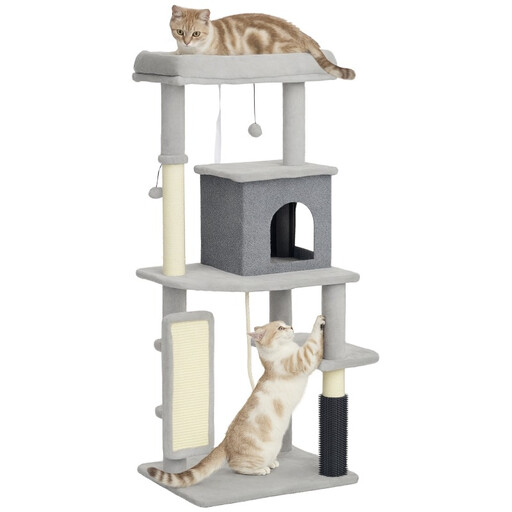
Why it suits this profile: At 132 cm tall, this model offers an accessible introduction to a large cat tree without going straight for a very tall tower. The product name lists a cat bed, cat house, jumping platform, sisal posts and anti-tip kit.
The listed anti-tip kit gives extra attention to stability. Once assembled, check that the fixings are suitable for your wall and floor.
132 cm tall; combines a resting spot, condo, scratching posts, jumping platform and grooming brush.
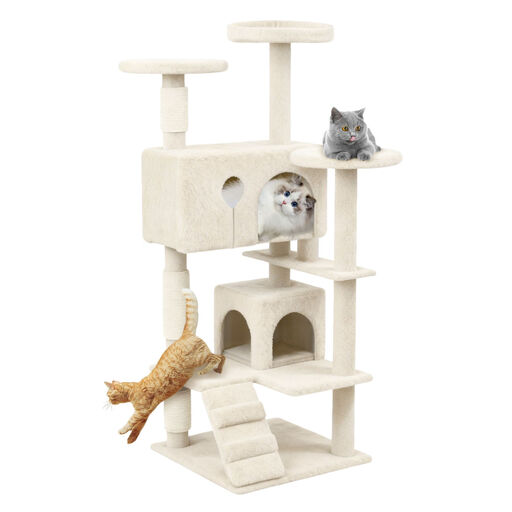
Why it suits this profile: With a stated base size of 49 × 49 cm, this model is a good choice if you can set aside a dedicated space almost half a metre deep and wide.
The name highlights its stable design. When it arrives, compare the base, assembly points and included scratching post with the current product information.
130 cm tall; 49 × 49 cm base; includes a cat bed and scratching post, according to the product name.
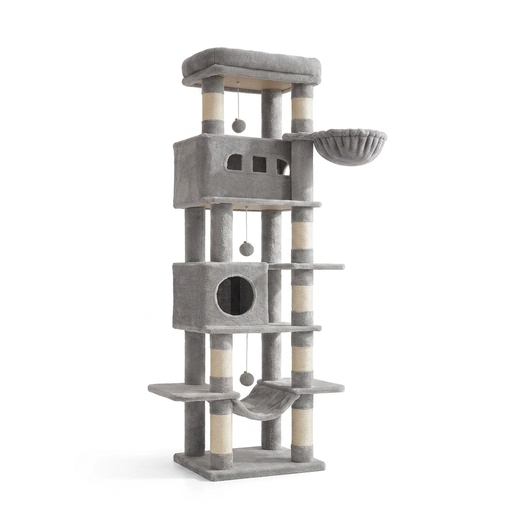
Why it suits this profile: This model is designed for households with several cats or cats that love to climb. It stands 170 cm tall and has six levels, several hideaways, a hammock and a raised bed.
The product description lists a double reinforced base and an anti-tip feature. It also has eight sisal-covered posts spread across several levels.
170 cm tall; 17 support posts, 8 of them covered in sisal; two cushions, two cat houses, a hammock and a 30 cm cat bed. The stated capacity is up to six cats weighing 6.8 kg each.
We’ve put together a complete, up-to-date list of products that meet these strict selection criteria and the applicable European safety regulations.
Assemble all the parts according to the instructions and place the base on a level surface. Use the included anti-tip kit if one is available. Check after a few days, and then regularly, that the screws are still tight. If you have a very active or heavy cat, securing the tree to the wall may be a sensible extra measure, provided the fixings are suitable.
Its lifespan depends on how it’s used, how many cats use it and the quality of its joints and covering. Sisal wears out more quickly when several cats scratch it every day. So choose a model with parts that can be replaced or tightened again. Regular vacuuming and removing loose threads promptly will help you keep an eye on wear.
Ongoing costs are usually limited to cleaning and replacing sisal, cushions or toys when needed. Removable, washable cushions can be more economical in the long run. Before buying, check which parts are available separately and whether the product instructions allow cleaning with water or specify dry cleaning only.
