
Vandaag of morgen in huis

Kwaliteit gegarandeerd

Welkomstaanbiedingen ontgrendelen: GRATIS bezorging | Tot 80% korting | Gratis 30 dagen JoyPlus-proefperiode
Download de app
A large cat tree can combine climbing, scratching, playing and sleeping. But some models can disappoint in practice. A tall post isn’t automatically stable, soft covering doesn’t tell you how hard-wearing it is, and a product with lots of levels won’t always suit your space or your cats.
Before you buy, watch out for these three common pitfalls:
First, measure the spot where you plan to put the large cat tree. Don’t just look at its height: check the width and depth of the base, too. A tall scratching post with a wider base will generally be more stable than a narrow model of the same height.
Also check whether the product information mentions an anti-tip feature, a reinforced base or a wall-fixing strap. Place the cat climbing tower on a level surface and leave enough room around it for your cat to jump and turn.
Spacious resting spots matter for larger or heavier cats. For example, a 50 × 30 cm platform gives your cat more room to move than a small perch where they can only sit upright.
Sisal is a commonly used material for scratching posts. Check how many posts are actually wrapped in sisal and which levels they’re on. With a multi-level cat tree, it’s useful if your cat can scratch at different heights.
Also look at how the support posts and scratching posts are combined. A sturdy cat tree doesn’t just need lots of components; it also needs a base that properly supports the structure. According to the product information for the 170 cm model, it has 17 support posts, 8 of which are covered in natural sisal. The seller also lists scratching areas on five levels. Treat these as product specifications to compare, not as a guarantee of how long the tree will last with every type of use.
A cat tree for multiple cats is more practical when they don’t all have to share the same sleeping spot. Look for a combination of a cat bed, cat hammock, cat house and open platforms. Having several resting areas can help reduce crowding around one spot.
Washable or removable cushions are useful for everyday care. You can often remove dust and hair with a vacuum cleaner or lint roller. Before buying, also check whether loose toys can be replaced and whether parts can be secured again.
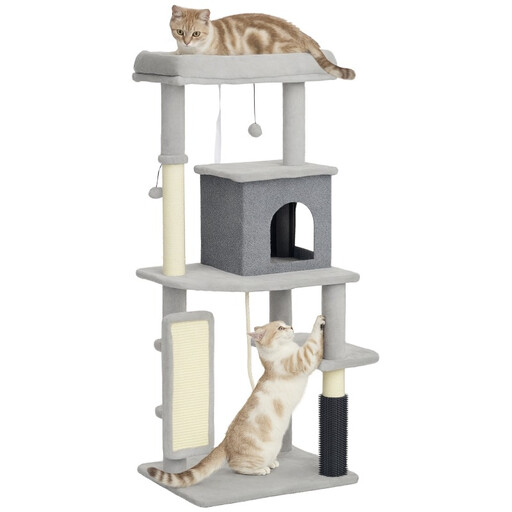
Why it suits this profile: At 132 cm tall, it offers climbing opportunities without taking up space like a very large piece of furniture. The listed sisal posts, cat bed, condo and anti-tip kit make it a good first indoor cat tree.
The product name lists both sisal and an anti-tip kit. That means you can check two important features before ordering: the scratching material and the support against tipping.
132 cm tall; combines a cat bed, condo, jumping platform and sisal scratching posts.
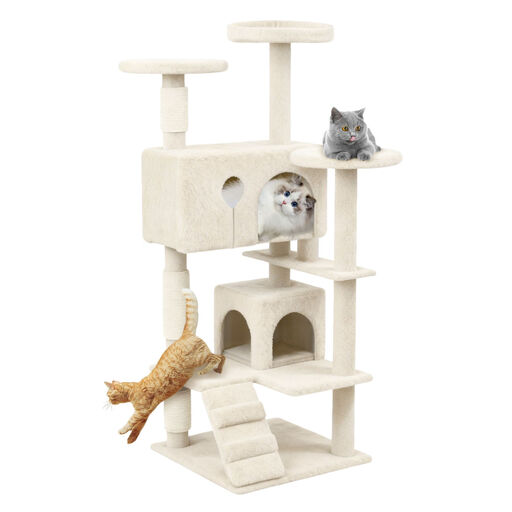
Why it suits this profile: This model has a 49 × 49 cm base and is 130 cm tall. It’s a good choice if you want to compare the dimensions and stated stable design with the floor space you have available.
The base dimensions are clearly stated in the product name. This lets you check in advance whether the balance between height and floor space is right for your room and cat.
Measures 49 × 49 × 130 cm; combines a cat bed and scratching post in one structure.
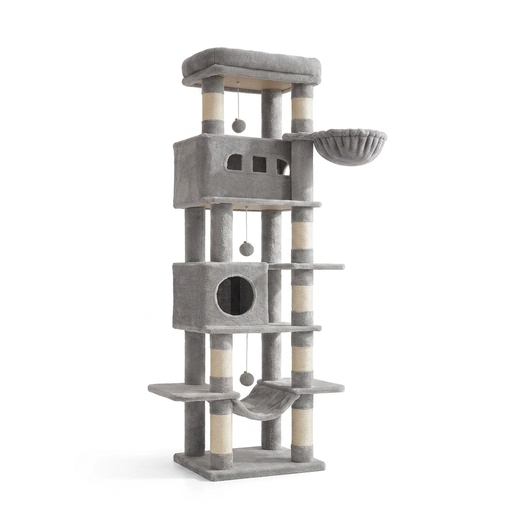
Why it suits this profile: This is a large cat tree with six levels, two cat houses, a hammock, a 30 cm bed and two removable cushions. According to the product information, it’s designed for multiple cats, including larger cats.
The listing mentions a double reinforced base and an anti-tip feature. It also has 17 support posts, 8 of which are wrapped in sisal, so scratching and support don’t rely on a single component.
170 cm tall; six levels, several resting spots, 8 sisal posts and replaceable hanging toys.
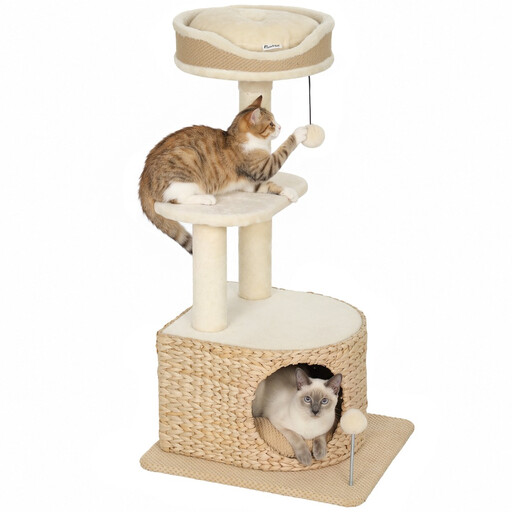
Why it suits this profile: With four levels and a height of 87 cm, this indoor cat tree takes up less vertical space than a tall scratching post. The jute scratching post, club-shaped condo and hanging resting spot combine play and relaxation.
The product information lists four levels and a height of 87 cm. This gives you a clearer idea of its size in advance than a general description such as “compact” or “space-saving”.
Four levels; jute scratching post; hanging resting spot and condo for indoor use.
We’ve put together a complete, up-to-date list of products that meet these strict selection criteria and comply with current European safety regulations.
First, place the scratching post on a level floor and check that all the screws are tight after assembly. For a tall model, it’s a good idea to secure it to the wall if the manufacturer provides for this. Check again after a few days for any loose connections; jumping and turning can gradually loosen a cat tree.
Put the tree somewhere your cat already likes to spend time, such as near a window or in the living area. Check the sisal and covering regularly. Replace damaged toys and tighten any loose parts. This will help keep the cat climbing tower in good condition without relying solely on marketing claims.
It depends on your cat and the space available. A model around 130 cm tall already offers several climbing levels. A 170 cm model may suit cats that like to perch up high, but it needs extra consideration when it comes to the base, assembly and clearance around it.
It can be, as long as there are several places to rest and scratch. Check the number of platforms, houses and hammocks, and always look at the stated load capacity. Having several cats on one small platform at the same time can cause stress and put extra strain on it.
Its lifespan depends on how heavily it’s used, the weight of the cats, the quality of the connections and the thickness of the sisal. Check regularly for fraying, loose posts and unstable parts. Replaceable scratching rope or separate replacement parts can make maintenance easier, but check that they’re available before you buy.
