
Vandaag of morgen in huis

Kwaliteit gegarandeerd

Welkomstaanbiedingen ontgrendelen: GRATIS bezorging | Tot 80% korting | Gratis 30 dagen JoyPlus-proefperiode
Download de app
A large cat tree may seem, at first glance, to be all about size. In practice, its construction, layout and materials determine whether your cat will use it every day. This is particularly important for large cats, indoor cats and households with several pets.
Many buyers focus mainly on the number of levels or an eye-catching design. As a result, important details can sometimes be overlooked. Use these points to compare cat trees more practically and avoid a purchase you regret.
A tall cat tree gives cats vertical space, but a narrow or lightweight base may shift when they jump. This could put them off using the top levels. Check:
A stable cat tree should stand firmly on a level surface. Ideally, place a tall model against a wall and use the supplied fixing, if there is one.
A cat tree with a hammock, toys and several hideaways can look appealing. However, small platforms are not suitable for every cat. Check the dimensions of the platforms and hideaways, especially when choosing a cat tree for large cats.
A platform where your cat can stretch out is often more practical than several small ones. Also check the distance between levels. A jump of 20 to 30 cm is easier for many cats to manage than a layout with awkward gaps.
Not every post on a cat tree is covered in sisal. With frequent use, a few short strips may not be enough. Check how many posts are actually wrapped in sisal and whether your cat can reach them at different heights.
Sisal scratching posts give cats a designated place to scratch. That does not automatically mean they will stop scratching your furniture: place the cat tree somewhere your cat already likes to spend time, and check regularly that the sisal is still intact.
First, measure the space where you plan to put the cat tree. A 170 cm model needs enough clearance from the ceiling, as well as a stable position with room to move around it. Also check the width and depth of the base.
For households with several cats, a layout with different resting areas is useful. This means they do not all have to share the same spot. A cat tree with a hideaway offers a sheltered space, while open platforms suit cats who prefer to keep an eye on their surroundings.
Check the number and thickness of the support posts. The product information may state a maximum weight capacity, but always consider this alongside how the weight is distributed across the levels. In a multi-cat household, a wide base is more important than a high weight capacity alone.
For the two large models below, the product information states a capacity of up to six cats, each weighing no more than 6.8 kg. This is a product specification, not a guarantee for every situation. Check that the construction is suitable for all your cats’ weight, jumping habits and size.
Removable cushions are handy for dealing with hair and dirt. Check whether the covers can be cleaned with a vacuum cleaner or lint roller, and whether the cushions are washable. A cat house or enclosed condo offers a quiet place to rest, while a hammock or basket provides a softer, more open alternative.
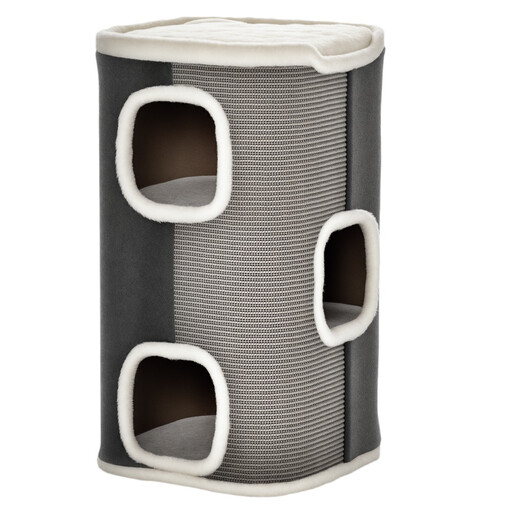
Why it suits this profile: At 40 × 40 × 74 cm, this compact model is easier to fit into a smaller home and combines places to rest and play.
Its compact design means you are not paying for height alone. The product name specifies two large connected openings and three play areas.
Compact size, plush and natural sisal combination, two large openings.
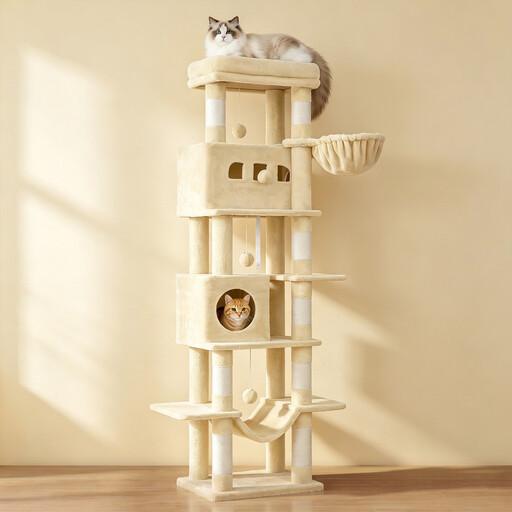
Why it suits this profile: At 212.5 cm tall, with six levels, two cat houses and a generous 65 × 45 cm platform, it offers plenty of variety for large cats or multi-cat households.
The product information specifies 17 support posts, 8 sisal posts, a double base and an anti-tip lock. Always check the floor surface and fixings before assembly.
212.5 cm tall, two cat houses, hammock, washable cushions and 8 sisal-wrapped posts.
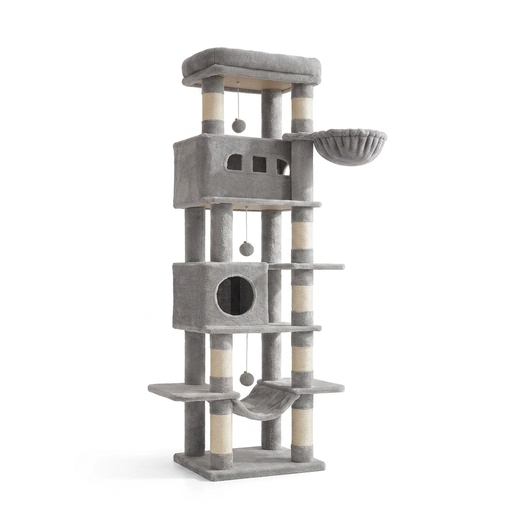
Why it suits this profile: This six-level cat tree combines a large platform, two houses, a basket and a hammock, making it a good choice for households needing several places to rest.
The dimensions and layout are clearly listed. The product information specifies 17 posts, 8 of which are sisal-wrapped, as well as a reinforced double base.
170 cm tall, large 50 × 30 cm platform, two removable cushions and a 30 cm basket.
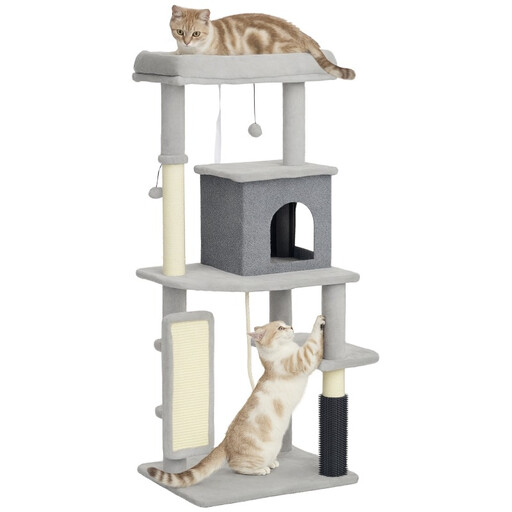
Why it suits this profile: Alongside scratching posts, this model includes a cat bed, condo, spring platform, grooming brush and anti-tip kit.
The anti-tip kit is listed as a separate component. This lets you plan for extra fixing during assembly rather than relying on the weight of the base alone.
132 cm tall, sisal posts, cat bed, condo, grooming brush and anti-tip kit.
We’ve put together a complete, up-to-date list of products that meet these strict selection criteria and the applicable European safety regulations.
Place a tall cat tree on a level floor, away from delicate furniture and somewhere a door will not hit it. Check all the screws and joints after assembly. Check them again after a few weeks of use, and thereafter whenever you notice movement or noise.
Remove loose threads and damaged toys promptly. For models with washable cushions, follow the seller’s care instructions. A hammock or basket can collect hair more quickly than an open platform, so include these parts in your cleaning routine.
It depends on the space available and your cat’s behaviour. A model between 130 and 170 cm tall offers several climbing levels. If your cat likes to perch up high, a model over 200 cm may be worth considering, provided the ceiling clearance, base and anti-tip fitting are suitable.
Yes, as long as it has enough resting spots, wide platforms and several scratching areas. Don’t just check the stated weight capacity: consider the dimensions of the resting areas and whether the cats can pass one another on the levels.
Lifespan varies depending on the cat, how often it is used and the quality of the wrapping. Sisal can fray over time, so check the wrapping and stability regularly. A replaceable toy or cushion won’t necessarily extend the life of the whole cat tree, but it can make maintenance easier.
