
Vandaag of morgen in huis

Kwaliteit gegarandeerd

Welkomstaanbiedingen ontgrendelen: GRATIS bezorging | Tot 80% korting | Gratis 30 dagen JoyPlus-proefperiode
Download de app
A large cat tree can serve many purposes at home: climbing, scratching, playing, sleeping and watching the world go by. However, a tall model isn’t automatically suitable for large cats or a household with several pets. A narrow base, thin sisal posts or too few resting places can make a cat tree wobbly or leave it barely used.
So focus on the construction and layout, not just the appearance. Read on to find out which features matter and which models suit different homes.
A tall cat tree takes up little floor space, which is useful in a flat. The risk is that some models aren’t wide or heavy enough for cats jumping and landing at the same time. So check the dimensions of the base, the weight of the tree and whether it includes an anti-tip feature.
For example, a 212,5 cm cat tree can offer plenty of vertical space for play, but it needs a sturdy base and must be secured correctly. Ideally, place a tall cat tree against a wall and follow the assembly instructions carefully.
Marketing copy may specify a number of cats, but always check whether this is linked to a maximum weight per cat. According to the product description for certain 212,5 cm models, up to six cats can use the tree at the same time, provided each cat weighs less than 6,8 kg. This is a supplier’s product specification, not a general standard for every cat or home.
Also consider your cats’ behaviour. A calm adult cat puts a different strain on a platform than several cats jumping on it at once.
Plush resting spots feel comfortable, but cat hair and dust can easily get caught in them. A removable, washable cushion is therefore more practical than a permanently upholstered surface. If you’re considering a cat tree with a hammock, check that it’s securely attached and that the fabric is easy to clean.
For a sturdy cat tree, these features are worth checking:
At home, measure not only the available floor space but also the distance to the ceiling. Leave enough clear space around the tree for jumping, and don’t place it right next to fragile ornaments.
A sisal cat scratching post helps direct scratching behaviour to a designated spot. Check the thickness, length and positioning of the sisal posts. Vertical posts are ideal for a full-body stretch; horizontal or angled sections may appeal to cats with a different scratching style.
A model with several sisal posts spreads use across the cat tree. This is useful in multi-cat households and can help prevent one post from wearing out too quickly. If the parts are replaceable, check whether replacements will still be available later.
A cat tree for multiple cats needs more than one bed at the top. Look for:
A large cat tree with cat houses is especially useful if your cats like to sleep separately. Low, easy-to-reach platforms are handy for kittens. For large cats, wide resting areas and sturdy connecting posts matter more than lots of small toys.
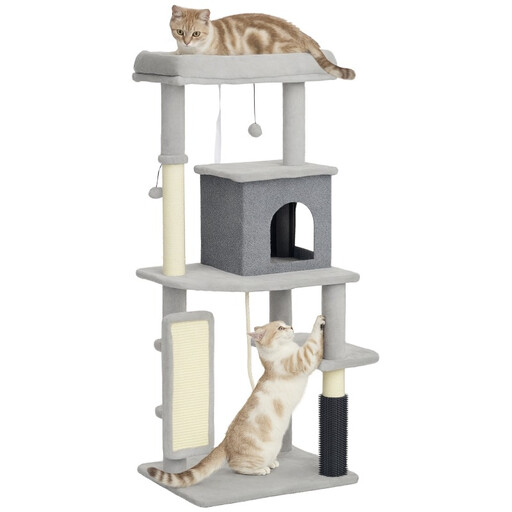
Why it suits this profile: At 132 cm tall, with scratching posts, a cat bed, a hideaway and a play platform, this is a straightforward starter option for one cat or a smaller household.
The included anti-tip kit addresses the risk of instability. Its lower height also makes it easier to fit into your home than a model over two metres tall.
Sisal scratching posts, a cat house, bed, jumping platform and grooming brush, all in one piece of furniture.
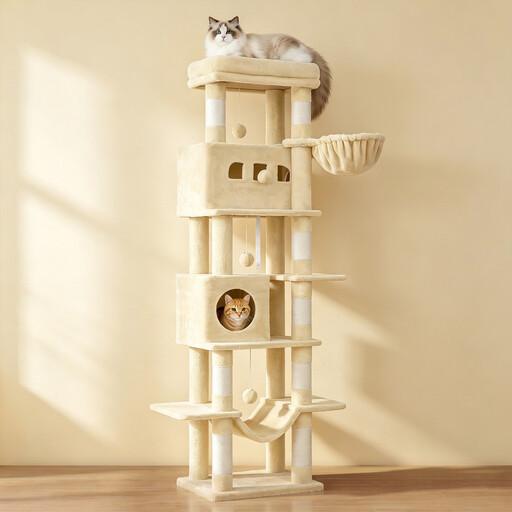
Why it suits this profile: This model is designed for households looking for several levels, multiple hideaways and plenty of scratching space. Its stated height is 212,5 cm.
The product description lists a double base plate, an anti-tip fastener and 17 thickened posts. Before buying, check that you have enough height and a suitable place to secure it.
Eight sisal posts, two cat houses, a hammock, a bed and a 65 × 45 cm platform.
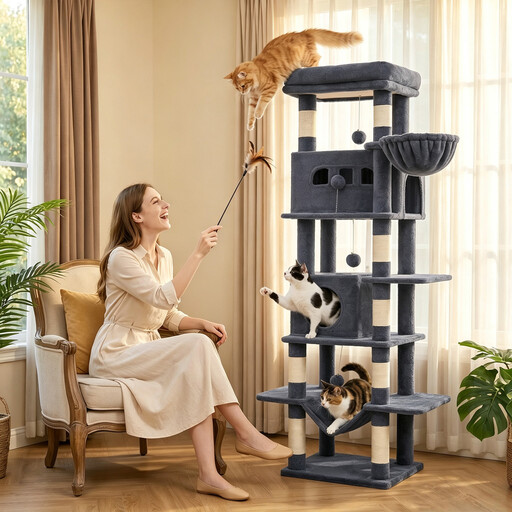
Why it suits this profile: Its vertical layout makes good use of height while keeping the floor space needed to a minimum. It could suit a smaller home with several cats, provided it’s assembled correctly.
The product information lists a widened base, anti-tip features and eight sisal posts. The loose, removable cushions may also make cleaning easier.
Six levels, two cat caves, a hammock, a 60 × 40 cm platform and 400 g/m² upholstery, according to the product description.
If you’re mainly looking for a natural look, another option is the Viervoeter Cat Tree, 160 cm. According to the product information, it has three levels, sisal posts, six extra branches and measures 165 × 60 × 60 cm. The manufacturer says it’s suitable for large cats; still, check the platform width and stability for your own cats.
We’ve put together a complete, up-to-date list of products that meet these strict selection criteria and the applicable European safety requirements.
Assemble all the parts according to the instructions, tighten the connections evenly and check that the base is level. Use the included anti-tip kit if there is one. Ideally, place a 212,5 cm model against a suitable wall and check all the connections again after a few days.
Its lifespan depends on the number of cats, their weight, how much they jump and the quality of the connections. Sisal wears out most in the spots where cats scratch the most. Check regularly for loose posts, torn fabric and wobbly platforms. Replace any part that’s no longer securely attached.
It can be, if the cat tree is designed to make the most of vertical space. Measure the floor area, ceiling height and walking routes beforehand. A narrow model saves space, but shouldn’t come at the expense of a wide base or resting spots that are large enough.
