
Vandaag of morgen in huis

Kwaliteit gegarandeerd

Welkomstaanbiedingen ontgrendelen: GRATIS bezorging | Tot 80% korting | Gratis 30 dagen JoyPlus-proefperiode
Download de app
At first glance, choosing a large cat tree might seem to be all about height and plenty of soft cushions. In practice, stability, dimensions and durability are what determine whether it remains a pleasure to use. Small construction flaws can soon become apparent, especially with large cats, active climbers or households with multiple cats.
Look out for these common pitfalls:
A sturdy cat tree needs more than a weighty appearance. Check the width and depth of the base, the thickness of the support posts and whether an anti-tip feature is included. A fastening strap or anti-tip kit can provide extra security when the tree is placed against a wall.
The layout also matters for a tall cat tree. Platforms spaced around 20 to 40 cm apart can make climbing up and down easier. Place the tree on a level surface and, after assembly, check that all the connections are secure.
A cat tree for large cats needs enough room to lie down. A small perch may be uncomfortable for an adult cat, even if the overall tree is tall enough. Look for:
According to the product information, the first product is suitable for up to six cats, each weighing 6.8 kg. This is a product specification provided by the seller. Always check that your cats’ weight and the way you plan to distribute them across the platforms are suitable.
A sisal scratching post gives cats a designated surface for scratching. Don’t just look at the number of posts; check where they’re positioned too. Sisal on several levels may be more appealing than a single post at the bottom.
Also check whether:
According to the sellers’ own product information, certain models can help protect furniture by providing designated scratching areas. This doesn’t guarantee that a cat will never scratch a sofa or chair again: getting used to the tree, where it’s placed and the cat’s personality all play a part.
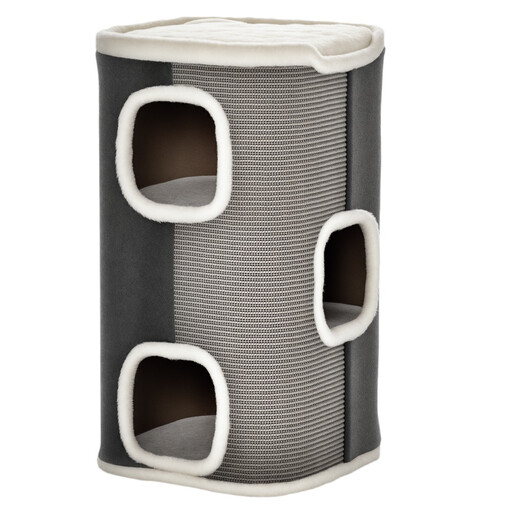
Why it suits this profile: At 40 × 40 × 74 cm, this compact model takes up less floor space and combines resting and play areas with natural sisal.
Its compact design means you won’t pay more for a tall tower that doesn’t fit your space. Check that the dimensions are large enough for your cat.
Three levels, two connected openings, and a combination of plush and sisal.
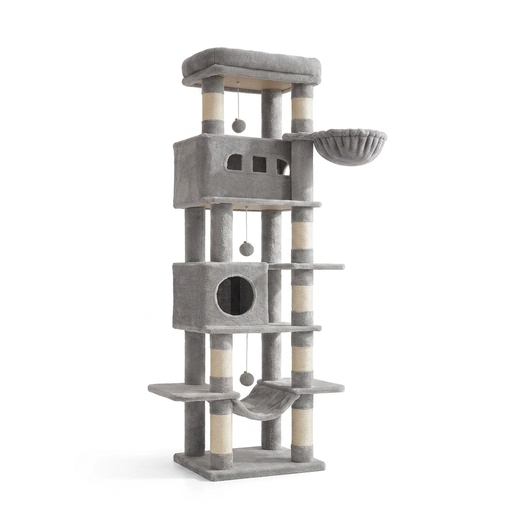
Why it suits this profile: With six levels, spacious resting areas and several places to relax, this cat tree is well suited to households looking for a feature-packed cat tree.
The double reinforced base and anti-tip feature are designed to reduce movement when cats climb and jump. Correct assembly and placement still matter.
170 cm tall, with 17 support posts, including 8 covered in sisal, two cat houses, a hammock and two washable cushions.
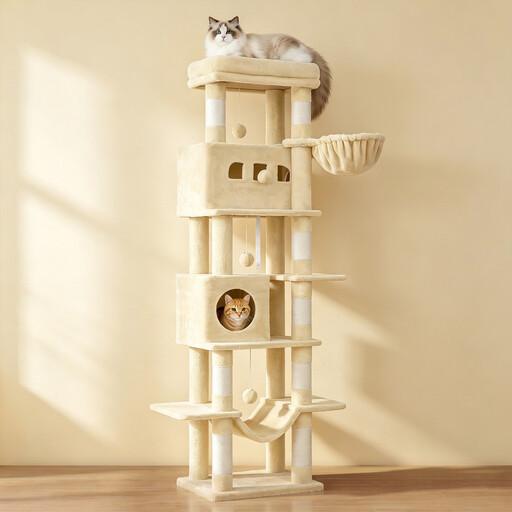
Why it suits this profile: Standing 212.5 cm tall, with two cat houses and several resting spots, this model is designed for active cats and households with multiple pets.
The double base, 17 posts and built-in anti-tip lock help address the main stability risks of a tall cat tree.
Two cat houses, a hammock, a 30 cm bed, washable cushions and eight replaceable hanging toys.
We’ve put together a complete, up-to-date list of products that meet these strict selection criteria and the applicable European safety regulations.
If you want to stop your cat jumping from the tree onto the sofa, don’t place a large cat tree right next to a delicate piece of furniture. A spot by a window can be appealing, but leave enough space between the tree and curtains, loose cables or breakable ornaments.
Tighten the connections again after a few weeks. Check the sisal, hanging toys and fastening straps for signs of wear too. Replace any loose or damaged parts before your cat swallows them or gets injured. Cat trees generally last longer when you remove hair regularly and avoid getting the plush unnecessarily wet.
Don’t just look at the overall height. Measure the width of the platforms, the diameter of the bed and the opening of the cat house. For multiple cats, several resting spots are more practical than one large platform at the top.
Assemble all the posts according to the instructions, place the base on a level floor and use the anti-tip kit provided if recommended. A tall cat tree shouldn’t wobble noticeably during normal use.
Its lifespan depends on the cats’ weight and behaviour, the quality of the connections and how well it’s maintained. Sisal wears out more quickly with frequent scratching. Check the posts, screws, hammock and cushions regularly, and replace any parts that come loose.
