
Vandaag of morgen in huis

Kwaliteit gegarandeerd

Welkomstaanbiedingen ontgrendelen: GRATIS bezorging | Tot 80% korting | Gratis 30 dagen JoyPlus-proefperiode
Download de app
A large cat tree can be a valuable addition for active cats, large breeds or multi-cat households. However, a tall scratching post often looks sturdier in a product photo than it is in practice. A narrow base, sleeping areas that are too small or sisal covering only certain sections can limit how useful it is.
Use these checkpoints to avoid a poor purchase and choose an indoor cat tree that suits your space, your cats’ weight and their behaviour.
A cat climbing tree measuring more than two metres provides plenty of vertical space, but height alone says nothing about stability. Also check the dimensions of the base, the material used for the platforms and whether an anti-tip feature is included. With tall models, fixing the tree to a load-bearing wall is often sensible or expressly recommended in the product instructions.
A stated static weight capacity is a technical indication measured under a stationary load. It does not automatically mean that cats can jump onto a platform together without risk. You should also consider the number of cats, the weight supported by each platform and how the tree needs to be assembled.
A cat tree with one sisal post may technically be a scratching post, but it offers little choice. For active cats, it is more practical if several routes and levels are covered with natural sisal. Also check whether the posts are thick enough and whether loose or replacement parts are available.
First measure the space where the large cat tree will stand. Take skirting boards, doors and walkways into account. A model measuring 206 or 212.5 cm needs a high ceiling and must be possible to assemble upright.
Pay attention to the size of the sleeping areas. A wide top platform is more useful for a large cat than several small platforms. For multi-cat households, different resting zones are also important: consider cat houses, a basket, a hammock and open lookout platforms.
A stable cat tree will generally have a wide or reinforced base, sturdy connecting pieces and platforms that do not visibly bend. Chipboard or particle board is common in this type of cat furniture. The quality of the assembly, the thickness of the panels and the connections all affect how sturdy the finished tree feels.
Assemble the tree exactly according to the instructions. Use the supplied anti-tip kit when one is mentioned. If the model is placed on a smooth floor, use a non-slip underlay if this improves stability. Check all screws after the first few days and regularly thereafter.
Sisal is intended as a scratching surface, while soft plush upholstery is mainly suitable for resting areas. Check whether the upholstery can be removed or cleaned. In multi-cat households, baskets and hammocks collect hair and dust more quickly.
A cat tree with a hammock is appealing to cats that like to lie somewhere soft and slightly above the ground. A cat tree with cat houses is better suited to animals that like to retreat. If you are unsure, choose a combination of open and enclosed resting places.
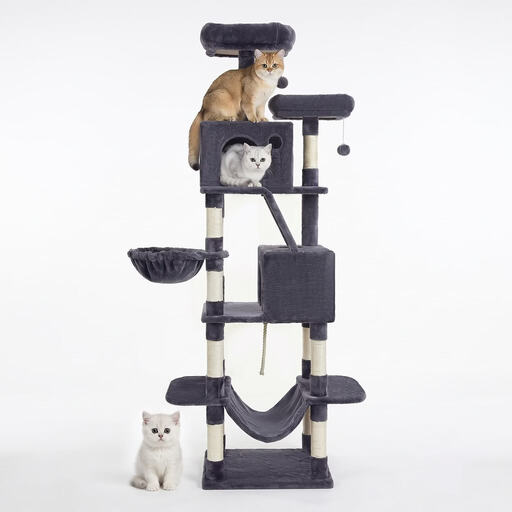
Why it suits this profile: This model combines a tall cat climbing tree with two platforms, two cat houses, a hammock and 13 sisal posts. This gives a household plenty of features in one piece of furniture.
The product information specifies a reinforced base and a total static load of up to 70 kg. The supplied anti-tip feature must be used correctly according to the instructions.
206 cm high; 13 natural sisal posts; two enclosed resting areas and a hammock.
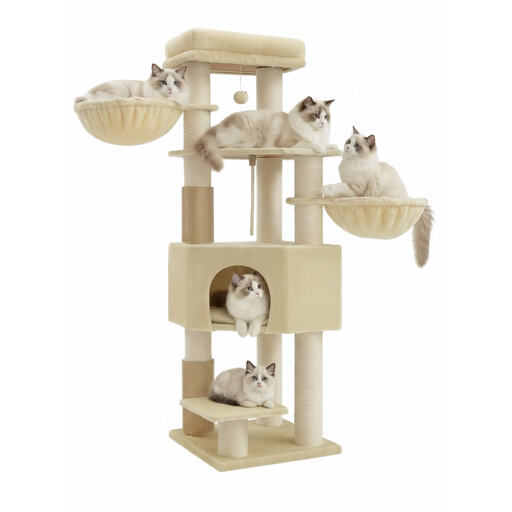
Why it suits this profile: This model is designed for large cats and combines a wide lounging area with a cave, baskets, nine sisal posts and removable mats.
The stated base measures 50 × 50 cm and the model includes an anti-tip kit. According to the product information, the static load is 105 kg; fixing it to a load-bearing wall remains mandatory under the usage instructions.
160 cm high; nine sisal posts; removable upholstery and an integrated brush.
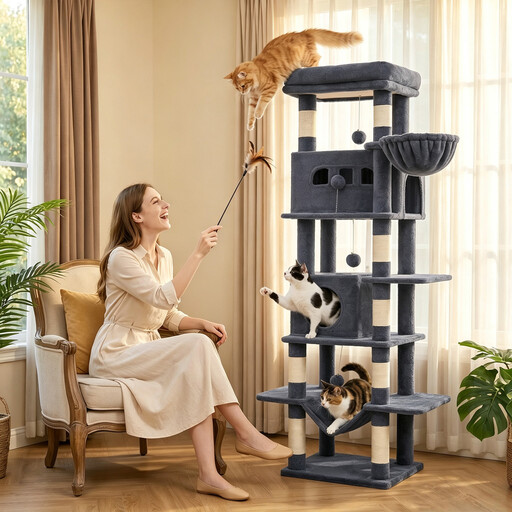
Why it suits this profile: The six levels, two cat houses, wide platforms, basket and hammock are designed for cats that love climbing and for multi-cat households.
The product description mentions a widened, reinforced base and anti-tip features. Check that all parts are present on delivery and follow the assembly instructions.
212.5 cm high; six levels; 60 × 40 cm platform and eight sisal posts.
Place a tall cat scratching post on a flat, dry and non-slip surface. Do not put it next to a heater, open fire or window cords. A spot by a window may be appealing, but leave enough distance from cables and blinds.
Give your cat time to get used to it. If necessary, encourage them towards a lower level with a toy and use a sisal post as their first scratching spot. Check the screws, connecting pieces, platforms and fabric parts regularly. Stop using the tree if any part is cracked, loose or heavily worn.
A small addition could be loose toys, such as the Meowmagic Feather and Sisal Ball Toy Pack of 4. Check toys before use and replace them as soon as feathers come loose or the sisal starts to fray. For more play ideas, you can also browse the range of toys for older cats.
We have put together a complete, up-to-date list of products that fully meet these strict selection criteria and the applicable European safety regulations.
This depends on your ceiling height and your cats’ preferences. Models measuring 160 cm provide vertical play space without being extremely tall. An XXL cat tree measuring 206 or 212.5 cm makes greater use of the available height, but requires extra attention to wall fixing and assembly.
Its lifespan depends on usage, weight, assembly and maintenance. Check the sisal posts and fixings regularly. A worn sisal surface or damaged platform must be replaced or repaired before cats use the tree again.
It can be, provided there are enough resting and scratching areas and the weight capacity is suitable for the intended use. Multiple cat houses, platforms and a cat tree with a hammock help reduce competition for one favourite spot. Always check the stated weight limits and secure a tall model according to the instructions.
