
Vandaag of morgen in huis

Kwaliteit gegarandeerd

Welkomstaanbiedingen ontgrendelen: GRATIS bezorging | Tot 80% korting | Gratis 30 dagen JoyPlus-proefperiode
Download de app
A large cat tree offers more than somewhere for your cat to sharpen its claws. Cats use a cat tree to climb, rest, play and keep an eye on their surroundings. However, a large model won’t automatically suit every home or cat. A tall structure can wobble, soft covering can wear quickly, and an impressive number of levels doesn’t necessarily make it easier to use.
Keep these points in mind to avoid a poor purchase and choose more confidently between a large cat tree, a cat tree with a bed or one with a hideaway.
A tall cat tree takes up vertical space, but it also needs a sturdy base. A narrow base combined with several upper platforms can feel unstable when an adult cat jumps on it. Always check the base dimensions, the overall height and whether an anti-tip device is included.
A stable cat tree is particularly important in a home with several cats. The strain comes not only from their weight, but also from jumping and landing at the same time.
A cat tree with a hideaway, hammock, play platform and bed sounds like it has everything. In practice, small resting spots or narrow passages can be awkward for larger cats. So check the size of the resting areas, not just the total number of features.
For example, a wide top platform may be more useful than an extra small shelf. Compact levels are often easy for kittens to reach, while adult cats need more room to move around.
A sisal cat tree is only practical if your cat can easily reach the scratching areas. Sisal around the support posts is useful, as cats can scratch as they climb. Check the position and number of sisal posts, as well as how the material is attached. A brand’s product information may state that sisal is suitable for scratching, but how long it lasts in practice depends on factors such as scratching habits, frequency of use and maintenance.
First, measure the space available. Leave enough room around the cat tree for jumping and walking. A 130 cm model may fit well in a flat, while a 212,5 cm structure may be better suited to homes with plenty of vertical space.
Look out for the following:
A stable cat tree has a wide or reinforced base and a structure that doesn’t move easily from side to side. Some models come with an anti-tip kit. Use it as directed by the manufacturer, especially with tall cat trees or if you’re placing one in an area where children and pets spend time.
An anti-tip kit is no substitute for correct assembly. Tighten the fixings according to the instructions and check that all the parts fit together properly once assembled. Also check the screws, posts and platforms regularly.
Many cat trees combine plush covering with sisal scratching posts. Plush can be comfortable, but it needs regular vacuuming. Removable cushions or washable covers are handy if the tree gets heavy use. A hammock or cat bed should be securely attached to the structure and must not hang over a walkway.
Before buying, also check the product information for assembly instructions, included parts, weight limits and indoor use. European product safety is about more than just the materials: safe design, correct assembly and responsible use matter too.
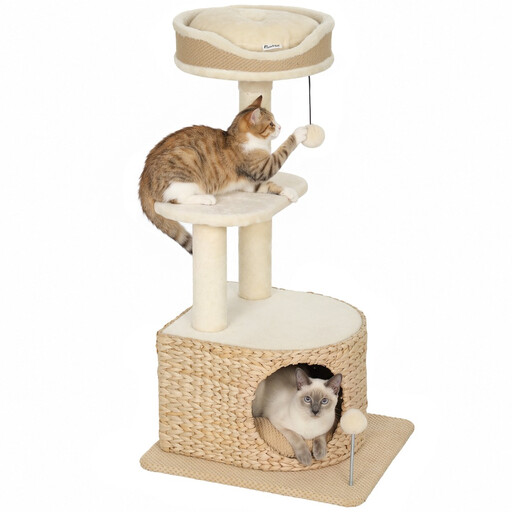
Why it suits this type of owner: At 87 cm tall with four levels, this is a simple, manageable option for kittens, smaller cats and homes where a tall cat tree won’t fit.
Its lower structure helps avoid the risk of an overly tall, narrow tower. Do check that the resting areas are the right size for your cat.
Four levels, a jute scratching post, a club-shaped hideaway and a hanging resting spot.
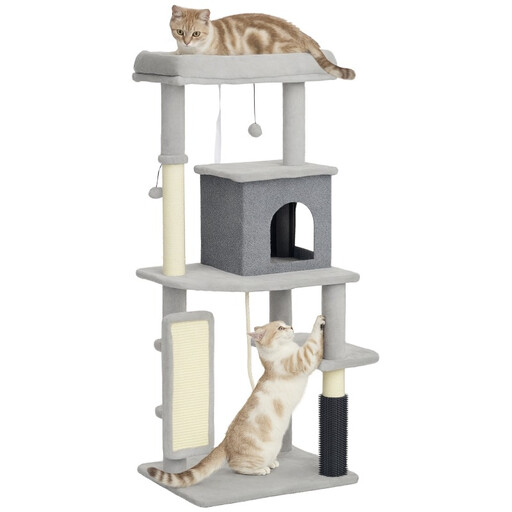
Why it suits this type of owner: This model combines a height of 132 cm with sisal scratching posts, a cat bed, a hideaway and a jumping platform.
The product information lists an anti-tip kit. Use it according to the assembly instructions, then check that the structure is secure.
Sisal posts, a cat bed, a condo, a play platform and a grooming brush in one cat tree.
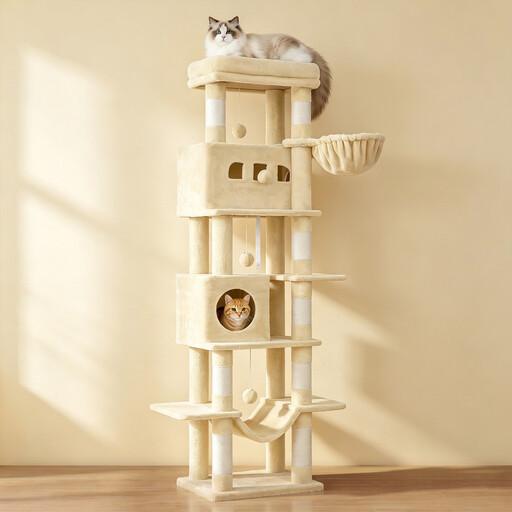
Why it suits this type of owner: Standing 212,5 cm tall, with six levels, two cat houses and a hammock, this model is designed for heavy use and homes with several cats.
The product information lists a double base, an anti-tip lock and 17 support posts. The stated capacity is up to six cats, each weighing less than 6,8 kg; check that this is suitable for your situation.
Eight sisal posts, two hideaways, a hammock, a 30 cm bed and wide platforms.
We’ve put together a complete, up-to-date list of products that meet these strict selection criteria and the applicable European safety requirements.
Place a large cat tree on a level surface, ideally somewhere your cat can see the room. Don’t put it right next to a delicate cabinet or in a narrow passageway. A spot by a window can be appealing, but check that your cat can’t use the tree to reach an open window that could be unsafe.
Check the cat tree regularly for loose fixings, fraying sisal and damaged hanging toys. Replace any parts that come loose or pose a risk. If you have several cats, it’s a good idea to provide separate resting and scratching spots in other rooms as well as the large cat tree.
Don’t just look at the height. A cat tree for several cats should ideally have multiple resting spots, enough space between levels and a wide base. Also check the recommended weight limit and the dimensions of the platforms.
Assemble all the parts according to the instructions, place the tree on a level floor and use the included anti-tip kit if specified. Check the fixings again after a few days of use, as the parts may settle.
Its lifespan depends on the number of cats, their weight, their scratching habits, and the quality of the assembly and maintenance. Sisal and covering tend to wear most with use. Regular vacuuming, tightening the fixings and replacing loose parts promptly can help keep the cat tree in good condition.
