
Vandaag of morgen in huis

Kwaliteit gegarandeerd

Welkomstaanbiedingen ontgrendelen: GRATIS bezorging | Tot 80% korting | Gratis 30 dagen JoyPlus-proefperiode
Download de app
A large cat tree might seem straightforward to choose at first. However, there are clear differences in stability, finish and usable space. A model that is too lightweight can quickly start wobbling, especially with large or chubby cats, or in a home with more than one cat. A tall cat tree with few sturdy scratching surfaces may also disappoint in practice.
So don’t focus only on the height or number of levels. Check for these common pitfalls in particular:
For a stable cat tree, the size of the base is at least as important as the height. A tall, narrow cat tree needs a wide base and, ideally, an anti-tip fitting that can be secured to the wall. Place the tree on a level surface and check that all the joints are secure after assembly.
A manufacturer may state a weight capacity. Treat this as product information from the brand and always check whether it refers to the total weight or the weight per cat. In a multi-cat household, you’ll also need to account for their combined weight when they climb or rest at the same time.
A cat tree for large cats needs more than an extra level. Look for:
According to the product information, the 170 cm model has six levels, with gaps of around 20 to 30 cm between them. The large platform measures 50 × 30 cm and the larger house measures 50 × 40 cm. These are specific measurements you can check, and they tell you more than a description such as “extra large”.
Sisal scratching posts are popular because sisal has a rough texture that suits cats’ natural scratching behaviour. Check how many posts are actually covered in sisal and where they’re positioned on the cat tree. A model with scratching surfaces at several heights offers more choice than a single post at the bottom.
Also consider how easy the tree is to care for. Removable cushions, washable covers and surfaces that can be cleaned with a vacuum cleaner or lint roller are practical in a home with indoor cats. Replaceable play balls mean a small defect won’t immediately make the whole tree unusable.
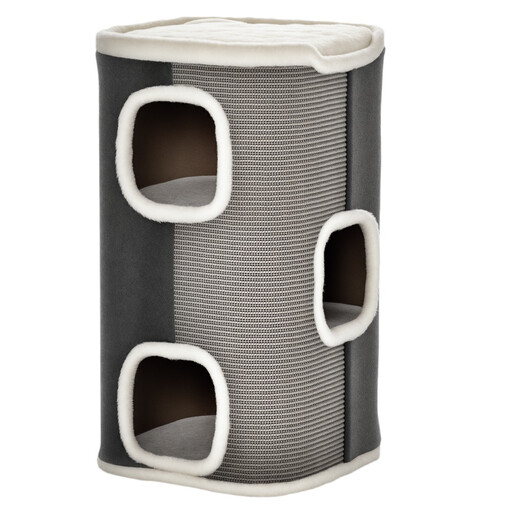
Why it suits this profile: At 40 × 40 × 74 cm, this compact model is ideal for a flat or smaller room where a tall scratching post isn’t practical. Its three play levels combine resting, climbing and scratching.
The dimensions are clearly stated, so you can check in advance whether the tree will fit your available space. Its two large, connected openings offer more usable room than a single small sleeping spot.
Compact design, natural sisal and three areas for play and rest.
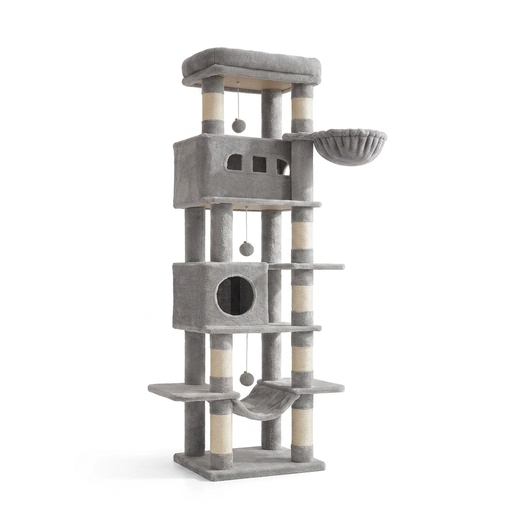
Why it suits this profile: This cat tree combines height with a choice of resting spots and play accessories. According to the product information, it has 17 support posts, eight of them covered in sisal, as well as two houses, a hammock and a 30 cm basket.
The scratching areas aren’t limited to one spot. The wide base and supplied anti-tip fitting are designed to reduce movement and the risk of tipping, but correct assembly and fixing are still important.
Six levels, two removable cushions and several places to rest and scratch.
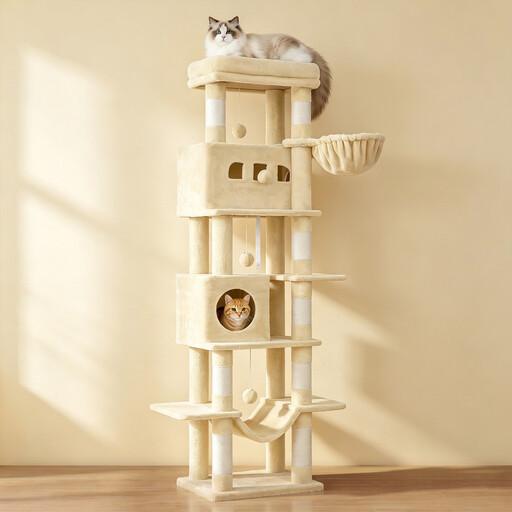
Why it suits this profile: This model is designed for multi-cat households and cats that love to climb. The product information lists six levels, two houses, a 65 × 45 cm platform, a hammock and a 30 cm basket.
According to the product description, the double base, 17 support posts and anti-tip strap are designed to provide extra stability. Before buying, check the stated weight limit and how the tree can be secured.
212.5 cm tall, with eight sisal posts and several separate resting spots.
We’ve put together a complete, up-to-date list of products that meet these strict selection criteria and the applicable European safety regulations.
First, measure the space where you plan to put the cat tree. Allow for the ceiling height, skirting boards and furniture. A tall scratching post often works well by a window, but check that the floor is level there and that your cat can jump safely.
Tighten the screws again after a few weeks. Regularly check whether the sisal is coming loose, platforms are tilting or cushions are damaged. Replace loose parts before your cats start pulling at them. Use the anti-tip mechanism according to the assembly instructions, and don’t place heavy models on a slippery surface without suitable protection.
Pay particular attention to the dimensions of the platforms, houses and baskets. A height of 130 to 170 cm may be enough for many indoor cats, but a larger cat mainly needs wide platforms and a sturdy base. Always compare the exact measurements with your cat’s body length.
It can be, provided the tree has several resting spots, enough scratching posts and a sturdy base. Check the stated weight capacity and whether cats can pass one another on the platforms and between levels. An anti-tip fitting is especially important for large or active cats.
Its lifespan depends on how intensively it’s used, how many cats use it, and the quality of the joints and sisal covering. A tree with replaceable play balls and securely fastened parts may be easier to maintain. Check the sisal regularly and replace the scratching post when its posts become unstable.
