
Vandaag of morgen in huis

Kwaliteit gegarandeerd

Welkomstaanbiedingen ontgrendelen: GRATIS bezorging | Tot 80% korting | Gratis 30 dagen JoyPlus-proefperiode
Download de app
A large cat tree can combine many functions in a multi-cat or active household: climbing, scratching, playing and sleeping. However, a tall model is not automatically suitable. A narrow base, small resting areas or too little sisal can make the cat tree wobble, wear out quickly or barely get used.
As a Joybuy Product Recommendation Officer, I filter product information based on verifiable features. So don’t just look at the number of levels or an attractive photo. Focus mainly on the construction, dimensions and maintenance options.
A tall cat tree appeals to cats that like to keep watch, but greater height also raises the centre of gravity. A model with a narrow base can move when cats jump on it or use it at the same time. So check:
An anti-tip mechanism helps, but you should still place the cat tree on a level surface. After assembly, check that all the connections are securely tightened.
A cat tree can look comfortable while still offering too few scratching options. Cats often prefer vertical, securely wrapped posts to a small horizontal surface. Sisal scratching posts at various heights are practical, especially if you want to protect your furniture from scratch damage.
Pay attention to the number and position of the sisal posts, and check whether replacement parts are available. A loose sisal mat or thin rope can wear out more quickly with intensive use.
A cat house or cat hammock should be large enough for the cat using it. Small houses and narrow platforms can be uncomfortable for large or heavy cats. Look at the actual dimensions rather than relying only on terms such as “extra large” or “for all cat breeds”.
With a cat tree for multiple cats, several resting areas are important. This means the cats don’t all have to share the same top platform. Also consider the distance between levels: steps of around 20 to 40 cm are easier for many cats to use than large, awkward jumps.
Ideally, choose a stable cat tree with a wide base, several support posts and clear assembly instructions. Product listings sometimes state a load capacity for multiple cats. Always read the conditions, such as a maximum weight per cat.
According to the product description, the Reinforced Cat Tree has a capacity of up to six cats weighing no more than 6.8 kg each. This is a specification from the product information, not a guarantee for every home or usage situation. Check whether the available resting areas are also practically large enough for your cats.
A cat climbing post is more versatile when the support posts also serve as scratching posts. Check whether the sisal is positioned along routes where cats actually climb and descend. Eight sisal posts spread across different levels may offer more opportunities for use than one large scratching column at the bottom.
A well-planned layout can also help redirect scratching behaviour away from sofas, chairs and door frames. However, this effect depends on your cat’s preferences and where you place the cat tree.
A practical cat furniture unit combines climbing areas with a cat house, platforms and, potentially, a cat hammock. Removable cushions are useful when hair, dust or dirt builds up. Also check whether the cover can be cleaned with a vacuum cleaner or lint roller and whether the components are removable.
Don’t place the furniture directly next to a radiator or somewhere a cat could fall through an open window. A quiet corner with a view of the room is often more practical than a spot where people frequently walk past.
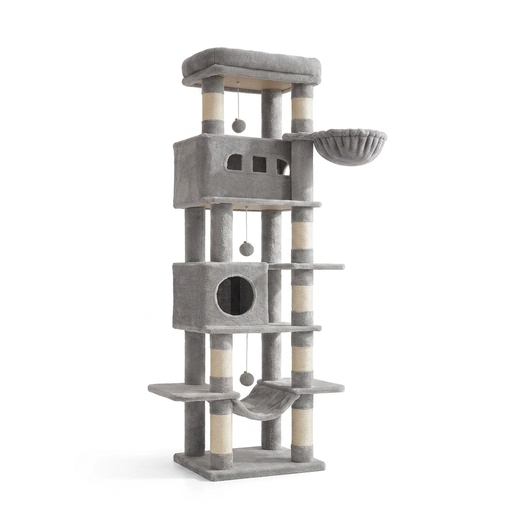
Why it suits this profile: This model offers six levels, a large and a small cat house, a hammock and two removable cushions. It gives you several functions in one piece of cat furniture without immediately opting for a model over two metres tall.
The product description lists 17 support posts, eight of which are covered in sisal, as well as a double reinforced base and anti-tip device.
170 cm tall; 50×30 cm platform; removable top platform and two washable cushions according to the product information.
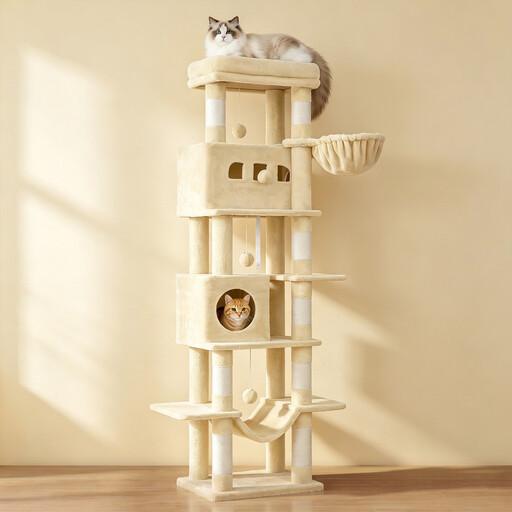
Why it suits this profile: If you’re mainly looking for plenty of scratching zones and separate resting areas, this 212.5 cm structure offers two cat houses, a hammock and a raised basket.
The product description mentions eight sisal posts in key climbing areas, a double base and a built-in anti-tip lock.
65×45 cm wide platform; two cat houses; 30 cm enclosed basket; two washable cushions; stated capacity of up to six cats weighing no more than 6.8 kg each.
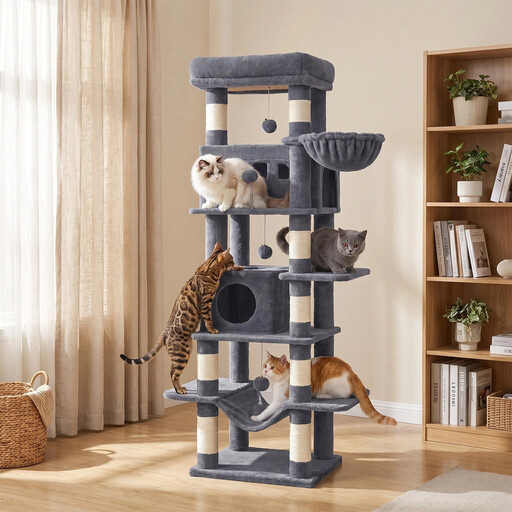
Why it suits this profile: This model is designed for households with multiple, larger or somewhat heavier cats, combining a tall climbing structure with separate sleeping and play zones.
According to the product listing, there are scratching surfaces on five levels, eight sisal-covered posts and a widened double base with an anti-tip device.
170 cm tall; 17 support posts; hammock; 30 cm basket; two removable, washable cushions.
We’ve put together a complete, up-to-date list of products that fully meet these strict selection criteria and the applicable European safety regulations.
Place a large cat tree somewhere the base cannot shift. An anti-slip mat can help on a smooth floor. With a tall model, it is advisable to use the included anti-tip device when required by the assembly instructions.
Every few weeks, check:
Replace loose toys immediately if any parts could come away. A damaged cat tree does not always need to be replaced completely; with some models, cushions, balls or sisal posts can be replaced individually. Check this before buying.
As well as the overall height, consider the number of resting areas and the size of the platforms. For multiple cats, at least two separate resting zones are practical. For larger cats, wide platforms and a sturdy base are more important than simply having extra levels.
Choose a quiet, level spot with a view of the room. Keep it a safe distance from windows, delicate decorations and heat sources. Make sure the cat tree is not positioned in a walkway and that cats can move safely from one level to the next.
Its lifespan depends on use, weight, assembly and materials. With intensive use, sisal posts and hanging toys usually wear out sooner than the base. Regularly tightening the fittings, cleaning the furniture and replacing parts in good time can help keep it usable for longer.
