
Vandaag of morgen in huis

Kwaliteit gegarandeerd

Welkomstaanbiedingen ontgrendelen: GRATIS bezorging | Tot 80% korting | Gratis 30 dagen JoyPlus-proefperiode
Download de app
A large cat tree gives your cat space to climb, scratch, play and sleep. However, a tall cat tree isn’t automatically suitable for large or heavy cats. A narrow base, too little sisal or undersized resting spots can make it wobble and leave your cat hardly using it at all.
So don’t focus only on the height or number of levels. These three pitfalls are common:
A tall cat tree gives cats more room to move vertically, but the construction needs to be up to the job. Check:
For everyday use, a wide, double base is more practical than simply choosing an extra-tall tower. Place a tall cat tree on a level surface, and after assembly check that all the connections are secure.
A sturdy scratching post should have enough vertical or horizontal scratching surfaces. Check how many posts are covered in sisal and how they’re distributed across the levels. A model with just one small scratching area may soon lose its appeal, especially in a household with several cats.
Sisal doesn’t guarantee that your cat will choose the post over the furniture. Its location, height and texture also play a part. For example, place the scratching post near somewhere your cat already likes to scratch or rest.
A scratching post with a basket or cat house can provide extra space to rest. For large cats, the dimensions of the platforms and resting spots are particularly important. In a multi-cat household, several sleeping spots can help prevent a bottleneck around one favourite place.
Also check whether the cushions are removable and washable. Plush surfaces can collect hair, so a model that can be cleaned with a vacuum cleaner or lint roller will usually take less day-to-day effort. Check the product dimensions and stated weight capacity before buying. A general description such as “for several cats” doesn’t tell you how much weight the structure can actually support.
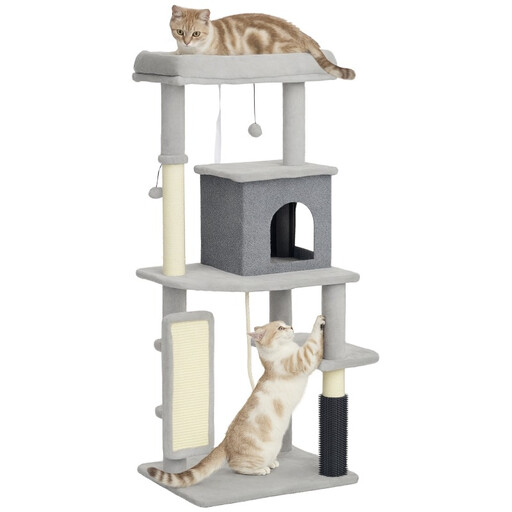
Why it suits this profile: A compact option for a household looking to add vertical space without going straight for an XXL scratching post. The product name lists sisal scratching posts, a cat bed, a cat house and an anti-tip kit.
The anti-tip kit is a useful feature to consider when it comes to assembly and stability. Be sure to check the full dimensions and fitting instructions before use.
132 cm tall; sisal, a resting spot, cat house and jumping platform, according to the product title.
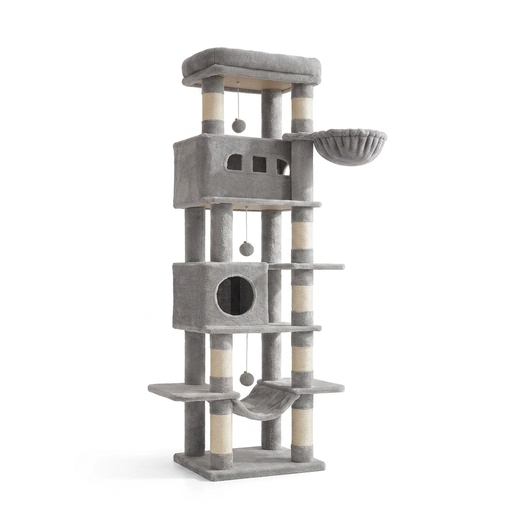
Why it suits this profile: This model combines six levels with places to rest and play, making it a good choice for households looking for a cat tree with plenty of features.
The product description specifies 17 posts, eight of them covered in sisal, as well as a widened, double-reinforced base and an anti-tip feature.
170 cm tall; large 50 × 30 cm platform, 50 × 40 cm cat house, hammock, 30 cm basket and two removable cushions.
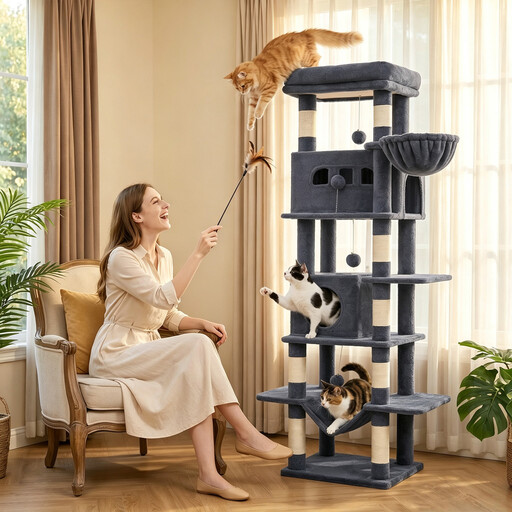
Why it suits this profile: Its height and layout are designed for households with several cats or cats that love to climb. Its vertical design takes up relatively little floor space.
The product description lists eight sisal posts, a widened reinforced base and anti-tip features. Before buying, check that the stated weight capacity is suitable for your cats.
212.5 cm tall; six levels, two cat houses, a hammock and a 60 × 40 cm platform with removable cushions, according to the product description.
Don’t place a large cat tree right next to a radiator, freestanding piece of furniture or narrow doorway. A level floor and plenty of clear space around the base help reduce the risk of collisions. An anti-tip feature is particularly important for a very tall cat tree. Use it as directed in the instructions, and check regularly that no screws have come loose.
Introduce the cat tree gradually. Put a familiar toy on a lower level and let your cat explore the higher levels in its own time. Don’t force it to use the tree. Check the sisal, connections and upholstery regularly. Replace damaged toys or parts if the product information says they can be replaced.
We’ve put together a complete, up-to-date list of products that meet these strict selection criteria and the applicable European safety regulations.
It depends on the space you have available, your cat’s age and how much it likes to climb. A model around 130 cm tall may be enough for basic use. For cats that like to perch up high, models measuring 170 cm or more provide extra vertical space. Always check the width of the base and the dimensions of the resting spots too.
It can be, as long as there are enough places to rest and scratch, and the structure can support their combined weight. Several cat houses, a basket and a range of platforms mean less waiting for one favourite spot. Check the stated weight capacity for each model and position the tree securely.
Its lifespan depends on the materials, how often it’s used and how well it’s maintained. Sisal and attachment points tend to take the most wear. Vacuum the upholstery, tighten any loose connections and replace parts where possible. A model with replaceable toys or washable cushions may be more practical for everyday use.
