
Vandaag of morgen in huis

Kwaliteit gegarandeerd

Welkomstaanbiedingen ontgrendelen: GRATIS bezorging | Tot 80% korting | Gratis 30 dagen JoyPlus-proefperiode
Download de app
A large cat tree needs to offer more than a few sisal posts and a soft place to lie down. For heavier cats or households with several cats, stability, weight capacity and a well-designed layout matter more than a striking appearance.
Many buyers run into the same problems:
So don’t focus on height alone. A 170 cm cat tower may be less practical than a lower model with a wider base, enough room on each level and an anti-tip feature.
A sturdy cat tree starts at the base. Check its dimensions and see whether it’s double-layered or reinforced. A narrow base may seem convenient in a small room, but it offers less resistance to sideways movement when a cat jumps or lands on a hammock.
An anti-tip feature, such as a fixing strap or anchor point, provides an extra safety measure. Place the cat tree on a level floor and fit the feature according to the assembly instructions. Consider the stated weight capacity in relation to how the tree will actually be used: several cats climbing at once put a different strain on the structure than one cat resting quietly in a basket.
For large cats, height isn’t the only thing that matters. In particular, measure:
A platform that only fits a cat’s front paws is unlikely to be used as a resting spot very often. A spacious cat tree with several levels gives cats the chance to climb, move away from each other and sleep separately. This is especially useful with a cat tree for multiple cats.
Sisal scratching posts are designed to provide a dedicated scratching surface. Check how many posts are covered in sisal and whether they’re easy to reach vertically. Cats don’t all scratch in the same way: some stretch out to do it, while others prefer to scratch horizontally.
Also look for removable cushions and washable parts. Plush covering can be comfortable, but it collects hair. A design that’s easy to clean with a vacuum cleaner or lint roller can save you time. Always check the product information before buying to see how to wash and wipe it down, and how to fit any replaceable parts.
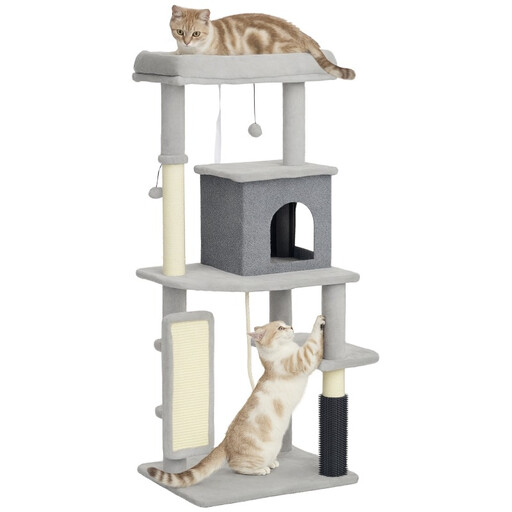
Why it suits this type of buyer: This model combines a cat hideaway, resting spot, jumping platform and sisal posts without the height of a very large cat tower. That makes it easier to fit into an average-sized flat.
The product information lists sisal scratching posts and an anti-tip kit. During assembly, check that the fixing is securely attached to the wall or fitted as instructed in the manual.
132 cm tall, with a cat bed, hideaway, jumping platform and grooming brush; suitable for resting, climbing and scratching.
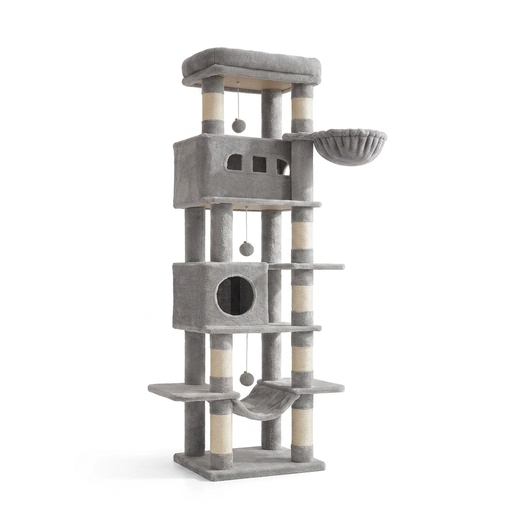
Why it suits this type of buyer: Its six levels, two cat hideaways, hammock, 30 cm basket and two cushions provide a variety of places to rest and play. It’s a good fit for households looking for a versatile piece of cat furniture.
The specifications list 17 support posts, eight of them covered in sisal, as well as a widened double base and an anti-tip feature. This gives you more detail about the structure than models that only state their height.
170 cm tall, with six levels, eight sisal posts, two cat hideaways, a hammock, a basket and removable cushions.
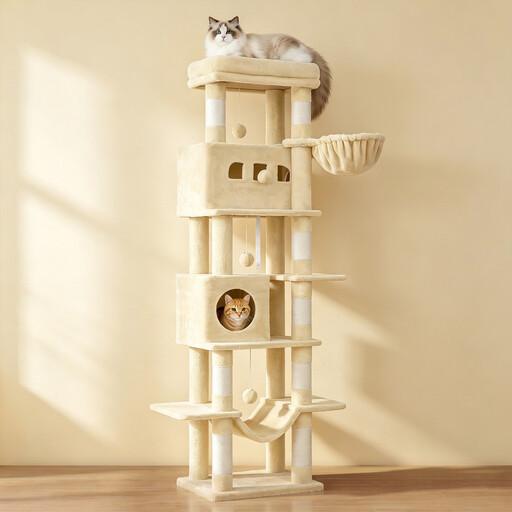
Why it suits this type of buyer: This model is designed for intensive use by multiple cats. Its six-level layout, two enclosed cat houses and wide top platform offer several features in one cat tree.
According to the product description, the model has 17 reinforced support posts, a double integrated base and an anti-tip lock. The stated maximum is six cats weighing up to 6.8 kg each; don’t exceed this limit.
212.5 cm tall, with a 65 × 45 cm platform, two cat houses, a hammock, a 30 cm basket and eight replaceable toy balls.
We’ve put together a full, up-to-date list of products that meet these strict selection criteria and comply with current European safety regulations.
Place a large cat tree somewhere your cat already likes to spend time, such as by a window or in a quiet corner of the living room. Leave enough clear space around the base for your cat to jump. Don’t put the tree right next to fragile ornaments or a radiator.
Check all screws and connections after assembly. Do so again after a few weeks of use, and whenever you notice movement or creaking. Replace damaged sisal or loose toy balls promptly. Cat furniture with a hammock and soft cushions will also stay more appealing if you remove hair regularly.
It depends on the space you have and your cat’s behaviour. A height of around 130 to 170 cm usually provides several levels to climb, but the width of the platforms and the stability of the base are just as important. For heavier cats, a wide, reinforced base is often more practical than simply choosing an extra-tall tower.
It can be, but consider the number of resting spots, cat houses and accessible scratching areas. With several cats, separate resting places and multiple routes up and down can help reduce congestion. In a larger household, having two cat trees in different parts of the home can be a practical addition.
Its lifespan depends on the cats’ weight and number, the quality of the connections and how intensively they scratch. Regularly check the sisal covering, screws, platforms and anti-tip feature. Any part that comes loose or splits should be secured or replaced before the cat tree is used again.
