
Vandaag of morgen in huis

Kwaliteit gegarandeerd

Welkomstaanbiedingen ontgrendelen: GRATIS bezorging | Tot 80% korting | Gratis 30 dagen JoyPlus-proefperiode
Download de app
A large cat tree for cats offers more than just somewhere to sharpen their claws. Cats use a cat tree to climb, play, retreat and sleep up high. In a home with several cats, a tree that’s too small or unstable can quickly cause problems.
When buying, don’t focus only on the colour or the number of toys. These common pitfalls are worth watching out for:
A 168 cm cat tree gives cats more vertical space. This is especially appealing to cats that like to survey the room from a raised spot. Make sure the ceiling height, available floor space and access around the tree are suitable.
Also check how many levels it has. A multi-level cat tree provides a better spread of places to rest and play. For example, a five-level model might combine a lower entrance, intermediate platforms and a higher resting area. This means cats don’t all have to use the same route or sleeping spot.
A sturdy cat tree should have plenty of vertical scratching surfaces. Check:
The model described here has 13 scratching posts and one scratching ramp, making a total of 14 scratching and climbing surfaces. The manufacturer lists particleboard, plush and sisal in its construction. These are verifiable product specifications; how long the tree lasts depends on how it’s used, the number of cats and how well it’s maintained.
A large cat tree takes up more space and has to withstand more movement. The product information lists a reinforced base, an anti-tip device and a total static load capacity of 65 kg. This doesn’t guarantee stability during every movement or jump. Distribute the load by placing the tree on a level surface, and secure it to the wall using the anti-tip device provided.
After assembly, check:
The instructions say to secure the cat tree to the wall. Let your cats get used to their new surroundings at their own pace, and check the fixings periodically.
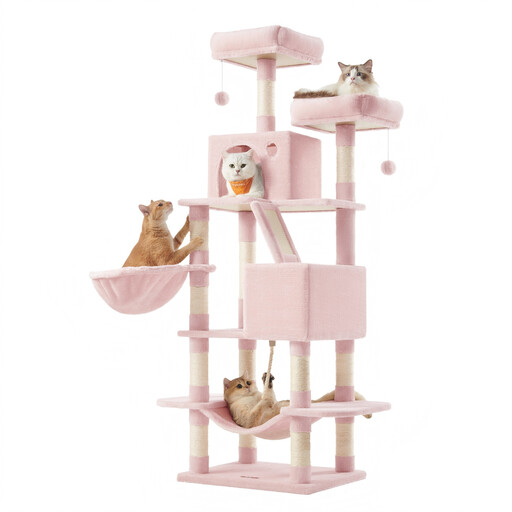
Why it suits this profile: A well-balanced combination of climbing spots, scratching posts and resting places for anyone buying a large cat tree for the first time. The pastel pink colour also works well in a light living space.
The specifications list five levels, a reinforced base and an anti-tip device. Even so, secure the tree to the wall and check that it’s assembled correctly.
168 cm high, with 13 sisal posts, one scratching ramp, two platforms, two cat houses, a basket and a hammock.
Why it suits this profile: Ideal if you’re looking for more than just a tall post and want to combine several features in one piece of furniture: scratching, climbing, hiding and resting.
The layout includes two soft resting spots, two cat houses, a basket and a hammock. That gives your cats several types of resting place, rather than just one high platform.
A combination of particleboard, plush and sisal, plus a stated static load capacity of 65 kg and an anti-tip device.
Why it suits this profile: The combination of plenty of scratching space and a variety of resting spots is well suited to homes where several cats are active at the same time.
The manufacturer says it’s suitable for up to six cats. This is a product claim, not a guarantee for every household; weight, temperament and supervision still matter.
Five levels, several resting spots, 13 scratching posts and a ramp. It measures 55 × 45 × 168 cm and weighs 18,4 kg.
Place the cat tree on a level floor, ideally with plenty of space around it. Match the parts to their labels and follow the assembly instructions provided. A spot by a window can be appealing, but avoid placing the tree next to a radiator or unstable piece of furniture.
Vacuum the plush surfaces regularly and remove hairs with a slightly damp cloth. Check the sisal posts, ramp, platforms and hammock for wear. Loose screws, torn fabric or damaged toys are all reasons to repair or replace the part before using it again.
We’ve put together a complete, up-to-date list of products that meet these strict selection criteria and the applicable European safety regulations.
Place it on a level surface, tighten all the fixings and use the anti-tip device provided. After a few days, check again that the screws and fixing points are still secure.
That depends on the number of cats, their weight and play habits, and how well the tree is maintained. Check the sisal, plush, hammock and fixings in particular. Replace damaged parts before letting your cats use the tree again.
A model with several levels, different resting spots and plenty of scratching space is a more practical choice. Don’t just look at the stated load capacity; consider the space available and how your cats play and rest together.
