
Vandaag of morgen in huis

Kwaliteit gegarandeerd

Welkomstaanbiedingen ontgrendelen: GRATIS bezorging | Tot 80% korting | Gratis 30 dagen JoyPlus-proefperiode
Download de app
A large cat tree gives cats room to climb, scratch, play and sleep. But a tall model won’t automatically suit every home or cat. A narrow base, small resting spots or poorly finished sisal posts can make the tree wobble or leave it barely used.
Pay particular attention to the construction and layout. Marketing terms such as “XXL” or “for multiple cats” don’t tell you much on their own. Always check the dimensions, weight capacity, number of scratching posts and safety instructions in the product description.
A tall cat tree takes up little floor space, but it still needs a wide, sturdy base. A narrow base can allow the structure to move when a heavy cat jumps onto the top platform. That’s why an anti-tip device, a reinforced base and a level surface are important.
For models over 150 cm tall, wall anchoring is often a sensible precaution, especially if you have active cats. Follow the assembly instructions provided, and check the screws and joints regularly.
A cat tree with a hideaway may look spacious in a product photo, while the hideaway or platform is too small in practice. Check the dimensions of the resting spots, not just the overall height. For example, a 60 × 40 cm platform gives cats more room to move around than a small, round perch.
If you’re choosing a cat tree for multiple cats, several resting areas are important. That way, they don’t all have to share the same basket or hideaway.
A hammock, balls and a basket can make a cat tree more appealing, but cats also need sturdy surfaces to scratch. Check how many posts are wrapped in sisal and where they’re positioned. Natural sisal is designed for scratching; how long it lasts depends on factors including its thickness, how it’s attached and how much it’s used.
Keep in mind that hanging toys wear out. Check them regularly and replace them as soon as threads start to come loose or parts become damaged.
A tall cat tree is ideal for cats who like to rest up high, but it needs to suit your home. Measure the available floor space as well as the ceiling height, and leave enough clearance above the highest platform.
Also check:
A stated capacity is a product specification, not a guarantee for every situation. Place the cat tree on a level surface and check that it doesn’t move after assembly.
For many cats, levels spaced around 20 to 40 cm apart can be easier to reach than large jumps. Wide intermediate platforms and a gradual layout are practical for kittens, older cats and less agile cats.
Also consider the combination of features: a cat tree with a hammock, hideaways, a basket and several platforms offers different places to rest. This is particularly useful in households with multiple cats.
A cat tree with sisal posts should provide scratching space in several places. Check that the posts are tall enough for your cat to stretch out fully. Removable, washable cushions make the tree easier to care for. You can usually keep the upholstery clean with a vacuum cleaner or lint roller; always follow the specific cleaning instructions.
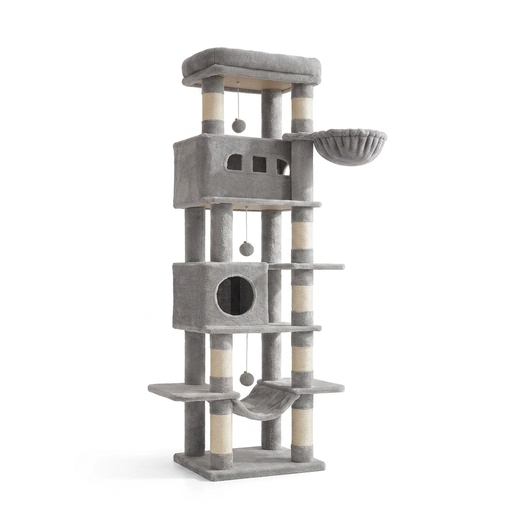
Why it suits this profile: A straightforward six-level model for households looking for a multifunctional cat tree without going straight for a tower over two metres tall.
The description lists 17 support posts, eight of them wrapped in sisal, as well as a double reinforced base and an anti-tip device.
170 cm tall, with six levels, two hideaways, a hammock, a 30 cm basket and two removable cushions.
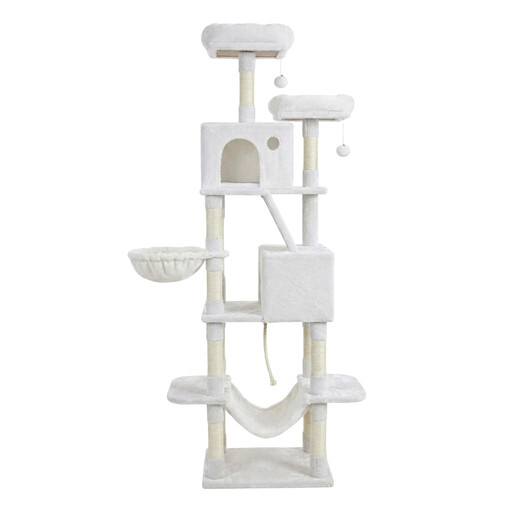
Why it suits this profile: Ideal for cat owners who want to combine plenty of vertical space, several resting spots and a large scratching area in one model.
The product information mentions a wide reinforced base, a recommended anti-tip kit and 13 posts wrapped in natural sisal.
Two platforms, two hideaways, a basket, a hammock and a stated total static weight capacity of up to 75 kg.
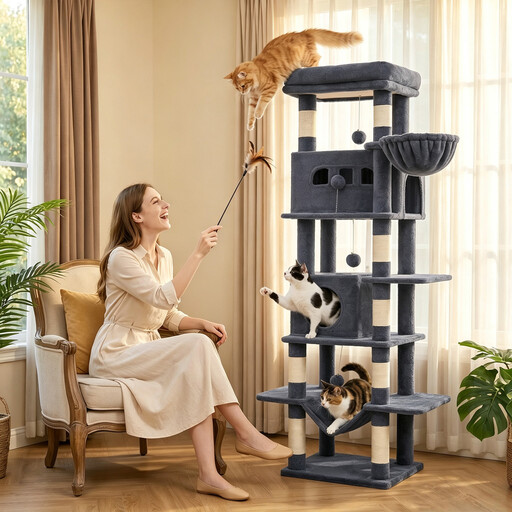
Why it suits this profile: For a household with several or larger cats that need a number of separate places to rest and hide.
The description mentions a wide reinforced base, anti-tip features, eight sisal posts and six levels spaced around 30 to 40 cm apart.
A 60 × 40 cm platform, two hideaways, a hammock, a basket and removable cushions.
A large cat tree offers height and a place to relax, while separate cat toys can add variety. A teaser wand is ideal for interactive play, with you in control of the movement. Balls with feathers and sisal can be rolled or thrown. Check them before and after use, and replace toys as soon as feathers come loose, sisal starts to fray or the fabric gets damaged.
According to ZEZE’s product descriptions, Silvervine cat toys combine silvervine and catnip to encourage interest in playing and chewing. The effect varies from cat to cat, and not every cat reacts to scents in the same way. Use these toys under supervision and dispose of them if they split, material comes loose or the filling is exposed. For independent play, options include the ZEZE Corn Color Silver Vine Toy and ZEZE Lemon Silvervine Cat Toy. The Meowmagic Feather and Sisal Ball Toy Pack of 4 includes several lightweight toys to rotate.
We’ve put together a complete, up-to-date list of products that meet these strict selection criteria and the applicable European safety requirements.
Place it on a level, non-slip surface. Assemble all the parts according to the instructions, then tighten the screws again after the first period of use. For tall models, wall fixing with the anti-tip kit provided or suitable fittings is recommended.
Its lifespan depends on the number of cats, their weight, how often they climb and the quality of the joints and upholstery. Check the sisal posts, cushions, platforms and screws regularly. Replace or repair any parts as soon as they become loose or damaged.
Not always. Measure the available floor space, ceiling height and doorways before ordering. A tall cat tree can save floor space, but you’ll need enough room around it for assembly, maintenance and safe movement.
