
Vandaag of morgen in huis

Kwaliteit gegarandeerd

Welkomstaanbiedingen ontgrendelen: GRATIS bezorging | Tot 80% korting | Gratis 30 dagen JoyPlus-proefperiode
Download de app
A large cat tree can serve many purposes indoors: climbing, scratching, playing, hiding and sleeping. But a cat tree can sometimes disappoint in practice. A tall post may wobble, a basket may be too small and soft furnishings can be difficult to keep clean.
So don’t focus only on the number of levels or an eye-catching design. These three common pitfalls are worth watching out for:
First, measure the space where you plan to put the cat tree. Leave enough room around it for your cat to jump up and land safely. A tall cat tree should ideally have a wide, double or reinforced base and, where possible, an anti-tip feature.
Check the stated weight capacity too. This is especially important if you’re looking for a cat tree for multiple cats or a cat tree for large cats. For example, a product description may state the maximum number of cats and the weight per cat. Treat this as a product specification, not a guarantee that every cat can lie in the same spot at once.
A tall cat tree is a good choice for cats who like to keep an eye on their surroundings. However, check the distance between the platforms. Steps of 20 to 30 cm can work well for many cats, while a very compact layout may be less suitable for heavier or older cats.
A large cat tree with several levels works best when the route between them is well thought out. Look for wide platforms, an easy-to-reach cat house and perches where your cat can stretch out fully.
A sisal scratching post provides a dedicated surface for cats who like to scratch vertically. Check:
Some models’ product descriptions say that having scratching surfaces in different places can help divert cats’ attention from furniture. This isn’t guaranteed to work for every cat. So place the cat tree somewhere your cat already likes to spend time, such as by a window or near the sofa.
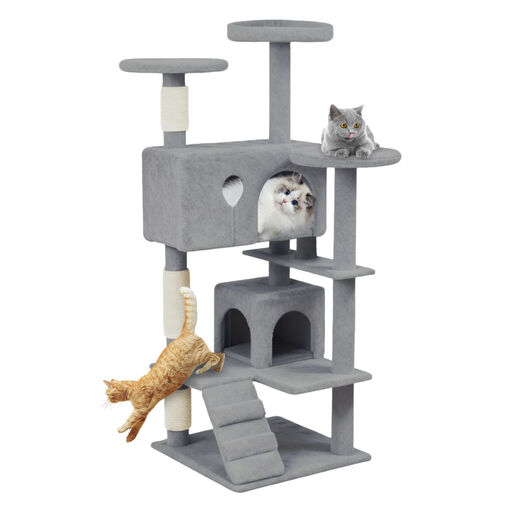
Why it suits this type of buyer: Measuring 49 × 49 × 130 cm, this cat tree is a manageable size for a flat or as a first piece of cat furniture. The combination of a cat bed and scratching post is ideal for everyday resting and scratching.
The stated footprint makes it easy to check whether you have enough room before buying. However, check that the bed and scratching area are large enough for your cat.
130 cm tall; combines a cat bed and scratching post; suitable for a compact indoor space.
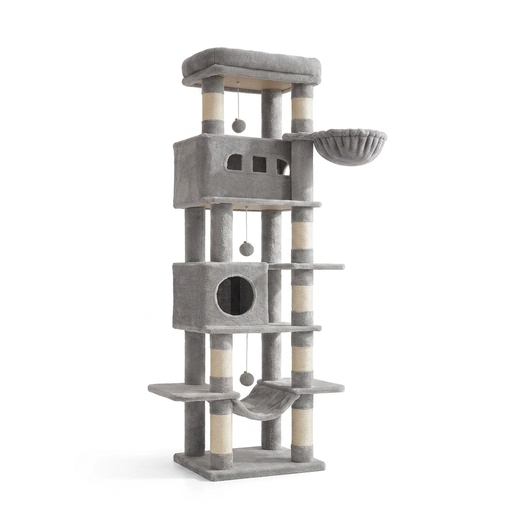
Why it suits this type of buyer: This model is 170 cm tall and has six levels, two cat houses, a hammock, a 30 cm basket and two removable cushions. It’s a good fit for households looking for several places to rest and scratch.
The product description lists 17 support posts, 8 of which are covered in sisal, as well as a widened, reinforced base and an anti-tip feature. According to the product information, it can support up to 6 cats weighing 6.8 kg each.
Six levels; 8 sisal posts; washable cushions; cat houses, a basket and a scratching post with hammock all in one piece of furniture.
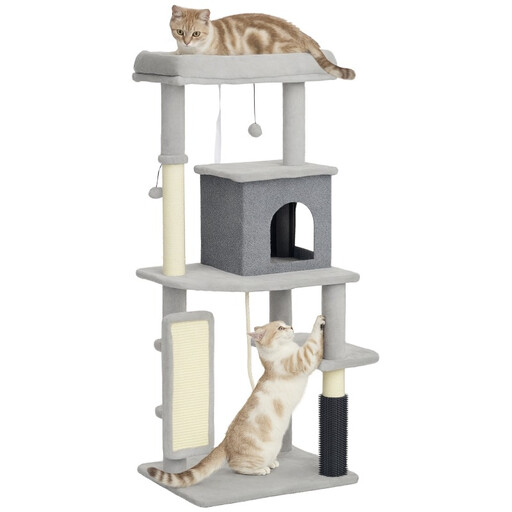
Why it suits this type of buyer: The combination of sisal scratching posts, a cat bed, a cat house, a jumping platform and an anti-tip kit is designed for cats who use their furniture for a range of activities every day.
The product name specifies both sisal scratching posts and an anti-tip kit. This makes it easier to check the structure and scratching features in advance than with a model described only with general terms such as ‘sturdy’.
132 cm tall; sisal scratching posts; anti-tip kit; cat bed, cat house and jumping platform.
We’ve put together a complete, up-to-date list of products that meet these strict selection criteria and the applicable European safety regulations.
Place a stable cat tree on a level surface. With a tall model, it’s a good idea to use the supplied anti-tip feature according to the instructions. After assembly, check that all the screws are tight and the platforms don’t shift.
Clean soft parts regularly with a vacuum cleaner or lint roller. Wash cushions according to the care label. Check sisal, ropes and hanging toys for loose threads or damage. Replace any part that no longer stays securely in place. This will help keep the cat furniture in good condition and reduce the chance of your cat continuing to pull at damaged parts.
It depends on your cats’ weight, age and behaviour. If you have several cats, choose a tree with multiple resting spots, enough space between the levels and more than one scratching area. Also check the overall weight capacity and the dimensions of the baskets and platforms.
Choose a model with a wide base and, ideally, an anti-tip feature. Place the tree on a level floor and assemble all the parts according to the instructions. A tall cat tree should not only feel sturdy but also remain stable after assembly when a cat jumps on it.
Its lifespan depends on how many cats use it and how often they scratch. Sisal shows signs of wear and can fray over time. Check the posts regularly and see whether replacement parts are available. A model with several sisal surfaces spreads the wear more evenly than a piece of furniture with just one small scratching area.
