
Vandaag of morgen in huis

Kwaliteit gegarandeerd

Welkomstaanbiedingen ontgrendelen: GRATIS bezorging | Tot 80% korting | Gratis 30 dagen JoyPlus-proefperiode
Download de app
A large cat tree needs to offer more than a tall post with a bit of plush fabric. Indoor cats use a cat tree to scratch, climb, play and sleep. If you have several cats or larger cats, there are extra things to consider: enough space, a sturdy base and resting spots that don’t feel cramped.
When buying, look out for these three common pitfalls:
So the right choice isn’t just about height. Check the size of the resting areas, the number of scratching posts and how the base is reinforced.
A tall scratching post gives cats more climbing opportunities and a place to perch and look around. Check that the levels are sensibly spaced, though. A gap of around 20 to 30 cm between levels can work well for many cats, depending on their age, build and agility.
A six-level model generally offers more variety than a simple cat bed on a single platform. Ideally, place a tall cat tree on a level surface, away from a door that’s often opened or somewhere people are likely to bump into it.
A sturdy scratching post has a wide, stable base. Check the thickness of the baseboard, the number of support posts and whether it comes with an anti-tip strap or another fixing point. A tall cat tree without a good base may slide around if cats jump on it regularly.
Check the stated weight capacity, too. This is particularly important for a cat tree for multiple cats. The maximum stated weight isn’t a guarantee for every home: don’t just consider how the weight is distributed across the whole structure; check that each platform is large enough for the cats using it.
Sisal is a commonly used material for scratching posts. Don’t just look for the word “sisal”; check how many posts are covered with it and where they’re positioned. A cat tree with sisal scratching posts at several heights gives cats more choice and stops one post from bearing all the wear.
Measure the resting spots, too. A 50 × 30 cm platform offers a different experience from a narrow shelf. For larger cats, spacious platforms, a wide cat bed or a generous hammock are often more practical.
Measure the available floor and ceiling space before ordering. Remember to allow for skirting boards, radiators and windows. A cat tree is usually more stable against a wall, but it shouldn’t block a passageway or escape route.
Check all the screws and connections after assembly. Also check regularly for loose sisal, damaged plush seams or a hanging toy ball that needs replacing. Follow the assembly instructions and use an anti-tip feature if one is included.
When checking product information, distinguish between verifiable specifications and marketing claims. Dimensions, number of levels, materials and included components are specific details. Claims about behaviour or performance aren’t guaranteed results. For example, according to the seller’s own information, a model may be suitable for several cats; its actual suitability depends on your cats’ weight, temperament and how they use it.
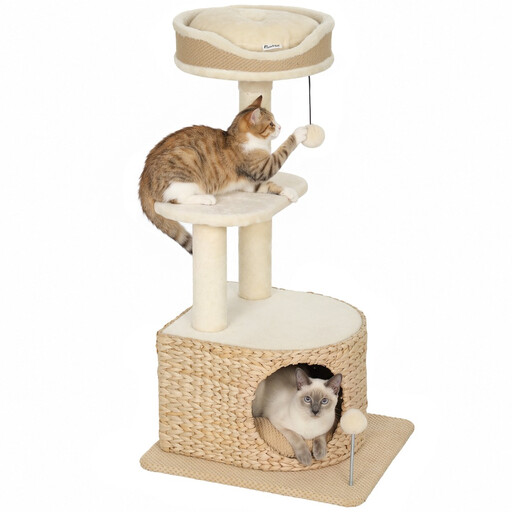
Why it suits this profile: At 87 cm tall with four levels, this model is suited to smaller homes, kittens and cats that need a compact piece of cat furniture.
The product name specifies four levels and a jute scratching post, so this isn’t a model with just one small scratching area.
Four levels, a jute scratching post, a club-shaped cat house and a hanging perch.
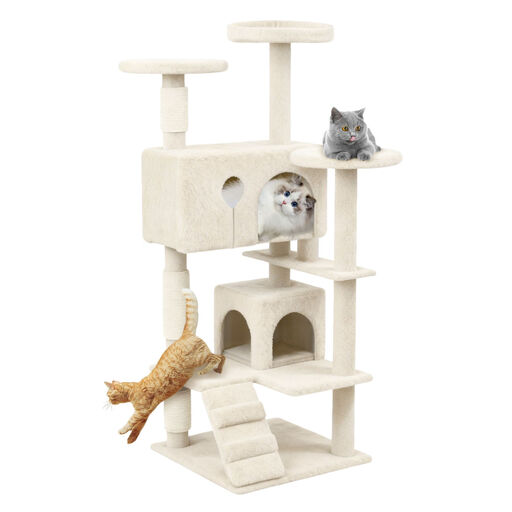
Why it suits this profile: This model has a square base measuring 49 × 49 cm and stands 130 cm tall. These dimensions make it easy to assess whether it will fit in a permanent spot at home.
The stated base dimensions show how much floor space you’ll need; check the measurements before ordering.
130 cm tall, with a bed included and a scratching post, according to the product name.
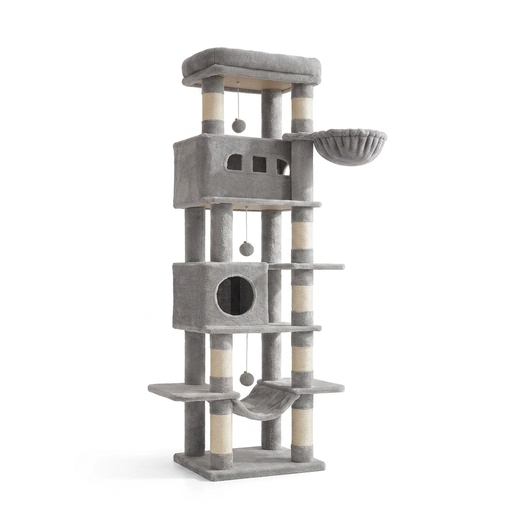
Why it suits this profile: With six levels, several resting spots and 17 support posts, this model is designed for households with multiple or larger cats.
According to the product information, eight of the 17 posts are covered with sisal, and the base is reinforced and has an anti-tip feature. Check the assembly after use.
170 cm tall, with a 50 × 30 cm platform, a 50 × 40 cm cat house, a hammock, a 30 cm bed and two washable cushions, according to the product description.
We’ve put together a complete, up-to-date list of products that meet these strict selection criteria and the applicable European safety requirements.
Think about the number of cats you have, their weight and their sleeping preferences. Several separate resting spots and scratching areas reduce the chance of one platform being occupied all the time. Also check the overall base dimensions and the stated weight capacity.
Place the cat tree on a level surface, tighten all the connections and use an anti-tip strap if one is included and recommended. Check it after a few days, then regularly afterwards, to make sure the screws are still tight and the base hasn’t shifted.
Its lifespan depends on the materials, how it’s used and how well it’s maintained. Sisal wears out faster when several cats scratch it every day. Replace loose toy balls and damaged parts promptly, keep fabric surfaces free of hair and check the structure regularly. This helps you spot sooner when a piece of cat furniture is no longer stable or comfortable.
